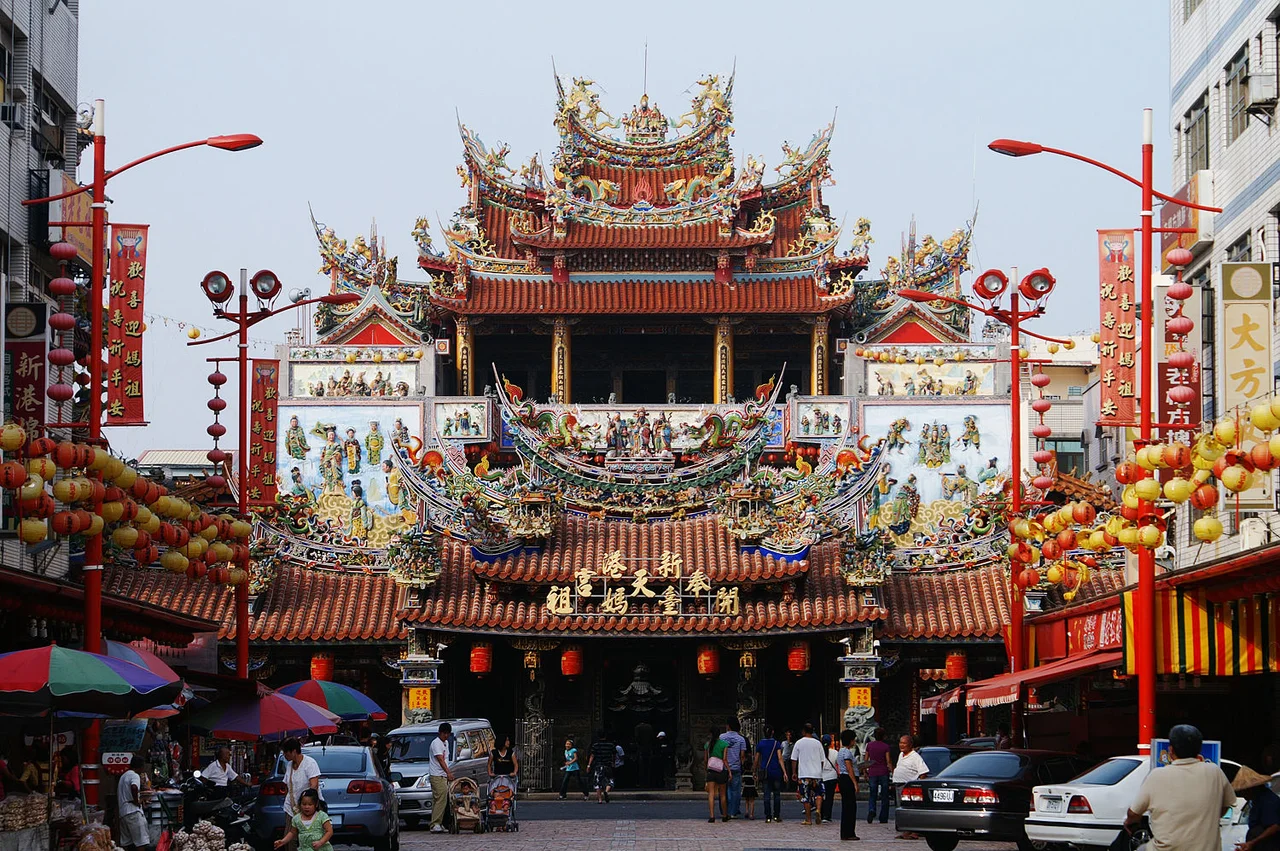

Fengtian Temple
Every year, the goddess comes home. For the Dajia Mazu pilgrimage — one of the great religious processions of the Chinese-speaking world — the final destination has long been Fengtian Temple in Xingang, Chiayi County. Hundreds of thousands of devotees walk for days through the Taiwanese countryside, carrying Mazu's sedan chair to this temple, where her image rests and the incense never quite stops burning. The journey ends here because, according to temple tradition, Fengtian Temple is the birthplace of the Dajia Mazu statue itself. Whether or not that origin story holds historically, the devotion it generates is undeniably real.
A Temple Rebuilt from Earthquake Rubble
The temple that stands today owes much of its form to catastrophe. In 1906, the Meishan earthquake — one of the most devastating to strike Taiwan during the Japanese colonial era — severely damaged the structures that had stood on this site since 1811. The reconstruction that followed lasted from 1906 to 1917 and was led by Wu Haitong, a celebrated woodworker and temple craftsman of the era. Wu's most visible legacy is the Sanchuan Hall, the street-facing entrance to the complex. Its swallowtail roof curves upward at the eaves in the classic Hokkien style, encrusted with Cochin ware — the colorful, low-fired ceramic figures of deities, dragons, and auspicious animals that distinguish southern Taiwanese temple architecture. The stone pillars flanking the entrance are carved with religious inscriptions. Facing south on County Highway 164, the temple sits at the heart of downtown Xingang, impossible to miss and difficult to leave quickly.
Halls, Deities, and a Tiger with Its Own Altar
The compound follows the classic three-hall axial arrangement of Hokkien religious architecture. Walk through the Sanchuan Hall and you reach the Main Hall, dedicated to Mazu, the sea goddess worshipped across coastal communities from Fujian to Taiwan to Southeast Asia. Behind it stands the Rear Hall, home to Guanyin, the bodhisattva of compassion. Flanking halls house Wenchang Dijun, the god of literature; Guan Yu, the deified general; and Chenghuangye, the city god. A modern four-story hall at the rear accommodates the overflow of Taiwan's broad folk religion pantheon.
One detail sets Fengtian Temple apart from most Taiwanese temples: Huye, the tiger deity, has his own dedicated altar in the right flanking hall. In Taiwanese folk religion, Huye — whose name means Tiger Lord — is the protector of children, usually venerated at the base of other deities' altars as a subordinate guardian. Here, he commands a space of his own. Parents bring their children to pray before him. The altar is low, the tiger crouching, and the incense smoke drifts upward toward a ceiling painted in deep red and gold.
A Plaque from the Emperor's Temple
In 1928, during Japan's colonial administration of Taiwan, a gold-plated plaque arrived at Fengtian Temple — not as a gesture of local piety, but as a product of state policy. The Imperial House of Japan had crafted the plaque at Myoshin-ji, a major Zen temple in Kyoto, as part of a broader Japanization campaign designed to align Taiwanese religious sites with Japanese imperial culture. Twenty major temples across Taiwan received similar plaques.
Fengtian Temple's copy is now considered the best-preserved of the twenty. The plaque's survival, in near-pristine condition nearly a century after it arrived, is something of an irony: a symbol of colonial religious pressure has become one of the temple's prized historical artifacts. Taiwan's relationship with its Japanese colonial period is layered and complex, and this plaque sits at the intersection of those layers — a Japanese gift to a Chinese goddess's temple, kept and cared for by the people it once sought to assimilate.
The Mazu Pilgrimage and Fengtian's Place in It
The relationship between Fengtian Temple and the Dajia Mazu Pilgrimage has not always been straightforward. The procession, which departs from Zhenlan Temple in Dajia, Taichung, historically traveled south to Fengtian Temple in Xingang — a journey of roughly 300 kilometers on foot that draws participants from across Taiwan and, increasingly, from around the world. But the pilgrimage route and the temple relationships that anchor it have shifted over decades. For a period spanning roughly thirty years, Dajia's Mazu traveled to Beigang's Chaotian Temple instead. The return to Xingang as the destination was neither simple nor uncontroversial.
Through all of it, Fengtian Temple endured as a place of genuine religious life. The county government recognized its significance on August 18, 1985, designating it a county-level monument for its historical, cultural, and artistic value. That designation protects the structure. But the pilgrims who arrive each spring, exhausted and exhilarated after days of walking, need no official designation to know what the temple means.
Arriving at Xingang
Xingang is a small town in the flat agricultural plains of Chiayi County, where the land opens wide and the sky feels close. For most of the year, the temple operates on the rhythms of daily worship — families burning incense, schoolchildren brought by grandparents, locals pausing on their way somewhere else. The smell of sandalwood and charcoal from the incense burners drifts into the surrounding streets. The Sanchuan Hall's ceramic decorations catch the afternoon light in the reds and greens of Cochin ware.
During pilgrimage season, the scale shifts entirely. The streets fill, the surrounding area fills, and the temple — already large — seems somehow larger, pressed on all sides by the weight of collective devotion. Fengtian Temple does not perform religiosity; it practices it, day after day, decade after decade, in a building that has been standing in some form since 1811 and still draws the faithful from every direction.
From the Air
Fengtian Temple is located at 23.5567°N, 120.3479°E in Xingang, Chiayi County, southwestern Taiwan. From the air, Xingang appears as a compact town center in the flat Chiayi Plain, with agricultural fields spreading in all directions. At 3,000 feet, the dense urban core of Xingang is visible against the surrounding paddy and field landscape. Chiayi Airport (RCKU) lies approximately 12 kilometers to the southeast. The Central Mountain Range is visible to the east on clear days, and the coastline of the Taiwan Strait lies roughly 20 kilometers to the west. Recommended viewing altitude is 2,000–4,000 feet for a clear look at the temple complex and its position within the Xingang town grid.
Nearby Stories
- Puli 7.3 km away
- Guanzihling 11 km away
- Fangyuan Lighthouse 11 km away
- Yakou Mountain Pass 13 km away
- 1999 Jiji Earthquake 15 km away
- China Airlines Flight 611 23 km away
- TransAsia Airways Flight 222 26 km away
- Dongji Island 26 km away