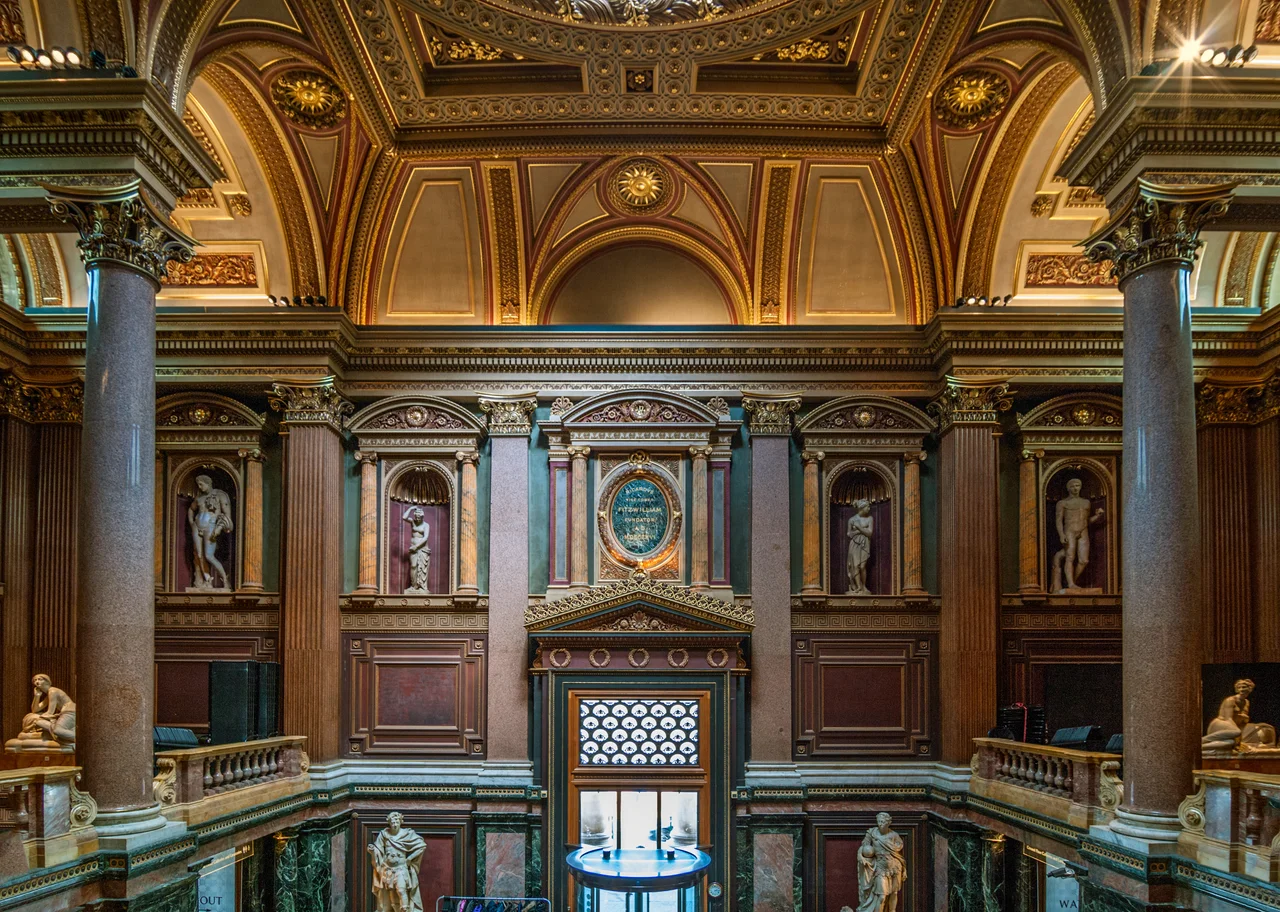

Fitzwilliam Museum
In January 2006, a visitor tripped on a shoelace near the foot of the main staircase and shattered three Qing Dynasty porcelain vases that had stood in the Fitzwilliam Museum on public display since 1948. The vases were not in a case. They were not behind glass. They were simply there, where anyone could walk past them — which is something the Fitzwilliam has always believed in. The museum, founded in 1816 with the bequest of Richard FitzWilliam, 7th Viscount FitzWilliam, has kept faith with its founder's vision: the finest art of multiple civilisations, available to any person who walks through the door, free of charge.
A Viscount's Legacy
Richard FitzWilliam died in 1816 and left behind something remarkable: £100,000 specifically earmarked 'to cause to be erected a good substantial museum repository,' along with his personal library and art collection. The collection he bequeathed included Old Master paintings, prints, illuminated manuscripts, and ancient coins — the assembled enthusiasms of a well-travelled eighteenth-century aristocrat who happened to have excellent taste. The buildings constructed to house his gift, on Trumpington Street in the heart of Cambridge opposite Fitzwilliam Street, are Grade I listed. They are among the finest examples of neoclassical museum architecture in Britain. More than two centuries later, the collection has grown to over 500,000 objects. Admission remains free, as FitzWilliam intended.
Five Rooms Worth of History
The museum's collection divides into five departments: Antiquities; Applied Arts; Coins and Medals; Rare Manuscripts and Printed Books; and Paintings, Drawings and Prints. Together they span the globe and most of recorded history. The Antiquities galleries hold objects from ancient Egypt, Nubia, Greece, Rome, Cyprus, and western Asia — including a bas-relief from Persepolis and a colossal caryatid from Eleusis. The Egyptian galleries, refurbished at a cost of £1.5 million and reopened in 2006, are considered among the best displays on ancient Egypt outside the British Museum. The paintings collection runs from thirteenth-century Italian altarpieces through Titian, Rubens, Van Dyck, Rembrandt, Hogarth, Gainsborough, and Constable to Monet, Degas, Renoir, Cézanne, and Picasso. John Ruskin donated twenty-five Turner watercolours to the university in 1861. The economist Maynard Keynes donated his personal collection, including a Cézanne he had bought in 1918.
Music on Parchment
Less visited but quietly extraordinary is the music manuscript collection. The Fitzwilliam holds the largest collection of sixteenth-century Elizabethan virginal manuscript music in the world — pieces by William Byrd, John Bull, Orlando Gibbons, and Thomas Tallis, the composers who defined the sound of Tudor England. These are not printed scores but handwritten manuscripts: actual pages touched by the composers and their copyists. The collection draws musicians and musicologists from around the world. It is a reminder that the Fitzwilliam is not simply a museum of visual art and ancient objects — it is an archive of how people made music, wrote books, cast coins, and shaped objects across several thousand years of human effort.
Losses and Near-Misses
The Fitzwilliam's history includes a few moments when the collection's openness came at a cost. The shattered Qing vases were restored by the museum's own scholars and conservation experts and returned to display behind security glass. In April 2012, eighteen pieces of Chinese jade were stolen by a gang subsequently convicted and sentenced to a combined eighteen years in prison; estimates of the stolen artefacts' value ran to around £10–15 million, making it one of the most significant museum thefts in recent UK history. More triumphant was 2015, when the museum exhibited two bronze statues — the Rothschild Bronzes — that scholars proposed might be the only surviving bronze sculptures by Michelangelo. If confirmed, they would fill a gap in the Renaissance master's known work that has puzzled art historians for centuries. The attribution remains under scholarly debate. The museum, for its part, simply keeps the doors open.
From the Air
The Fitzwilliam Museum is located at 52.2003°N, 0.1194°E on Trumpington Street in central Cambridge. The neoclassical facade of the museum building is distinctive from lower altitude, situated on the south end of the university's historic core. Cambridge is approximately 80 km north of London. London Stansted Airport (EGSS) is 40 km to the south; Cambridge City Airport (EGSC) is a small general aviation field 3 km to the east. The River Cam and the Backs — the strip of parkland behind the university colleges — are identifiable from altitude west of the city centre.
Nearby Stories
- Kentwell Hall 2.5 km away
- Thetford Hoard 2.8 km away
- King's Ely 6 km away
- Bedford 7.8 km away
- White House Farm murders 13 km away
- Oundle 14 km away
- Hemel Hempstead 14 km away
- North Weald Airfield 15 km away