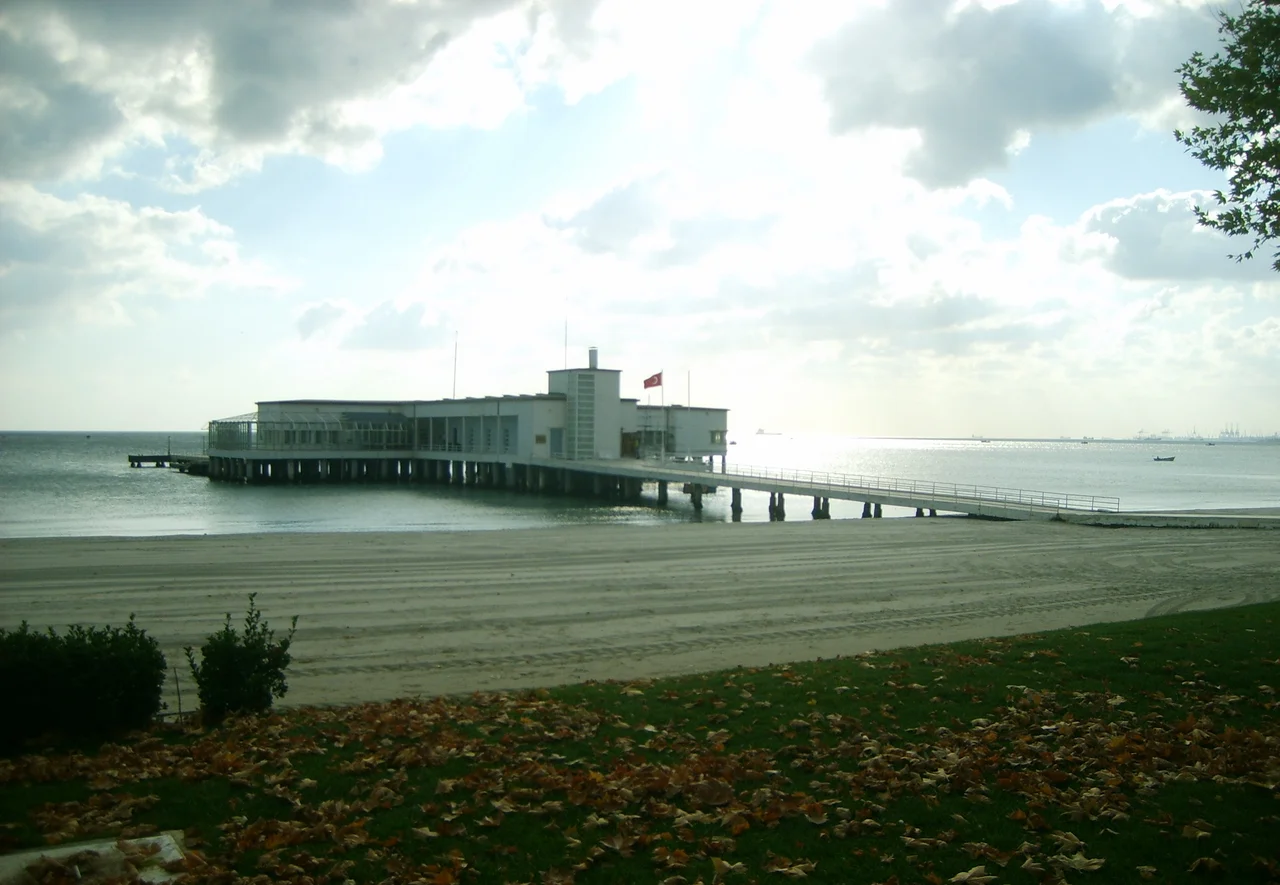

Florya Atatürk Marine Mansion
There is a small wooden pier running out from the sandy beach at Florya, and at the end of it stands a low, white building balanced on steel legs above the water. The Florya Atatürk Marine Mansion looks modest from a distance — one story, L-shaped, almost weightless on the surface of the Marmara. But it was built in 1935 for Mustafa Kemal Atatürk, the founder and first president of the Republic of Turkey, as a place to escape the demands of state. Designed by architect Seyfi Arkan in the Bauhaus style, completed in a matter of months, gifted to Atatürk by the Istanbul municipality — the building is an artifact of a particular moment in modern Turkish history, when the new republic was consciously building itself in the image of European modernism.
Steel and Sea
The engineering of the mansion is quietly remarkable. The building stands on steel piles driven into the seabed of the Sea of Marmara, connected to shore by a wooden pier roughly 70 meters long. This was not a symbolic gesture — it was a working solution to the problem of building a private retreat directly over the water, accessible yet separate. Inside, the layout is spare: a reception hall, a reading room, bedrooms, a bathroom, service and staff rooms. The Bauhaus influence is evident in the clean lines and functional arrangement, the absence of ornament for its own sake. Arkan received the commission in 1935 and completed the building on 14 August of the same year. In the Turkey of 1935, still only a dozen years old as a republic, adopting the aesthetics of international modernism was itself a statement — a deliberate rejection of Ottoman decorative tradition in favor of the rational geometries of contemporary Europe.
Atatürk's Summer Retreat
Atatürk used the mansion for rest and recreation along the Marmara coast. The beach at Florya was — and remains — one of Istanbul's accessible summer destinations, offering the calmer, warmer waters of the Marmara as an alternative to the more turbulent Bosphorus. The surrounding grounds include a grove created in the remains of the Agios Stefanos Monastery, which had fallen into ruin; Atatürk took possession of the ruins and had the grove planted as a garden. That grove, the Florya Atatürk Grove, is today a public park. The overlap of monastery ruin, presidential garden, and public green space captures something of the layered history that attaches itself to even modest structures in Istanbul: every corner seems to have an earlier corner beneath it.
A Modernist Vision
Seyfi Arkan was one of Turkey's most significant architects of the early republican period, and his work on the Florya mansion reflects the broader cultural project of the Kemalist state. Atatürk personally supported the adoption of modernist architecture in Turkey's public and institutional buildings — it was aligned with his wider drive to westernize Turkish civic culture, from the adoption of the Latin alphabet to the reform of dress codes. The Bauhaus movement, founded in Germany in 1919, emphasized the unity of art and craft, clean functional design, and the use of new industrial materials. By 1935, the movement had been suppressed in Germany by the Nazi government, and some of its practitioners had scattered across Europe and beyond. The Florya mansion is a small but genuine example of the style reaching the shores of the Marmara.
Museum and Memory
Atatürk died in 1938, three years after the mansion was built. The site became a museum and is today open to visitors several days a week (closed Mondays and Thursdays), operating under the Turkish Ministry of Culture and Tourism and the national palaces administration. The museum preserves the mansion in its 1930s configuration, offering a glimpse of the restrained elegance that Arkan achieved: the reading room where Atatürk sat with books and papers, the reception hall where he received guests. Turkey has a number of Atatürk museums, each associated with a place he lived or worked; the Florya mansion is among the most architecturally distinctive, because of the unusual fact of being built over water. The pier that leads to it, the Marmara lapping beneath the floorboards, gives it a quality unlike any other site in the Atatürk memorial landscape.
Florya Now
The Florya neighborhood today sits between the former site of Atatürk Airport to the east and the Lake Küçükçekmece basin to the west, on a stretch of Istanbul's Marmara coastline that has been heavily developed over the decades. The coastal road running from Florya toward Küçükçekmece passes the mansion's grounds. The Florya commuter rail station, on the Istanbul-Halkalı line, is roughly 500 meters from the site — making it one of the few historic presidential residences in the world reachable by suburban commuter train. The grove park is free and open. The mansion itself charges a modest admission. On a clear day, standing on the pier and looking south across the Marmara, the distant hills of the Asian shore are visible on the horizon — the same view that Atatürk would have had, looking out from his reading room over the water.
From the Air
The Florya Atatürk Marine Mansion sits at 40.9726°N, 28.7825°E on the Marmara coastline of European Istanbul, roughly 12 km west of the city center. From altitude, the Florya beach district is visible as a strip of sandy coast between the urban fabric and the blue Marmara, with the former Atatürk Airport (LTBA) immediately to the east and Lake Küçükçekmece visible to the west. The nearest active major airport is Istanbul Airport (LTFM), approximately 35 km to the northeast. At 3,000–5,000 feet in clear conditions, the pier and the distinctive white building over the water are identifiable from the cockpit.
Nearby Stories
- Istanbul Canal 5 km away
- Polonezköy 8.1 km away
- MV Struma 8.9 km away
- Sea of Marmara 11 km away
- HMAS AE2 42 km away
- Bandırma 75 km away
- Sangarius Bridge 101 km away
- Edirne 135 km away