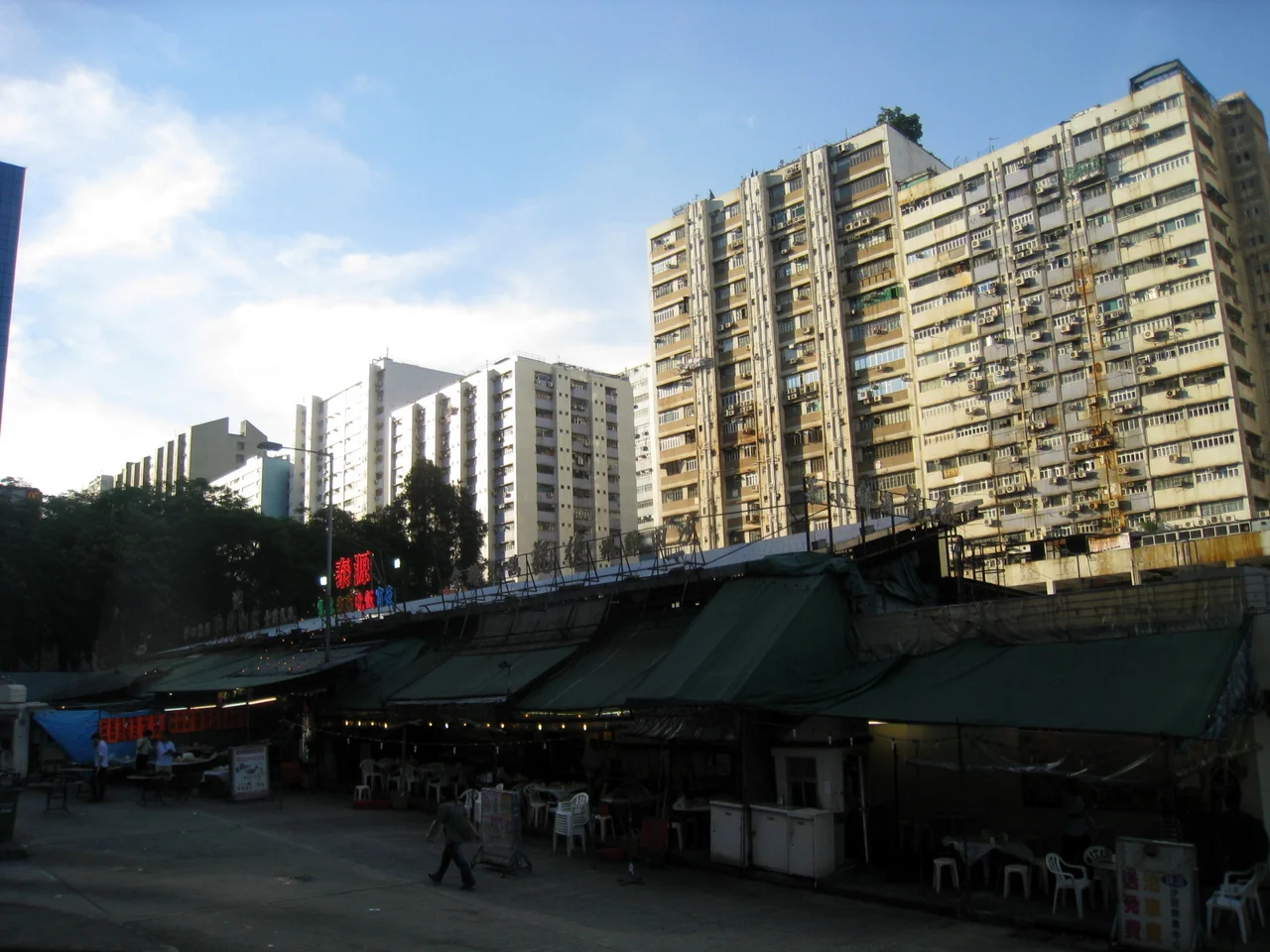

Fo Tan
The name has been wrong for a long time, and nobody seems to mind. Fo Tan — which translates roughly as "fire charcoal" in the Hakka pronunciation now in common use — started as something much more modest: "river beach," a reference to the sandbar that appeared when the Fo Tan Nullah receded. Hakka speakers called it that, and the name drifted through mishearing into "fire beach" and then into the charcoal association that stuck. By the time the area was developed as a light industrial zone in the twentieth century, the beach was long gone, the river was a channelled nullah, and factories had replaced the sand. Then the factories left too — moving to mainland China in the years after 2001 — and the buildings stood largely empty, their high ceilings catching dust.
A Name That Kept Changing
Etymology is usually straightforward. Fo Tan's is not. The Fo Tan Nullah, a channelled watercourse that runs through the district, was once a natural river. When water levels dropped, a sandy bank was revealed. The Hakka communities who settled here called the area "river beach" in their dialect, which sounds like "Fo Tan." But Cantonese speakers who arrived later heard something different in those syllables — "fire beach" — and that version spread. Later still, a further shift in pronunciation produced the current meaning: "fire charcoal." None of these interpretations describe anything that actually exists at the location. The river beach is gone. There is no fire. There is no charcoal. There is, instead, one of the Hong Kong MTR's East Rail stations, a string of residential towers, and a set of industrial blocks that became famous for something entirely unexpected.
When the Factories Left
Throughout the latter half of the twentieth century, Fo Tan functioned as a light industrial zone — the kind of place that made goods for export, employed blue-collar workers, and smelled of machinery and lubricant. When manufacturing shifted to mainland China in the late 1990s and early 2000s, Fo Tan lost much of its economic purpose. The industrial buildings remained: concrete blocks with loading docks, service elevators, and, crucially, ceiling heights that most residential and commercial spaces cannot match. Since 2001, more than 70 units in those utilitarian buildings have been taken over by artists. Potters, painters, photographers, ceramicists, and floral designers moved into the high-ceilinged spaces that factories had vacated. Fo Tan was chosen, in part, precisely because it is in the middle of the New Territories — away from the expensive real estate pressures of Hong Kong Island and Kowloon — and because the buildings offered raw space that could not be found elsewhere at a price artists could afford.
Fotanian: A Festival in the Factory Blocks
Every January, Fo Tan opens its studios. The Fotanian Open Studio Programme transforms the industrial district's private working spaces into a public art event: guided walks lead visitors through corridors and up freight elevators to studios that are ordinarily closed to outsiders. The range of work is broad — ceramic vessels, paintings, large installations, design work — unified only by the particular quality of light that falls through Fo Tan's industrial windows. The festival has run since the early years of the artist migration, gradually building an audience that returns each year to see what has changed and what has been made. It is an unusual kind of cultural institution: one that relies on artists opening their actual workplaces, not curated gallery shows, and on visitors willing to navigate a working industrial neighbourhood to find them.
Old Villages in the Factory Shadow
Before the factories and before the residential towers, Fo Tan was Hakka village country. The source records originally 24 Hakka villages in the area; today, settlements including Fo Tan Village, Lok Lo Ha, Pat Tsz Wo, and Wo Liu Hang survive amid the development. The Cheng Ancestral Hall in Fo Tan Village is a reminder that the land's history runs considerably deeper than its industrial chapter. To the south lies Sha Tin New Town; to the north, the Chinese University of Hong Kong and the neighbourhood of Kau To. The Sha Tin Racecourse sits nearby to the east, and across the Shing Mun River, City One Shatin fills the opposite bank. A.S. Watson Group, the retail and consumer goods conglomerate, maintains its head office in Watson House, Fo Tan — the sort of corporate anchor that indicates a district with reliable infrastructure and transport links, even one still associated in the public imagination with paint-stained floors and kiln smoke.
Flying Over Sha Tin District
Fo Tan lies at roughly 22.3969°N, 114.196°E, in Sha Tin District — south of Fanling and the North District border, tucked between the hills of Pat Sin Leng to the north and the Sha Tin valley basin to the south. From the air at 3,000 feet, the Shing Mun River's channelled course is the clearest landmark, with the flat reclaimed land of Sha Tin New Town spreading away from it on both sides. The Sha Tin Racecourse is impossible to miss — an immense oval cut into the valley floor. North of it, the industrial blocks of Fo Tan cluster in a way distinct from the residential towers; look for lower rooflines, loading bays, and the slightly irregular spacing that factory buildings take on when converted piecemeal for other uses. Hong Kong International Airport (VHHH) lies approximately 35 kilometres to the west.
From the Air
Coordinates: 22.3969°N, 114.196°E. Recommended viewing altitude: 2,500–3,500 ft. Fo Tan is most easily identified from the air by the Sha Tin Racecourse oval to the east and the Shing Mun River below. The industrial blocks of the artist district sit between the MTR East Rail line and the western foothills. Nearest airport: Hong Kong International (VHHH), approximately 35 km to the west. Clear winter days offer the best visibility over Sha Tin District.
Nearby Stories
- Chapel of St. Francis Xavier 3.5 km away
- Cuiheng 4.1 km away
- 2015 Shenzhen Landslide 16 km away
- Shunde 31 km away
- Wanshan Archipelago 37 km away
- Nanxiong Formation 96 km away
- Heyuan 149 km away
- Checheng Fu'an Temple 629 km away