
Fontys School of Fine and Performing Arts
Walk the long internal corridor of the Kunstkluster and you can hear the building's strange tenancy: a jazz quintet rehearsing behind one door, a contemporary dance class counting through a phrase behind the next, the muffled thrum of a rock drummer somewhere overhead, and, occasionally, the gasp of an audience watching a trainee circus performer take flight. The building is officially called the 'Art cluster.' In practice it is the most concentrated meeting of disciplines in Dutch arts education - the moment in 2005 when Tilburg decided to put music, visual arts, dance, theatre, and circus all under one roof and see what happened.
A Catholic Drawing Course That Refused to Stay Small
The seed was planted in 1912 when Hendrik Moller founded the RK Leergangen, a Catholic teacher-training college that happened to include a drawing course. The institution moved from Amsterdam to Den Bosch to Tilburg, settling in 1918, and over the following decades it kept absorbing and spinning off art forms the way a city absorbs neighbourhoods. A music school for children, opened the same year, slowly became the Brabants Conservatorium. A dance academy joined it in 1965. By the time everything finally consolidated under the Fontys umbrella in the 1990s, what had started as a single drawing class had become four full sectors and a dozen academies.
From Monastery to Muzentuin
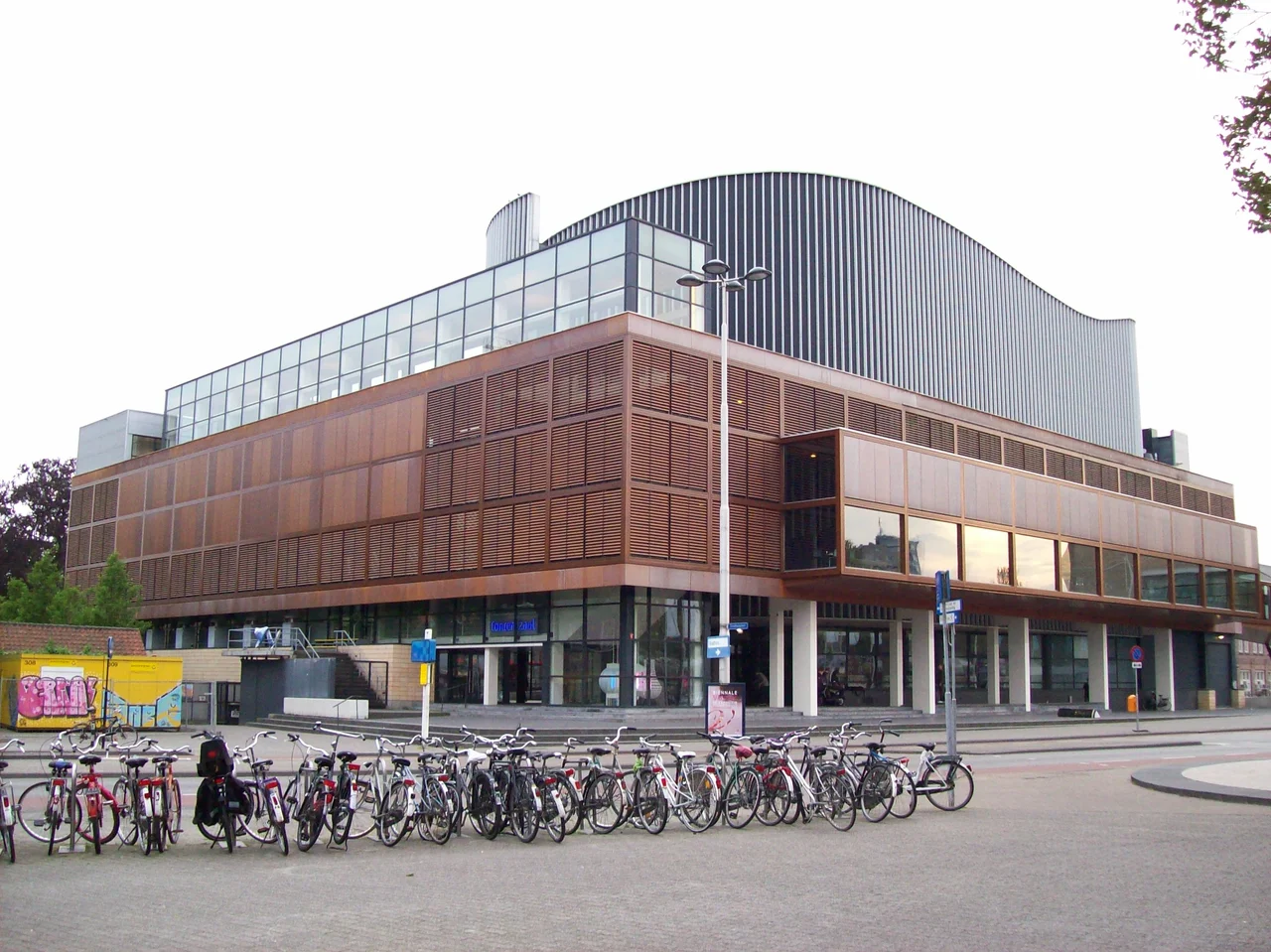
Architect Jo Coenen designed the Kunstkluster around an unusual constraint: parts of the site were already protected heritage. So he kept them. A 19th-century former monastery, complete with organ hall and library, became part of the building. A neo-Gothic chapel from 1895 was folded in alongside it. Coenen connected the historic pieces to new construction with a long internal corridor wrapping a central courtyard called the Muzentuin - the Garden of the Muses. The architectural seams are visible on purpose: a student walks from a brick monastic cell into a glass rehearsal box in twenty paces. The northern entrance is tucked behind a patio-shaped square, where the concert hall's curved roof rises above the otherwise rectangular block.
The Conservatorium's Cold War Hiring Spree
The Brabants Conservatorium did not become a serious institution by accident. In the 1950s and 60s, director Willem Goedhart used the Iron Curtain to his advantage, recruiting talented teachers from the Eastern Bloc who were looking for a way west. A regional Dutch conservatoire was suddenly staffed with players from cities most of its students had never seen. Under his successor Andries Clement, enrolment passed 500, and the school outgrew its old quarters in a converted Cenakel monastery. In 2017 the conservatorium rebranded as the Academy of Music and Performing Arts and switched all instruction to English - a final acknowledgment that its student body had become as international as its postwar faculty.
Pop Music Moves In
Most Dutch conservatoires guard the line between classical and popular music. The Kunstkluster does not. The Rockacademie, founded in 1999 by saxophonist Bertus Borgers and Gerard Boontje, originally lived near the 013 pop venue in the Veemarktkwartier. In 2005 it moved into the same building as the AMPA jazz and classical programmes, the dance academy, and the painters and designers of the Academie voor Beeldende Vorming. Students at the Rockacademie can specialise as performers, session musicians, bandcoaches, or audio engineers. Down the corridor, students at the Academy of Circus and Performing Arts - one of only a handful of accredited circus bachelor programmes in Europe - are learning aerial silks. The juxtaposition is the point.
The 840-Seat Surprise
The most visible piece of the Kunstkluster is the concert hall, rising in a curved shell above the otherwise low square building. Eight hundred and forty seats - large enough for full orchestral concerts, small enough that students still get to play in it regularly. A footbridge crosses the street to the Stadsschouwburg, the city theatre designed by Bernard Bijvoet and Gerard Holt in 1961, so a musical-theatre student can walk from a rehearsal studio to a proper proscenium stage without going outside. Tilburg is not a famous city in the way Amsterdam or The Hague are famous. But for several thousand young artists, it is the building they spend their twenties inside.
From the Air
Coordinates 51.5538 N, 5.0843 E, on the south side of central Tilburg. Best viewing altitude 1500-2500 ft AGL; the curved concert-hall roof of the Kunstkluster is distinctive against the lower surrounding cityscape. Nearest airports: Eindhoven Airport (EHEH) 27 km southeast, Rotterdam The Hague (EHRD) 60 km northwest. Brabant weather is often overcast; clear visibility most reliable in late spring and early autumn.
Nearby Stories
- Feyenoord 5.4 km away
- Heinz Struning 6.8 km away
- Moerdijk 7.5 km away
- Neder-Betuwe 8.7 km away
- Volkel Air Base 9.3 km away
- Kapellen 9.9 km away
- Campine 12 km away
- Limburg (Netherlands) 25 km away