
Foreign Cattle Market
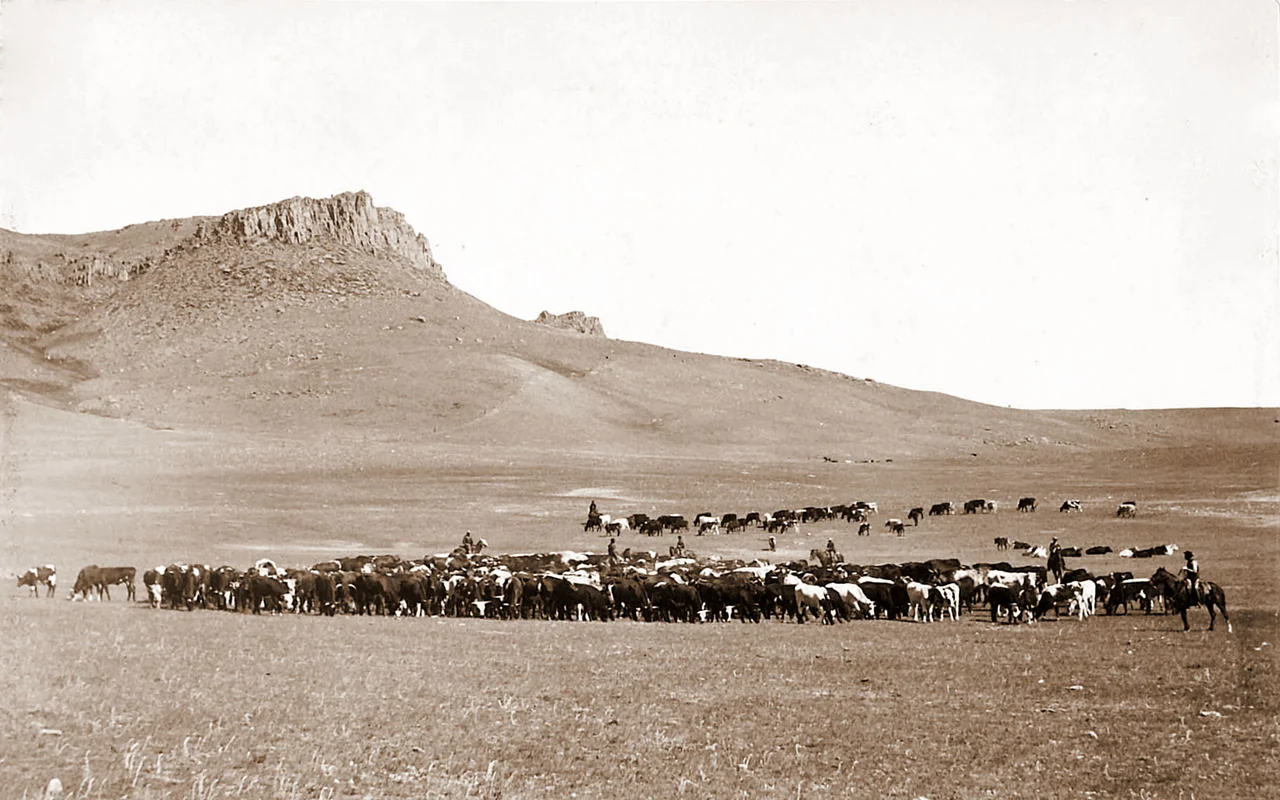
Cowboys rounded them up on the high plains of Montana and Wyoming. Drovers walked them onto trains. The trains delivered them to ports — Boston, Baltimore, Galveston — where they were loaded onto cattle steamers. Two weeks across the Atlantic, in conditions that killed thousands per crossing, then up the Thames, then down a gangway onto a quay that had been built by Henry VIII in 1513. They had ten days to live. Between 1872 and 1913, sixteen and a half million animals walked that gangway at the Foreign Cattle Market in Deptford, a quarantine slaughterhouse on the site of the old royal dockyard. None of them left alive.
Smithfield Was Too Small
For centuries London's cattle market had been held at Smithfield, where butchers bought animals and slaughtered them on the spot. The Victorian city's growth made this impossible. Drovers were herding cattle up Oxford Street in 1850. The smell was unbearable, the public health risk acute, the traffic chaos absurd. In 1855 Parliament moved the live cattle market to Copenhagen Fields in Islington, where it became the Metropolitan Cattle Market. Smithfield itself was rebuilt as a wholesale dead-meat market — the building that stands today. By 1895 it was supplying 130 pounds of meat annually for every man, woman and child within fifteen miles of Charing Cross.
The 1865 Plague
Free trade in cattle, enabled by Robert Peel's 1842-46 reforms, allowed European livestock to flood British markets. As the rail network reached into Russia, cattle came from the steppes. Russia had never been free of rinderpest, the cattle plague — a viral disease almost universally fatal to immunologically naive animals. In 1865 it broke out at the Metropolitan Cattle Market and spread across Great Britain. Veterinary scientist John Gamgee had warned this would happen. He was overruled by the commercial interests. The 1865-67 cattle plague epidemic killed hundreds of thousands of animals, devastated British agriculture, and was described as the most dramatic event in nineteenth-century farming. The Archbishop of Canterbury declared it divine retribution and called for a national day of humiliation. Parliament settled instead for new legislation.
Deptford Chosen
The 1869 Contagious Diseases (Animals) Act required the City of London to open a second metropolitan market exclusively for imported animals, to operate under strict quarantine, with no animal allowed to leave alive. It needed a port site with deep water and lots of space. The defunct royal dockyard at Deptford, just closed by the Admiralty that same year, was perfect — 22 acres of riverside, with three deep-water piers strong enough to receive ocean-going cattle steamers, and existing storehouses that could be converted to lairs and slaughterhouses. The City bought it for £91,500 in a transaction so questionable — the intermediary was the brother-in-law of the Solicitor to the Admiralty — that Parliament asked questions. The architect Sir Horace Jones, who would design Tower Bridge, drew up the conversion: three of the old shipbuilding sheds joined to make a pentagonal horseshoe of cattle lairs, the storehouses converted to seventy slaughterhouses, enough capacity for 8,500 cattle and 20,000 sheep at a time. The market opened in January 1872.
The Cattle Came From Everywhere
Initially the trade was European: Western Europe, Austria-Hungary, the Russian steppe. Then the transatlantic trade exploded. By 1880 most of the cattle slaughtered at Deptford had been rounded up by cowboys on the Great Plains. The volume was large enough to shape the American and Canadian cattle industries. Argentine pampas cattle came across the equator. By the early 1890s, more foreign cattle came to Deptford than British cattle to Islington. The largest single year's count was 224,831 cattle in 1897 and 783,440 sheep in 1882. Three paddle steamers — Racoon, Taurus and Claude Hamilton — were owned by the market itself for transferring cattle from large ocean-going steamers anchored at Gravesend. They moved over 1.6 million animals between them. The pub on site was called the Peter the Great, a nod to the dockyard's most famous visitor.
The Animals and the Work
The journey was brutal. Most animals had endured long railway journeys before they were loaded; severe methods were used on trains and ships to force recumbent animals to stand again, to prevent them being trampled. In stormy weather animals were washed overboard, jettisoned to lighten the ship, or stifled under closed hatches. The intercontinental traffic was not even economically necessary — by the 1880s it was cheaper to import chilled meat, which was of good quality. But the trade continued for forty years, possibly because British butchers could pass off Deptford-killed American or Argentine beef as 'Scotch' or 'English' meat at premium prices. The slaughtermen worked on piece-rate, killing and butchering within the ten days the law allowed. Drovers wore protective clothing, afterwards disinfected in sulphur chambers. Hides, horns, fleeces and offal were sterilised. In 1889 the market installed Alfred Seale Haslam's refrigeration plant, the first large-scale meat chilling system in the country, which dried the air to inhibit bacterial growth on the slaughtered carcasses.
The End of the Trade
By the Edwardian era the Chicago meatpackers had figured out how to bypass the auction system entirely, taking advantage of a regulatory loophole. Refrigerated shipping was killing live import. The market closed in 1913. In October 1914 the War Department took over the site as a Supply Reserve Depot for the Army Service Corps, distributing food to British troops abroad. After the navy closed the adjacent Royal Victoria Victualling Yard in 1961, a small Royal Naval Store Depot continued until 1984. The Ministry of Defence sold the site that year to Convoys Ltd, who used it for newsprint, and it is now part of the Convoys Wharf redevelopment. The piers Horace Jones designed for unloading cattle still stand on the riverbank, now connected to each other and quietly waiting for whatever Deptford's next century is going to ask of them.
From the Air
The Foreign Cattle Market site lies at 51.49N, 0.03W on the south bank of the Thames at Deptford, at the foot of Limehouse Reach, immediately upstream of Greenwich. The market occupied the southern and western portions of what is now Convoys Wharf, with the three cattle piers projecting into the river. London City Airport (EGLC) lies two nautical miles north across the Thames; Biggin Hill (EGKB) is southeast. The Greenwich peninsula and the O2 are visible just downstream. Recommended viewing altitude 1,500-2,500 ft AGL for the river bend and the surviving dockyard structures, including the 1846 Olympia Warehouse near the eastern edge of the site.
Nearby Stories
- Battle of Britain, Northfleet 1.1 km away
- Bayham Old Abbey 5.4 km away
- Catharine Macaulay 6.4 km away
- Hatfield rail crash 8.8 km away
- Chequers 8.9 km away
- Chelmsford Cathedral 10 km away
- Queen Victoria Hospital 13 km away
- Fishbourne Roman Palace 36 km away