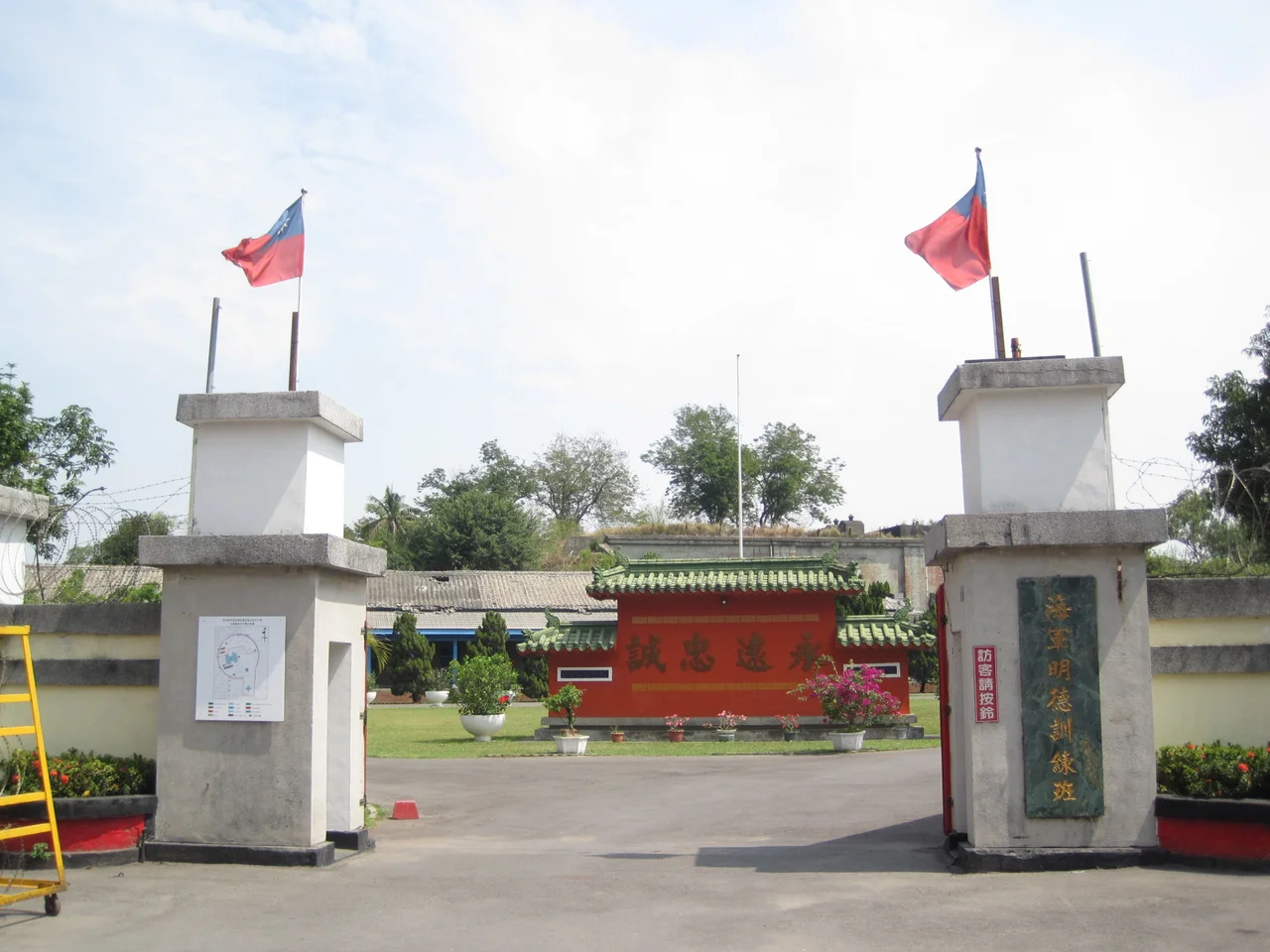

Former Japanese Navy Fongshan Communication Center
Most buildings serve one purpose and keep it for life. The compound in Kaohsiung's Fengshan District has had at least six. It started in 1919 as a radio station, the first the Imperial Japanese Navy built in Taiwan, and despite the military pedigree, its primary job was civilian communication: relaying messages between ships and shore across the waters of southwestern Taiwan. It would not stay civilian for long. Over the next century, each new regime that governed Taiwan found a different use for the same walls, and the uses grew progressively darker before the light was finally let back in.
Signals and Silence
The Fongshan station was one of three radio facilities the Imperial Japanese Navy operated in Taiwan. For its first two decades it handled routine maritime communication, a vital service on an island surrounded by busy shipping lanes. When a major mechanical failure at the station threatened maritime safety, the Navy built a second facility at Sankaiseki and in 1937 consolidated both into the Takao Communication Unit, named after the Japanese designation for Kaohsiung. The timing was fateful. The Second Sino-Japanese War broke out that same year, and the Takao Communication Unit was pressed into wartime service, maintaining Imperial Japan's southwest Pacific communications network. Its operators monitored and jammed American and British naval and air movements, turning a civilian transmitter into an instrument of military intelligence.
The Dark Decades
After Japan's surrender in 1945, Taiwan was handed to the Republic of China, and the Republic of China Navy took control of the Fongshan station. The radio equipment was no longer needed; the new owners converted the compound into a navy boarding house. That innocuous name concealed a grimmer function. Over the following decade, the boarding house served as an interrogation facility where navy servicemen accused of political crimes were questioned. Taiwan's authoritarian era, known as the White Terror, cast a long shadow over institutions like this one, where political suspicion could lead to detention without public scrutiny. In 1976, the compound was officially redesignated as the Mingde Disciplinary Camp, a military prison for what the navy termed persistently disobedient servicemen. The walls that once channeled radio waves now held people whose offenses ranged from genuine insubordination to politically inconvenient opinions.
Opening the Doors
When the Mingde Disciplinary Camp was finally decommissioned, the compound entered its most recent incarnation: the Kaohsiung Military Dependents' Village Cultural Association. The transformation reflects a broader movement in Taiwan to reckon with the material legacy of its authoritarian past. Military dependents' villages, or juancun, were communities built across Taiwan to house Nationalist soldiers and their families who arrived from mainland China after 1949. Many have been demolished in recent decades, and the cultural associations that preserve their memory serve as bridges between a generation that remembers life under martial law and one that does not. The Fongshan compound, designated a national monument, adds an additional layer to that conversation. Its architecture preserves the physical trace of Japanese colonial administration, wartime intelligence operations, and postwar political repression, all in a single site.
What the Walls Carry
Today the former communication center sits in a quiet part of Fengshan District, within walking distance of the Fongshan Junior High School metro station on the Kaohsiung MRT. Visitors encounter a compound that looks deceptively ordinary, low-slung buildings behind a perimeter wall, the kind of government architecture designed to be functional rather than memorable. But the ordinariness is the point. The most consequential things that happened here, the radio transmissions that guided ships, the intelligence that tracked enemy fleets, the interrogations that broke careers, the imprisonment that punished dissent, all took place behind walls that gave nothing away from the outside. The building's history is not written on its facade. It is carried in its rooms, in the records of what was done there, and in the decision by modern Taiwan to acknowledge rather than erase that record.
From the Air
Coordinates: 22.630N, 120.374E, in Fengshan District, eastern Kaohsiung. The compound is in an urban residential area, not prominently visible from the air. Nearest major airport: RCKH (Kaohsiung International Airport), approximately 6 km southwest. Viewing altitude: 2,000-3,000 ft AGL for urban context.
Nearby Stories
- Taimali 7.2 km away
- Meinong East Gate Tower 15 km away
- Kunci Temple 20 km away
- Checheng Fu'an Temple 42 km away
- Dongji Island 49 km away
- Orchid Island 69 km away
- South Penghu Marine National Park 77 km away
- Hong Kong 12 549 km away