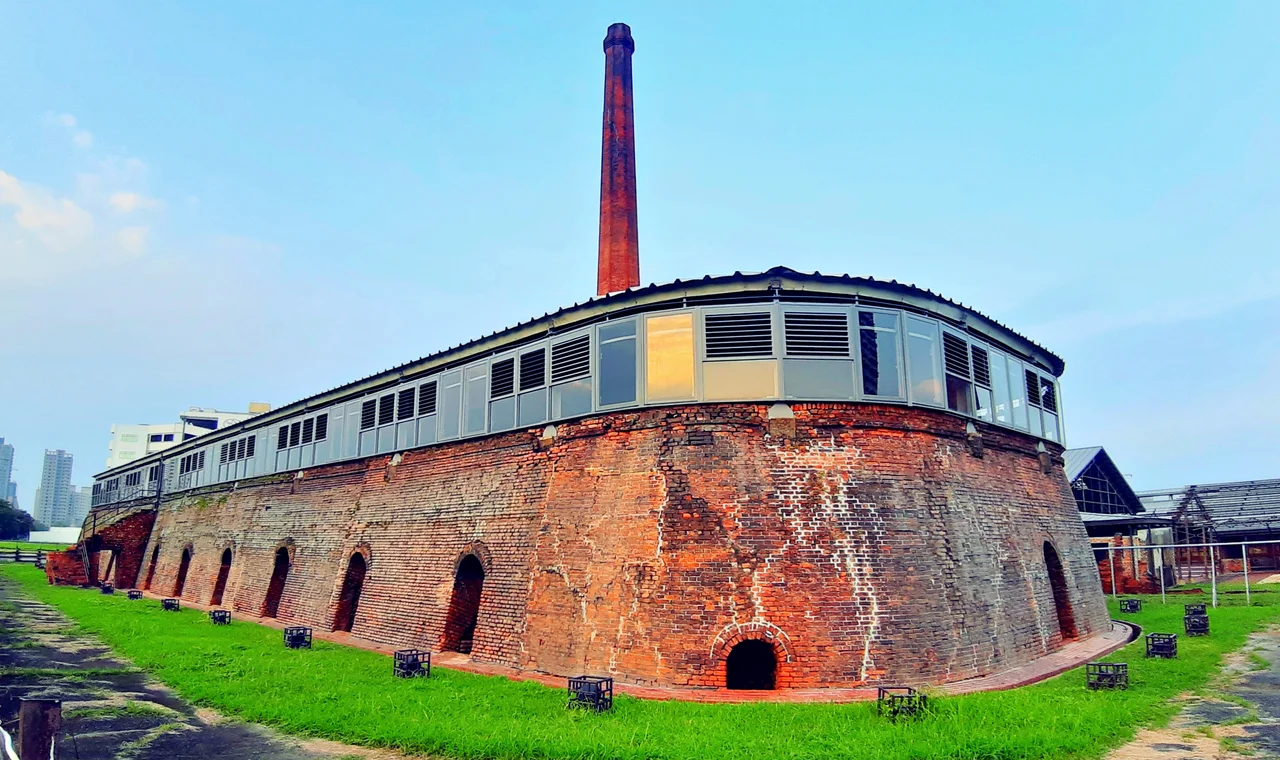

Former Tangrong Brick Kiln
For most of the twentieth century, Kaohsiung was built with bricks that came from a single address in Sanmin District. The tile factory the Japanese government established there in 1899 grew, over a few decades, into a facility so dominant that by the early years of Japanese rule, its output accounted for roughly 70 percent of all bricks produced in Taiwan. Cities require enormous quantities of brick to become themselves. The chimneys of the Former Tangrong Brick Kiln are, in a very literal sense, embedded in the walls of modern Kaohsiung.
From Tile Factory to Island Monopoly
The Japanese colonial government established the Sanmin District facility as a tile factory in 1899, introducing what it described as the latest kiln technology of the era. The Hoffmann kiln — a continuous-firing design that allowed bricks to be loaded, fired, and unloaded in a perpetual cycle — made mass production possible in a way earlier intermittent kilns could not match. Taiwan's economy was developing rapidly under Japanese administration, and the demand for building materials grew with it. By 1913, the colonial government had integrated all existing kilns in Taiwan under a single entity: the Taiwan Renga Company. Six additional high-yield kilns were added to the Sanmin facility. The bricks that emerged were branded Taiwan Renga — a mark that appeared on construction sites across the island. That one factory could command 70 percent of an island's brick supply says something both about the efficiency of the Hoffmann process and about the deliberate consolidation the colonial administration imposed on Taiwan's industrial base.
Ownership Changes, Fortunes Shift
When Taiwan passed from Japanese to Republic of China administration in 1945, the Taiwan Renga factory became state property — one of many industrial assets transferred in the handover. The government eventually sold it to a private firm, Tangrong Ironworks, which gave the site the name it carries today. For a time, business was good. During the period of rapid economic growth that characterized Taiwan in the postwar decades, the kiln generated significant profit for Tangrong. Then the pressures that eventually close every industrial facility of this type converged: labor costs rose, environmental regulations tightened, and the economics of brick production at this scale stopped working. The entire factory shut down in 1985. The company that had operated it had already hit a financial crisis by 1957, and the Ministry of Economic Affairs had stepped in to acquire the factory in 1962. The administrative building continued operating until 2002. After that, silence.
The Chimneys That Remain
What the Taiwan Renga Company and Tangrong Ironworks left behind is a remarkable industrial landscape. The Hoffmann kilns are long structures — continuous firing chambers with tall chimneys rising from the roofline — and several survive at the Sanmin District site. Red brick, naturally, is everywhere: in the kilns themselves, in the administrative building, in the boundary walls. After years of dormancy following the 2002 closure of the last operational sections, the site was renovated beginning in 2005 and opened as a tourist attraction. Visitors can walk the grounds and read the layers of the facility's history in its architecture: the early Japanese-era construction, the postwar modifications, the gradual shutdown. The chimneys, still standing, are the most visible monuments — visible from the street, visible from passing trains, visible from the air.
Industry as Heritage
The Tangrong site sits within easy walking distance of both Kaohsiung Main Station and Gushan Station, meaning it occupies terrain that was once central to the city's industrial identity and remains central to its transportation network. That proximity is not accidental. The factory was built where it was because Sanmin District had the infrastructure — rail access, labor, proximity to the growing city — that heavy industry required. Taiwan's Ministry of Culture has formally recognized the site, listing it among the country's national monuments. The designation acknowledges what the brick walls already communicate: that a facility this consequential to an island's built environment deserves to be understood, not just bulldozed. The bricks that Kaohsiung is made of came from here. It is appropriate, then, that the kiln itself survives to be seen.
From the Air
The Former Tangrong Brick Kiln is located at approximately 22.642°N, 120.285°E in Sanmin District, Kaohsiung, about 5 kilometers north-northeast of Kaohsiung International Airport (RCKH). From low altitude — around 1,000 to 1,500 feet — the tall kiln chimneys are distinctive against the urban grid of Sanmin District. Kaohsiung Main Station is visible nearby to the east. The Love River curves through the area to the southwest, providing orientation. Approach from the south along the harbor, then track northeast; the brick-red rooflines of the kiln complex stand out against the surrounding modern buildings. Best viewed in morning or late afternoon light when the chimneys cast long shadows.
Nearby Stories
- Taimali 7.2 km away
- Meinong East Gate Tower 15 km away
- Kunci Temple 20 km away
- Checheng Fu'an Temple 42 km away
- Dongji Island 49 km away
- Orchid Island 69 km away
- South Penghu Marine National Park 77 km away
- Hong Kong 12 549 km away