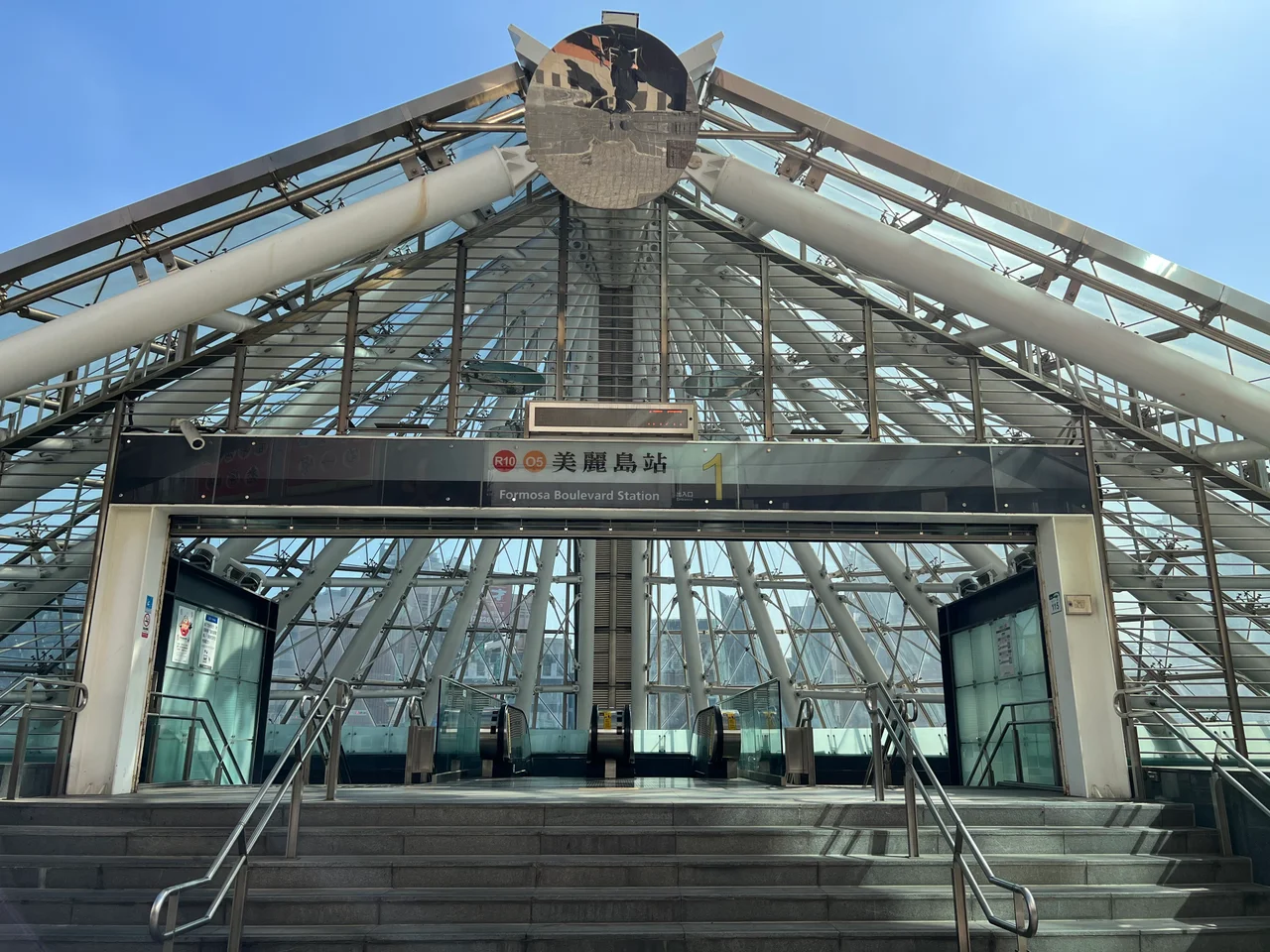

Formosa Boulevard Metro Station
On December 10, 1979, International Human Rights Day, police and soldiers attacked a pro-democracy rally in the southern Taiwanese city of Kaohsiung. The Formosa Incident, as it came to be known, resulted in the arrest, trial, and imprisonment of virtually the entire leadership of Taiwan's democratic opposition. Three decades later, the intersection where protestors once faced truncheons and tear gas became the site of the most extravagant metro station in Asia: Formosa Boulevard, named not for the old Portuguese word for Taiwan but for the magazine that organized the rally and the movement that changed the country.
The Dome of Light
The station's centerpiece is impossible to miss. The Dome of Light spans thirty meters in diameter and covers 2,180 square meters, making it the largest single work of glass art in the world. Italian artist Narcissus Quagliata designed it as a narrative cycle depicting water, earth, light, and fire, themes that trace the human journey from destruction to rebirth. The dome is assembled from 4,500 glass panels fabricated by the German firm Glassstudio Derix, supplemented by original glass rondels from the centuries-old glassmaking island of Murano, Italy. Sunlight filters through during the day, casting shifting patterns across the concourse floor. At night, integrated lighting illuminates the panels from within. The dome is so visually striking that couples book it as a wedding venue, exchanging vows beneath a ceiling that tells a story about surviving darkness and finding light. For a station named after a crackdown on democracy, the metaphor is not subtle.
Where Two Lines Cross
Formosa Boulevard sits at the junction of Kaohsiung Metro's Red and Orange lines, making it the system's only interchange station. The three-level underground structure combines an island platform with two side platforms. Eleven exits connect to the streets above, where the Liouhe Night Market, the General Post Office, and the Wedding Street along Jhongshan and Jhongjheng Road cluster within walking distance. The Orange Line station stretches 334 meters while the Red Line station extends 209 meters. Transferring between the two lines takes roughly four minutes. Beyond the dome, the station features four glass-paneled pedestrian entrances designed by the renowned Japanese architecture firm Shin Takamatsu Architect and Associates, each one funneling daylight down from street level into the underground concourse. The effect, combined with the dome, is of a station that refuses to feel subterranean.
From Protest Ground to Public Art
The station was named after the Formosa Boulevard project, itself a remodeling of Kaohsiung's Jhongshan Road undertaken in preparation for the 2009 World Games. The boulevard takes its name from the Formosa Incident of 1979, which catalyzed Taiwan's transition from authoritarian rule to democracy. Many of the dissidents imprisoned after the incident went on to become leaders in the democratic government that followed, including a future president and vice president. The decision to name a transit station after the event was deliberate: it embedded the memory of the democracy movement into the daily commute of hundreds of thousands of riders. The Dome of Light, with its themes of suffering, transformation, and renewal, reinforces the connection. Art and infrastructure merge here in a way that few transit systems anywhere in the world attempt, let alone achieve.
Underground Cathedral
Kaohsiung Metro opened its Red Line in March 2008, with the Orange Line following in September. Formosa Boulevard, at the crossing point, was designed to be the system's showpiece from the beginning. It is one of three Kaohsiung Metro stations that feature commissioned artworks by international artists, alongside Kaohsiung Arena Station and Kaohsiung International Airport Station. But Formosa Boulevard is the one that draws visitors who have no intention of boarding a train. They come to stand beneath the dome, to look up, and to take photographs of a ceiling that manages to be both monumental and intimate. In a city that has spent decades rebuilding its identity from industrial port to cultural destination, the station is a statement of ambition. It says that public infrastructure can also be public art, that a subway stop can carry historical memory, and that the place where a democracy was nearly strangled can become, quite literally, a cathedral of light.
From the Air
Coordinates: 22.631N, 120.302E, at the intersection of Jhongjheng and Jhongshan Roads in Sinsing District, central Kaohsiung. The station is underground and not visible from the air, but the intersection and surrounding commercial district are identifiable. Nearest major airport: RCKH (Kaohsiung International Airport), approximately 8 km south. Viewing altitude: 2,000-4,000 ft for urban context.
Nearby Stories
- Taimali 7.2 km away
- Meinong East Gate Tower 15 km away
- Kunci Temple 20 km away
- Checheng Fu'an Temple 42 km away
- Dongji Island 49 km away
- Orchid Island 69 km away
- South Penghu Marine National Park 77 km away
- Hong Kong 12 549 km away