,_Vila_Velha_-_ES,_Brasil._20240519161735.JPEG)
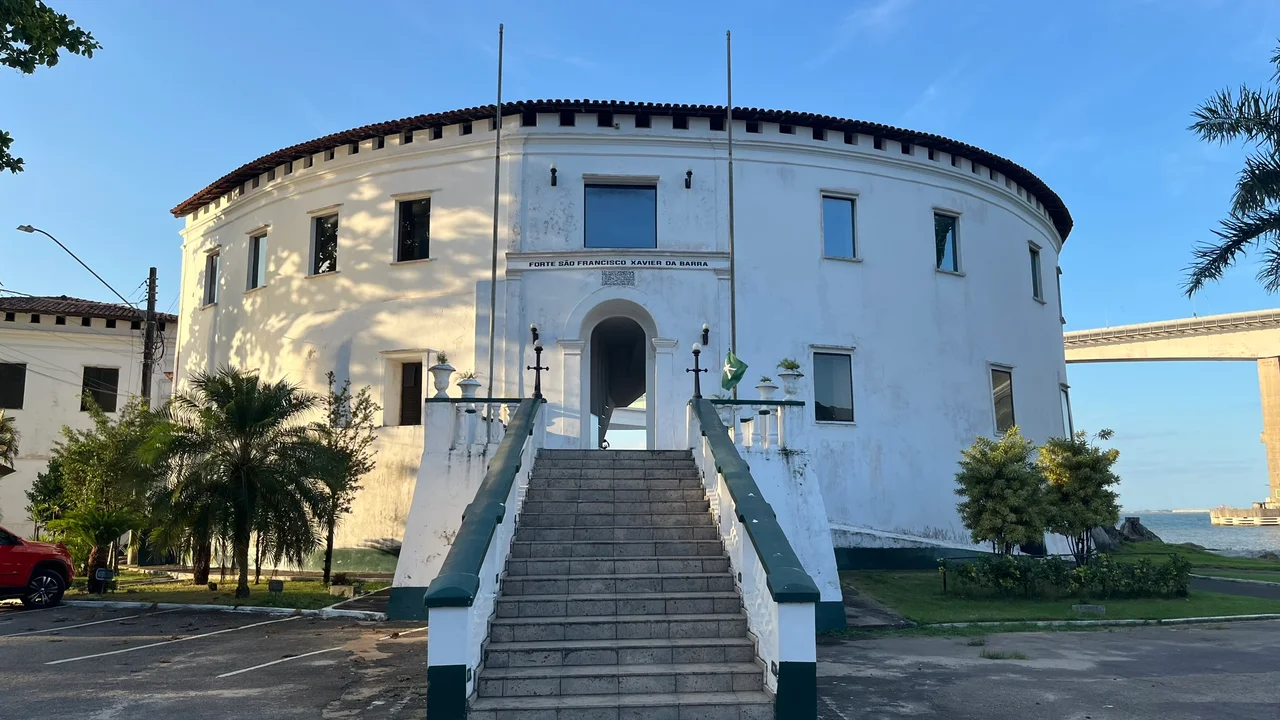
Fort of Sao Francisco Xavier de Piratininga
The fort was still under construction when the English and Dutch privateers attacked it in 1705. Walls half-built, cannons not yet mounted in their final positions, the structure nonetheless had to hold, because the southern bar of Vitoria Bay was the only way in and out of the Captaincy of Espirito Santo, and whoever controlled that channel controlled everything behind it. The fort held, more or less, and the Portuguese kept their colony. The circle of stone that survived that early test was renovated, expanded, and reconfigured over the next three centuries, passing through the hands of the Portuguese Crown, the Imperial Brazilian Navy, and the modern Brazilian Army. Today it anchors the 38th Army Infantry Battalion on the same rock where it stood in 1702.
A Fortress Before the Fort
The defensive history of this site began long before the current structure. In 1535, Vasco Fernandes Coutinho, the first donatario of the Captaincy of Espirito Santo, is believed to have built a small fortification on Penha Hill to defend his settlers from attack. That earlier fort did not survive long. The Captaincy itself struggled through its early decades, hit by Indigenous resistance, pirate raids, and administrative turbulence. It eventually passed through private hands. Around 1674 or 1675, Francisco Gil de Araujo from Bahia bought the entire Captaincy from Antonio Luis Goncalves da Camara Coutinho for 40,000 cruzados, a substantial sum that reflected both the Captaincy's strategic value and its problems. Gil de Araujo had ambitions, and defending his purchase meant rebuilding the forts.
1702 and the English Privateers
In 1702, under Gil de Araujo's administration, construction began on a new fortification equipped with ten pieces of artillery of various calibers. Captain-Major Francisco Ribeiro supervised the work, and by 1703 the structure was well advanced: known as the Fortress of Sao Francisco Xavier de Piratininga or simply the Fortress of Barra, it occupied the rock at the base of Penha Hill on the southern side of Vitoria Bay. Two years later the fort faced its first real test. English and Dutch privateers attacked it while construction was still ongoing. The details of the battle have faded from the historical record, but the outcome is clear enough: the fort held its position, and Portuguese control of the bay survived. The King of Portugal, Peter II, had ordered the fortress built through Rodrigo da Costa, Governor and Captain General of the State of Brazil.
The Circle of 1726
After the early attacks, the colonial government invested further in the structure. Viceroy Vasco Fernandes Cesar de Meneses commissioned the engineer Nicolau de Abreu Carvalho to repair the fortifications of Vitoria Bay, and the work at Piratininga began in 1726. Abreu Carvalho reconfigured the fort into a circular layout, rearmed it with fifteen pieces of artillery, and raised a two-storey Command House on its main level, accessed by an exterior ramp. In 1767 another round of renovations followed. A report by Dionisio Carvalho de Abreu from 1724 describes the fort in transitional condition: nine artillery pieces in place, one a 16-pounder and the rest 8-pounders, with two more dismounted and portions of the wall badly damaged. By the time Luis dos Santos Vilhena drew up the plans and elevations in 1801, the fort had settled into its mature form.
Navy, Army, Warehouse, Battalion
On June 2, 1862, the fort was transferred to the Brazilian Imperial Ministry of the Navy, which repurposed it as a warehouse. Its military role receded but did not end. On November 10, 1919, it returned to the custody of the Ministry of War, which built modern barracks on the grounds to house the 3rd Battalion of Hunters of the Brazilian Army. The traces of the navy period are still visible: a balustrade composed of anchors, a staircase on the interior, a navy mast still standing on the grounds. These small details, left in place through successive transitions, turn the fort into a layered artifact rather than a single-period monument. Today the old fort forms part of the 38th Army Infantry Battalion, and visits are possible only by prior arrangement with the battalion's Social Communication department.
At the Mouth of a Bay
Geography explains the fort's longevity. Vitoria Bay is one of the most strategic harbors on the central Brazilian coast, its natural channels offering deep-water access that has been exploited by every colonial power and every modern government to hold the territory. The Fort of Piratininga sits on the southern side of the bar, paired historically with fortifications on the northern side, forming a crossfire that could sweep any vessel trying to force the entrance. Vila Velha, the oldest town in Espirito Santo, lies immediately to the south of the fort; the island city of Vitoria sits to the north across the 4.8-kilometer bridge that now links them. The rock on which the fort stands has been called the bright rock in colonial records, because it catches the morning sun as ships approach from the open ocean.
From the Air
The Fort of Sao Francisco Xavier de Piratininga sits at 20.32 degrees S, 40.29 degrees W at the mouth of Vitoria Bay, on the Vila Velha side of the channel that separates Vila Velha from Vitoria island. Vitoria/Eurico Salles Airport (SBVT) is 10 kilometers north on the island. The fort is a circular stone structure at the base of Penha Hill on the southern side of the bay entrance, and from the air it is identifiable by its geometric form and position directly at the bay mouth. The Terceira Ponte bridge and the urban skyline of Vila Velha and Vitoria provide navigation references.
Nearby Stories
- Pedra Azul State Park 28 km away
- Guarapari 29 km away
- Mutum, Minas Gerais 74 km away
- Linhares 74 km away
- Paraiba do Sul 119 km away
- Petrobras 36 167 km away
- Itaúnas 180 km away
- Caraíva 393 km away