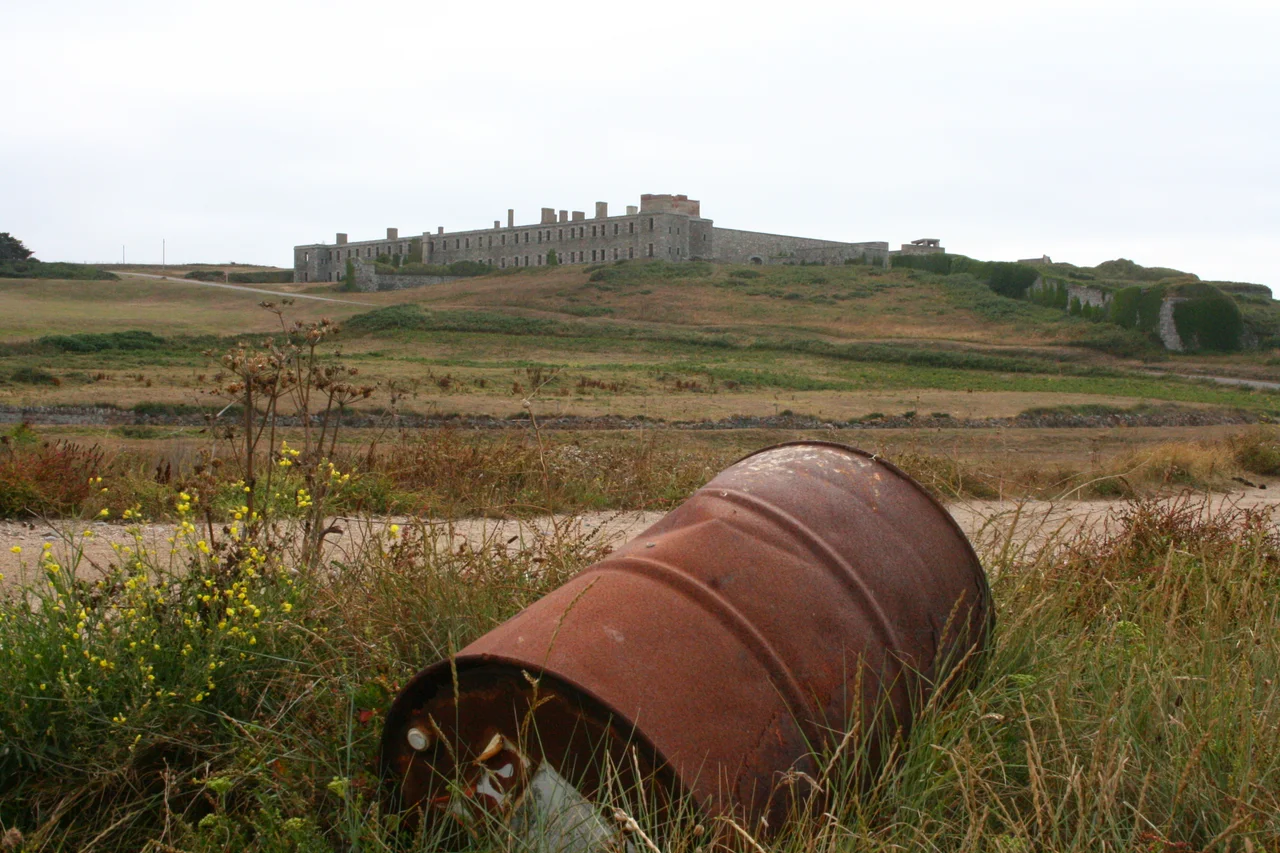

Fort Tourgis
Two empires fortified Fort Tourgis, eighty-five years apart, against entirely different enemies. The Victorians built it. Completed in 1855, it was designed for 346 men, 33 heavy cannon arranged in five batteries, and four 13-inch mortars - originally meant to be Alderney's largest fort before Fort Albert overtook it a year later. The Germans inherited it. From July 1940 onward, after the entire civilian population of Alderney had been evacuated and the Wehrmacht walked into the empty island unopposed, they renamed it Stützpunkt Türkenburg - Strongpoint Turk's Castle - and grafted concrete bunkers, anti-tank guns, and searchlights onto Cambridge Battery's smoothbore platforms. Today the kestrels nest in the Victorian musketry loops, and stonechats display on brambles that thrust up through the ruins.
Built for a Fleet That Never Came
Alderney's eighteen Victorian forts and batteries existed to support an ambition that didn't quite work. The harbour at Braye was being built to anchor a British battle fleet in the Channel, positioned to respond to French naval power across the water. By 1860 - five years after Tourgis was finished - rifled artillery and ironclad warships had already begun making stone-walled forts obsolete. By 1886 the island still mounted 124 guns. By 1893, only Fort Albert and Roselle Battery were armed. By 1908, the entire defence of the island had been reduced to two six-inch guns and two twelve-pounders. Tourgis kept its impressive shape and stopped serving any clear purpose. The citadel still contained the barrack block and main magazine. Three major batteries faced seaward, separated from each other and from the citadel by ditches crossed by drawbridges. The fort was, in essence, a Victorian set piece that the 20th century had outgrown.
Strongpoint Turk's Castle
In July 1940, German forces occupied Alderney. Over the next four years they turned the small island - barely three miles long - into one of the most heavily fortified positions on Hitler's Atlantic Wall. They built five artillery batteries, twenty-three anti-aircraft batteries, thirteen strongpoints, twelve resistance nests, three defence lines, and emplaced over 30,000 mines. The construction was done largely by forced labour - prisoners and slave workers held in four SS-administered camps on the island, including Sylt and Norderney. Hundreds of those workers died from exhaustion, beatings, and starvation; many were Russian, Polish, and French Jewish prisoners whose graves are still being identified. Tourgis itself was given a three-gun 20 mm Flak battery, two 10.5 cm beach-defence guns, two 7.5 cm Pak anti-tank guns, multiple searchlights, and numerous machine guns. A tunnel was driven under the Victorian wall to link the citadel to new bunkers outside it. The fort's 19th-century geometry became a frame for 20th-century concrete.
Cambridge Battery, Then and Now
Cambridge Battery - Battery No. 2 - sits at the fort's north-east corner. When it was first built, it mounted eight 68- and 32-pounder smoothbore guns on heavy timber platforms that rotated on iron pivots running on semicircular and circular racer rails. The rails are still there. The Germans built directly on top of the Victorian platforms. A 60 cm searchlight bunker, unique to Alderney's fortifications, sat on rails that let the lamp roll into position from a recessed storage area to cover the sea, the beach, or aerial threats out to five kilometres. Another bunker housed both a 7.5 cm Pak 40 anti-tank gun and a machine gun, the Pak swinging on a traverse track whose semicircle is still visible in the concrete floor. The most distinctive structure is a Jäger bunker - a type only built in the Channel Islands - that combined accommodation, magazine, and a captured French 10.5 cm gun aimed across the wide beach of Platte Saline.
Reclaimed by the Living Islands
Since 1945 the fort has belonged to the seabirds, the moths, and the slow patient work of conservation. Kestrels nest in the eastern musketry loops; buzzards, meadow pipits, stonechats, and even the occasional Dartford warbler use the shrubs and brambles that have grown through the battery walls. Barn swallows nest in the German tunnel that links the magazine to the outer bunkers. Bloxworth snout moths - a UK rarity - thrive in the cool concrete spaces. The Living Islands Project, supported by States Works volunteers, has cleared and conserved the northern defences enough to open Cambridge Battery to the public. From the searchlight bunker, the view sweeps over Clonque Bay and Platte Saline, with Forts Doyle and Grosnez visible to the east and the protected Ramsar wetlands to the west. Upwellings from the Swinge's tidal flows feed seabirds: gannets in formation, shags drying their wings, curlews and white egrets along the shore. The fort that was built to repel France, then occupied to repel Britain, now belongs to the seabird centre of the English Channel.
From the Air
Fort Tourgis sits on a hillside on Alderney's western side, north-west of Saint Anne (49.719°N, 2.219°W). From the air the citadel and its three seaward batteries are visible as a star-shaped stone complex above Platte Saline beach, with Clonque Bay to the south-west. Best low-altitude approach is from the north-west over the Swinge. Nearby airports: Alderney (EGJA) 1.7 nm east, Guernsey (EGJB) 19 nm south, Cherbourg-Maupertus (LFRC) 24 nm east. Look for the long line of German concrete bunkers and gun emplacements stretching west along the coast - they remain among the most visible artefacts of the Atlantic Wall.
Nearby Stories
- 1993 Cherbourg Incident 6.2 km away
- Channel Islands 7.4 km away
- Abbey of Saint-Sauveur-le-Vicomte 17 km away
- German Submarine U-672 21 km away
- HMS Formidable (1898) 38 km away
- HMS Affray 57 km away
- Needles Lighthouse 83 km away
- HMS Brisk (1851) 251 km away