
Freedom Park
Salvokop is a small hill on the southern edge of Pretoria, and from its summit you can see the Union Buildings across the valley, the seat of a government that once enforced apartheid. That sightline was chosen on purpose. Freedom Park rose here in the years after democracy as a deliberate answer to the older monuments of conquest, a place to honor not one people's heroes but everyone who died in the long making of South Africa. It opened in December 2007, and it asks a hard question: how does a divided country build a single memory?
The Wall of Names
The centerpiece is a wall that runs for nearly seven hundred meters along the hillside, and it is not a list of generals. It records the dead from eight conflicts that shaped the country: the precolonial wars, the genocides, the South African War, the two World Wars, and the struggle against apartheid itself. Tens of thousands of names are inscribed, and the wall is built to keep growing as more are recovered and verified. Some who died were never named at all. For them, an Eternal Flame burns nearby, a gesture toward the unknown and the unrecorded. To walk the wall's length is to feel the sheer arithmetic of loss, conflict after conflict, name after name, until the abstraction of history becomes something closer to grief.
A Landscape of Reconciliation
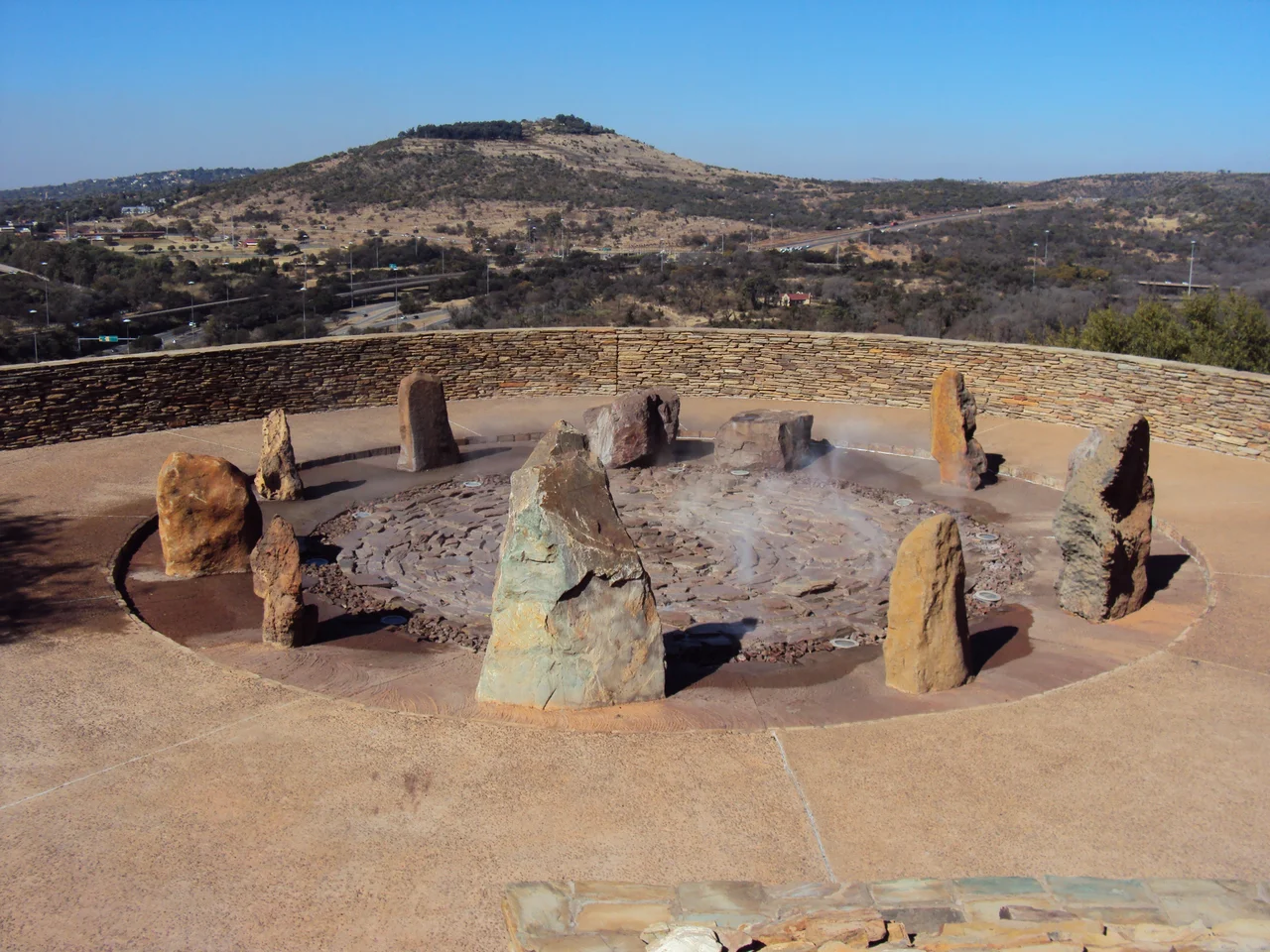
Freedom Park is more than its wall. The wider memorial, S'khumbuto, gathers an amphitheatre, a sanctuary, a Gallery of Leaders, and a curving stand of reeds. Lower on the hill lies Isivivane, a quiet circle of boulders, one brought from each of South Africa's nine provinces, conceived as a spiritual resting place for those who fell in the freedom struggle. The whole design draws on indigenous African spirituality rather than European monumental tradition, weaving Khoi, San, and other belief systems into stone and water and open sky. The poet Mongane Wally Serote, himself a former political prisoner and exile, guided the project from the start, ensuring it spoke in an African voice.
Who Belongs on the Wall
Deciding whom to honor was itself an act of nation-building, and not without controversy. In 2009 the project proposed adding two dozen liberation figures, among them Steve Biko, Oliver Tambo, Albert Lutuli, Helen Joseph, and the Afrikaner advocate Bram Fischer, who defended Mandela at the Rivonia Trial and then went to prison for his own beliefs. The list reached beyond South Africa's borders to honor those who aided the struggle or fought oppression elsewhere, including Mozambique's Samora Machel and the Guinea-Bissauan leader Amilcar Cabral. The breadth was the message. Freedom Park insists that the fight against injustice was never contained by a single flag.
Reading the View
Stand at the top and the geography becomes an argument. Behind you, the Voortrekker Monument, a granite shrine to Afrikaner pioneers, broods on its own ridge. Ahead, the Union Buildings hold the modern democratic state. Freedom Park sits between them and refuses to choose, holding all of that contested history in a single gaze. It does not erase the older monuments; it reframes them, placing them inside a wider story in which more people, finally, are counted. That is the quiet power of this hill. It does not shout. It remembers, deliberately and inclusively, in a country still learning how.
From the Air
Located at 25.767 S, 28.189 E on Salvokop, a hill immediately south of Pretoria's central business district and just south of the main railway station. The site is best appreciated from 1,500 to 3,000 feet AGL, where the long curve of the Wall of Names and the reed sculptures stand out against the hillside; the Union Buildings are visible across the valley to the northeast and the Voortrekker Monument to the southwest. Nearest airports: Wonderboom (FAWB) about 12 nm north, OR Tambo International (FAOR) roughly 30 nm southeast. Pretoria's Highveld setting at around 1,350 m gives clear, dry skies and long visibility, especially in winter.
Nearby Stories
- Little Foot 3.9 km away
- Hartebeesthoek Radio Astronomy Observatory 18 km away
- Boksburg explosion 23 km away
- Tswaing crater 24 km away
- Secunda CTL 69 km away
- Sun City 71 km away
- Bushveld Igneous Complex 87 km away
- Battle of Bergendal 127 km away