
Fulham
The Bishops of London lived here for thirteen hundred years. From around 704 until 1973, the manor of Fulham was the country residence of every Bishop of London who held the see — Saxon prelates, Norman appointees, Tudor reformers, Georgian aristocrats, Victorian Anglicans. They built and rebuilt the palace on the riverside meadows in a slow accumulation of medieval, Tudor and Georgian architecture, and they dug the longest moat in England around it. The moat is partly excavated now and the palace is a museum, but its quiet, hedged grounds still feel oddly cut off from the city that grew up around them — as if a piece of Saxon Middlesex slipped under the gate while London wasn't looking.
Fulla's Hemmed-In Land
The name is Old English: 'Fulla's hamm', the river-meadow of a man called Fulla, hemmed in by water on three sides as the Thames loops south around the peninsula. Domesday Book wrote it down in 1086 as Fuleham. Excavations around Fulham Palace have shown Neolithic occupation roughly 5,000 years old, and Roman settlements from the third and fourth centuries. In 879 a Danish army wintered here, drawn up the Thames on shallow-draft longships — Fulham was a defensible position with good landings, ideal for an over-wintering force whose chronicles, in their stiff Anglo-Saxon prose, describe the camp without much enthusiasm.
The Bishop's Palace
Two stories survive for how the bishops acquired the land. One says Bishop Erkenwald was granted the manor about 691 for himself and his successors. The other says Bishop Waldhere bought it from Bishop Tyrhtel in 704. Either way, the bishops were here a thousand years before London arrived. The surviving palace buildings are mostly Grade I listed medieval and Tudor work, with later Georgian additions, set in thirteen acres of grounds. The walled garden grows medlars and quinces. The part-excavated moat — once a complete circuit around the palace, more than a mile long — was the longest in England. Inside the palace is a small museum. Outside, in the churchyard of All Saints just beyond the palace gate, lie a number of Bishops of London under tombs that range from medieval simplicity to Victorian piety, in a churchyard whose 14th-15th-century tower still anchors the view from the river.
Craven Cottage and the Stadium That Wouldn't Move
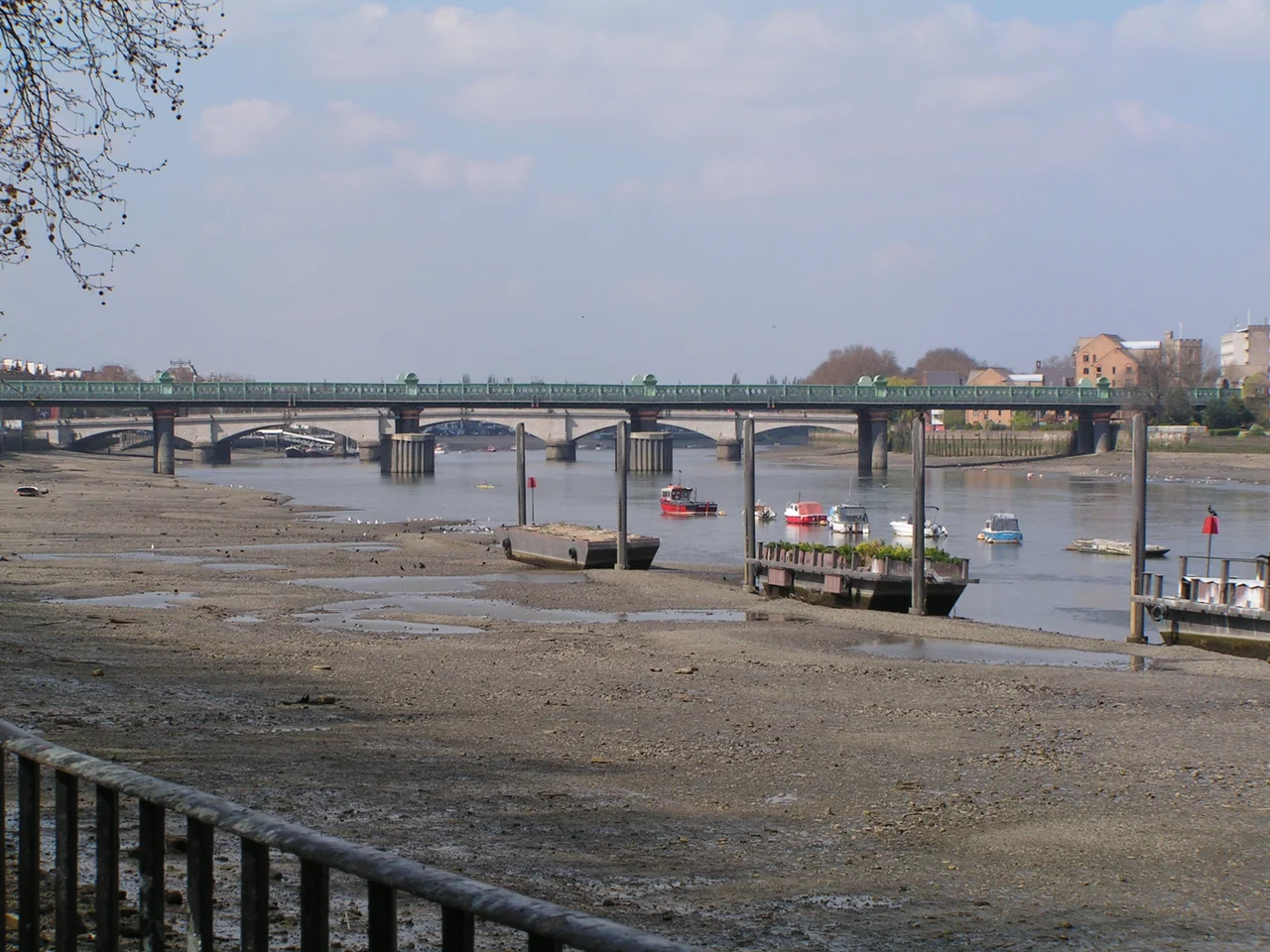
Fulham Football Club has played at Craven Cottage on the Thames riverside since 1896. The 'cottage' itself, after which the stadium is named, was a country house built in 1780 by William Craven, 6th Baron Craven — burned down in 1888, leaving only the name. The current Craven Cottage pavilion at the stadium dates from 1905, designed by the prolific football architect Archibald Leitch, who built half the major grounds in Britain. It is the smallest Premier League stadium and almost certainly the only one with a view out over a tidal river. The Thames Path used to be interrupted by the ground, with walkers diverted around the back streets, but with the 2024 Fulham Pier extension the riverside walk now continues uninterrupted past the stadium, the Bishop's Park, and onward toward Hammersmith Bridge.
Hurlingham, Where Polo Lives
The Hurlingham Club sits in 42 acres of grounds on the south side of Fulham, between Ranelagh Gardens and the river. Founded in 1869 as a pigeon-shooting club, it became in the 1870s the home of polo in Britain and the unofficial then official headquarters of the international game. The Hurlingham Polo Association governs the sport throughout the British Isles, much of Europe, the Middle East and Africa, and the world's rule book carries Hurlingham's name. The club's polo grounds were built over after the Second World War for housing, but Hurlingham Park nearby hosts the annual Polo in the Park tournament. The club itself remains private, Georgian, manicured, and quietly central to a sport most Londoners have never seen played.
Trades, Industries, Lost Theatres
Before the gentrification of the late twentieth century, Fulham worked. Fulham Pottery dates from the seventeenth century; tapestry weavers from the Gobelins manufactory in Paris set up a branch here in the 1750s. William De Morgan made tiles in Sands End with his wife the painter Evelyn De Morgan; Edward and Georgiana Burne-Jones lived at the Grange in North End. The aviation pioneer Geoffrey de Havilland built his first aeroplane in a workshop on Bothwell Street in 1909. The Imperial Gas Light and Coke Company — the world's first public utility — opened its works on the Sandford estate in 1824; its number 2 gasholder, completed in 1830, was reputedly the oldest in the world. Brewing, ceramics, automotive assembly, photographic processing for Kodak, gin distilling at Burnett's White Satin — all of it has gone, or nearly so. The Granville Theatre, designed by Frank Matcham and founded by music-hall comedian Dan Leno in 1897, became a film studio and was demolished in 1971. The Grand Theatre, designed by W. G. R. Sprague the same year, became offices in the late 1950s. The neighbourhood that once worked is now mostly the neighbourhood that brunches.
Bishop's Park on a Saturday
What survives, beyond the buildings, is a sense that this loop of the river has always been slightly apart from London proper. The bishops chose it for that reason. The polo players chose it for that reason. Fulham Football Club's fans, who have followed a small club through promotions and relegations for over a century, choose it for that reason. The Thames bends here in a way that gives the place the feel of an island, and from Bishop's Park on a Saturday in May, with the Putney rowers training upstream and the Fulham striker scoring a hopeful equaliser audible across the river, you can stand for a moment and remember that Fulla, whoever he was, picked a good piece of land.
From the Air
Fulham occupies a peninsula at 51.48N, 0.21W in West London, with the Thames looping around it on three sides — east, south and west. Putney Bridge crosses to Putney; Wandsworth Bridge to Wandsworth; Hammersmith Bridge to Hammersmith. Heathrow (EGLL) lies about ten nautical miles west; London City (EGLC) is east across the city; the London Heliport at Battersea is immediately downstream. Recommended viewing altitude 1,500-2,500 ft AGL — the Fulham peninsula is unmistakable from altitude, with Craven Cottage stadium on the south bank of the loop, Fulham Palace and All Saints Church on the southern point, and the Hurlingham Club's grounds on the southern edge. Stamford Bridge stadium, home of Chelsea FC, sits at the northeast corner.
Nearby Stories
- Battle of Britain, Northfleet 1.1 km away
- Bayham Old Abbey 5.4 km away
- Catharine Macaulay 6.4 km away
- Hatfield rail crash 8.8 km away
- Chequers 8.9 km away
- Chelmsford Cathedral 10 km away
- Queen Victoria Hospital 13 km away
- Fishbourne Roman Palace 36 km away