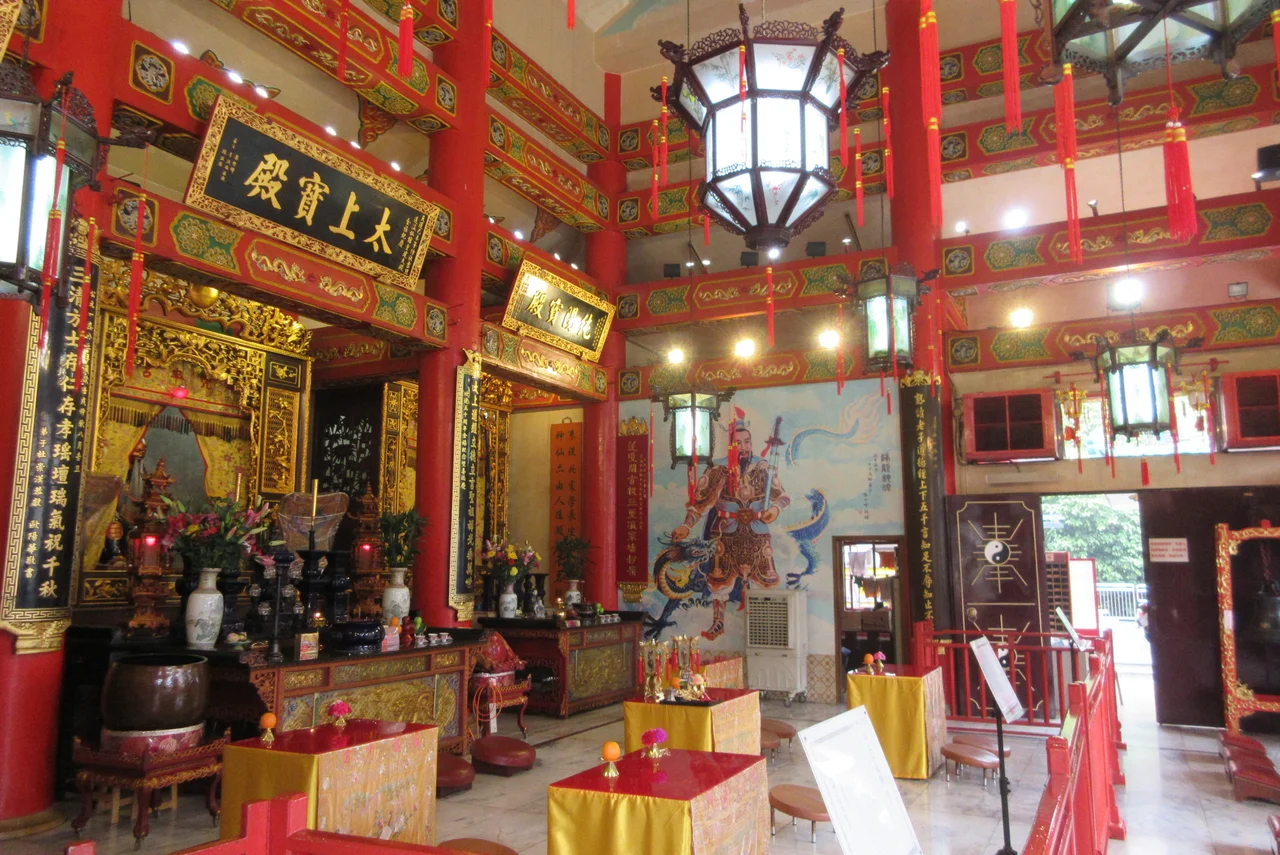

Fung Ying Seen Koon
The orange-tiled double roof catches your eye before anything else. From the street below Fanling's hillside, the massive traditional roof of Fung Ying Seen Koon — its broad eaves curving upward at the corners, supported by stout red stone pillars — announces itself with the visual confidence of a building that knows it belongs. The temple complex was founded in 1929 as an affiliate of the Quanzhen Longmen lineage of Taoism, the Dragon Gate school that traces its lineage through the 13th-century master Qiu Chuji. Its name comes from two fairy islands of the Bohai Sea: Fung Lai and Ying Chau, mythical places of immortality that the temple's founders chose as their spiritual aspiration. The name translates roughly as "Abode of the Fairy Islands," and the building, looking out over the New Territories from its hillside position, makes a reasonable physical argument for the claim.
The Lineage of the Dragon Gate
Fung Ying Seen Koon belongs to the Quanzhen School of Taoism — the "Complete Perfection" tradition founded in the 12th century by Wang Chongyang, a Shaanxi ascetic whose disciples spread across China in the decades after his death. The Longmen, or Dragon Gate, lineage within Quanzhen traces its origins to Qiu Chuji, Wang Chongyang's most celebrated disciple. Qiu Chuji is venerated at the Grand Temple alongside Taishang Laojun — the deified form of the philosopher Laozi, author of the Daodejing, and one of the three highest deities of Daoism — and Lü Dongbin, one of the Five Patriarchs of Quanzhen and an early master of internal alchemy. The trio represent different dimensions of Taoist tradition: philosophical depth, meditative practice, and the quest for spiritual transformation. Worshippers who enter the Grand Temple are in the presence of deities whose veneration stretches back over a millennium.
A Temple of Temples
Within the main complex, Fung Ying Seen Koon contains multiple distinct worship spaces. The Guanyin Temple is dedicated to the bodhisattva of mercy and compassion, whose presence in a Taoist context reflects the long interpenetration of Taoism and Buddhism in Chinese religious life. The Yuen San Temple focuses on Doumu — the mother of the deities of the Northern Dipper, a goddess of medicine, healing, fertility, and nurture — alongside the sixty Great Generals of the Chinese sexagesimal cycle. Each person's birth year corresponds to one of these sixty Generals, who serve in turn as patron deities; visiting the Yuen San Temple to make offerings to one's own General is a common act of piety. The walls and courtyards between these spaces hold their own rewards: a yin-yang carving near the general office; the colorful sculpture depicting the Yellow Emperor's visit to the hermit Guangchengzi of Mount Kongdong, who is said to have discovered the secrets of immortality.
The Scroll and the Stamp
One of Fung Ying Seen Koon's most unusual treasures is a carved version of the Scroll of Eighty-Seven Immortals, a composition considered a masterpiece of Chinese line-drawing technique. The original scroll, which depicts 87 immortals in procession before the supreme deity, was attributed by the celebrated painter Xu Beihong (1895–1953) to the 7th-century Tang dynasty artist Wu Daozi. Xu Beihong apparently felt strongly enough about this attribution to stamp the scroll with a seal reading "Beihong's Life" — an unusual mark of personal conviction. The original scroll is now held at the Xu Beihong Memorial Museum in Beijing. The carving at Fung Ying Seen Koon reproduces the composition in stone, bringing a piece of Chinese classical art history into a working religious site in the New Territories.
A Temple That Runs Schools and Broadcasts Television
Fung Ying Seen Koon is not simply a place of worship — it is an institution that has grown into the surrounding community in unexpected ways. Tai Ping Kindergarten, established in October 1989 within the complex, provides early childhood education under Taoist auspices. The Taoist orchestra, formed in July 1996, promotes Taoist musical tradition through performance. Most strikingly, in 2004 the temple launched what it describes as the first 24-hour Taoist television channel — an entirely unprecedented venture for a religious institution of this kind, later extended online in 2006. The vegetarian canteen has served temple visitors and the public since the complex's early years; most of the food is also vegan. These are not peripheral activities. They reflect a Taoist institution committed to engaging the world it overlooks rather than retreating from it.
Flying Over Fanling's Hillside Temple
Fung Ying Seen Koon sits at approximately 22.4905°N, 114.138°E, on the hillside above Fanling town. From the air, the complex is identifiable by its distinctive orange-tiled double roofs, which stand out against the green slopes. Fanling station on the East Rail line lies a short walk to the south — the temple's own transit directions send visitors to Exit B and then follow the signs. From 2,500 feet on a clear day, the arrangement of the temple's courtyards and halls is visible against the hillside, framed by the residential density of central Fanling below. The Shenzhen border lies a few kilometres north. Hong Kong International Airport (VHHH) is approximately 50 kilometres to the west. Visibility is best in the winter months, when the humidity drops and the New Territories open under sharp, cool light.
From the Air
Coordinates: 22.4905°N, 114.138°E. Recommended viewing altitude: 2,000–3,500 ft. Fung Ying Seen Koon sits on the hillside above Fanling town; look for the distinctive orange-tiled double roofs against the green slope just north of Fanling station (East Rail). The Sham Chun River and Shenzhen border are visible a few kilometres north. Nearest airport: Hong Kong International (VHHH), approximately 50 km to the west. Winter months offer the clearest views.
Nearby Stories
- Chapel of St. Francis Xavier 3.5 km away
- Cuiheng 4.1 km away
- 2015 Shenzhen Landslide 16 km away
- Shunde 31 km away
- Wanshan Archipelago 37 km away
- Nanxiong Formation 96 km away
- Heyuan 149 km away
- Checheng Fu'an Temple 629 km away