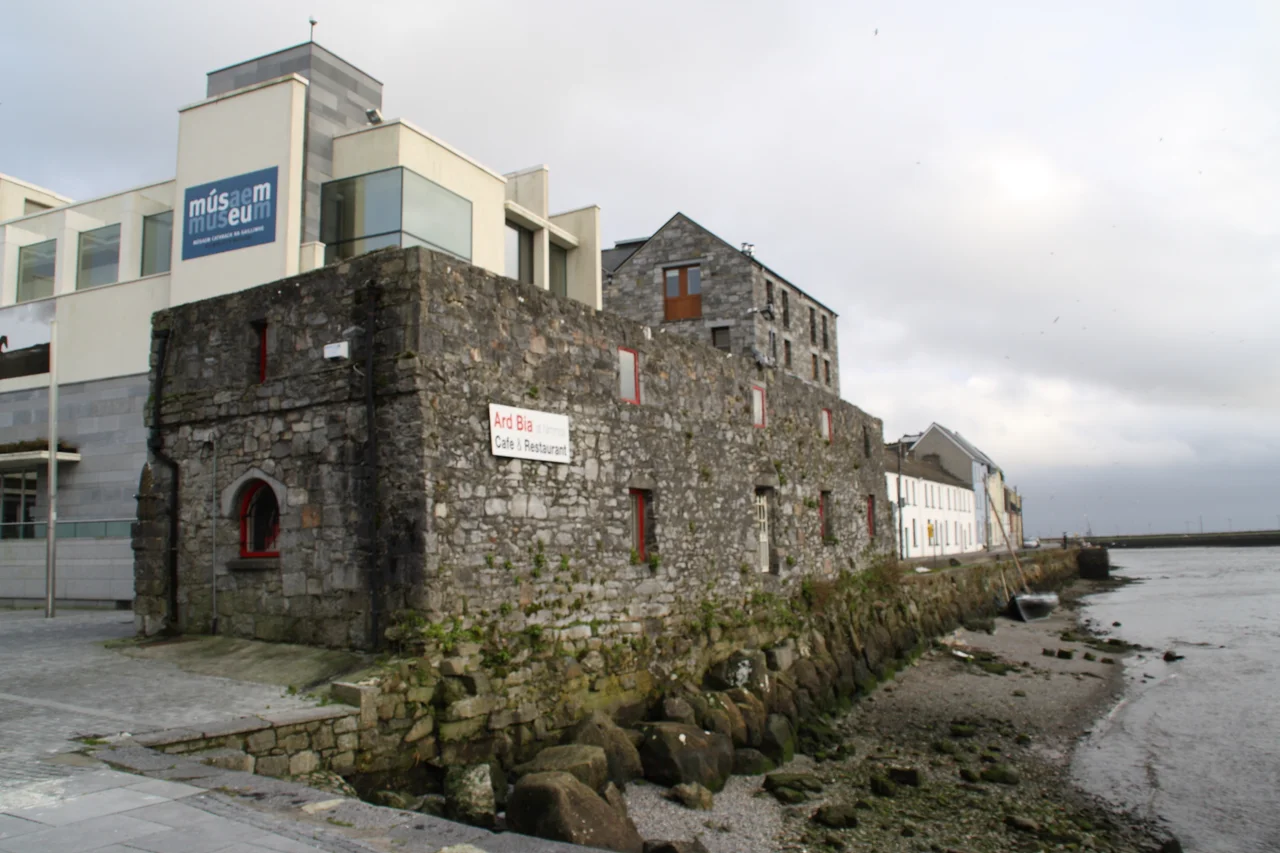

Galway City Museum
The museum sits beside the Spanish Arch, a piece of the medieval city wall that once kept Cromwell and the Atlantic out, more or less in that order. The current building opened in 2007 - an L-shaped, three-storey limestone-and-glass affair designed by Office of Public Works architects Ciaran O'Connor and Ger Harvey, who won the Bank of Ireland Opus Architectural Award for it the same year. Inside: medieval stones, the civic sword of King James I, fishing boats from the Claddagh, a Connaught Rangers regimental record, and a chalice made by the man who is said to have invented the Claddagh ring. Free entry. Open most days.
Comerford House and Clare Sheridan
The museum did not begin in 2007. It began in 1976, in Comerford House - a Georgian property built around 1800 that the Comerford family donated to Galway City Council. Between 1948 and 1954 the house was lived in by Clare Consuelo Sheridan, who is a sufficiently strange figure to deserve a stop. Sculptor, journalist, novelist, first cousin of Winston Churchill, she had spent the 1920s travelling through Bolshevik Russia and interviewing Lenin and Trotsky, both of whom sat for her clay portraits. She had spent the 1930s in California writing books with titles like My Life. She ended up in Galway, somehow, and lived in Comerford House for six years. The medieval stones she collected became the founding museum collection. The old museum at Comerford House closed in 2004. The new building rose behind the same site in time for the 2007 opening.
Galway Within the Walls
The permanent exhibition Galway Within the Walls is the heart of the museum - the story of the medieval merchant city that prospered through Atlantic trade, especially with Spain. Among the holdings: the Atty Doorway from 1577, two intact stone fireplaces, one from the Slate House Nunnery on Kirwin's Lane dating to 1615, the other bearing the arms of the Lynch and Henry families from a vanished High Street house. Many of these stones come from buildings demolished centuries ago - the only physical remnants of houses owned by the famous Tribes of Galway, the fourteen merchant families that dominated the city in the medieval and early-modern centuries. The Spanish Arch and the section of city wall it belongs to are immediately adjacent. The Long Walk runs north along the Corrib. The plaza between museum and arch hosts civic events when the weather, which is to say rarely, permits.
Sword and Mace
On loan from Galway City Council are the city's two most important ceremonial objects. The Civic Sword dates from the Charter of King James I in 1610, which authorised the carrying of such a weapon before the mayor of Galway. The Civic Mace was manufactured in Dublin in 1710 and presented to the town in 1712 by Edward Eyre, then Mayor of Galway and ancestor of the Eyres who gave their name to Eyre Square. Also on loan: the Daly Collection of twenty-four paintings and four sculptures - including works by John Constable, Paul Henry, Sir John Lavery, Roderic O'Conor, Walter Frederick Osborne, George Russell (AE), Leo Whelan, and Jack Butler Yeats - donated by the estate of the late Peter Francis Daly. Plus a copy of the famous 1651 pictorial map of Galway, Albert Power's bronze statue of the writer Padraic O Conaire (relocated from Eyre Square), and the early-nineteenth-century Royal Arms of George III from the old Town Court House.
Richard Joyce's Chalice
On loan from the Dominican Order of Nuns in Galway is a collection of eighteenth-century church silverware - chalices, candlesticks, a host box, an altar frontal, and a reliquary casket of St Ursula. The reliquary was made by Richard Joyce. The Galway tradition holds that Joyce is the man who invented the Claddagh ring - the heart-held-by-hands-crowned-with-a-crown design that has become one of Ireland's most recognised symbols. Joyce was a Galway man, captured by Algerian pirates in the 1670s, sold into slavery in North Africa, trained there as a goldsmith, and eventually freed and returned to Galway in 1689 where he set up shop. Whether the Claddagh ring is genuinely his invention or simply the design he popularised is a matter of debate; what is certain is that he was making rings in Galway in the 1690s and the design that bears the Claddagh name spread from there. His reliquary now sits in a glass case a few hundred metres from the harbour where his story began.
Fishing Boats and Magdalene Receipts
The maritime collection holds the boat-building tools of John Reney, the last of the Claddagh's boat builders, whose yard once stood right where the museum now sits. Fishing boats, navigation books, an Aldis lamp for signalling. The Claddagh collection preserves apron and shawl - the distinctive dress of the Claddagh fishing village that once stood opposite Galway across the Corrib mouth. The DJ Murphy Collection - over 300 farm and industrial implements mostly from County Galway - includes rare straw objects from a vanished rural Ireland. The Galway Militia and Connaught Rangers artefacts cover wars from Crimea through both World Wars. And among the nineteenth- and twentieth-century shop and business artefacts is a receipt book from one of the Magdalene Laundries - a quiet, terrible object, a record of paid work that was nothing of the kind. In 2010 the museum received designated status under the National Cultural Institutions Act 1997, which lets it retain archaeological objects on behalf of the Irish state.
From the Air
Galway City Museum sits at 53.27 N, 9.05 W on the south side of Galway city centre, beside the Spanish Arch on the east bank of the River Corrib mouth, where the river enters Galway Bay. Galway Airport (EICM) is about 7 km east. The site is essentially the historic heart of medieval Galway - the Spanish Arch and the surviving fragment of city wall, the Long Walk running north along the river, the Claddagh on the opposite bank. The three-storey L-shaped building is visible from altitude as a modern structure adjoining the older stone of the Arch. Best viewed in clear afternoon light as part of the wider Galway waterfront.
Nearby Stories
- Inis Oirr 3.9 km away
- Milltown, County Galway 4.2 km away
- Kilmacduagh Monastery 6.4 km away
- Ahascragh 8.9 km away
- Acadamh na hOllscolaíochta Gaeilge 12 km away
- Roscommon 17 km away
- Croagh Patrick 20 km away
- Lorrha 21 km away