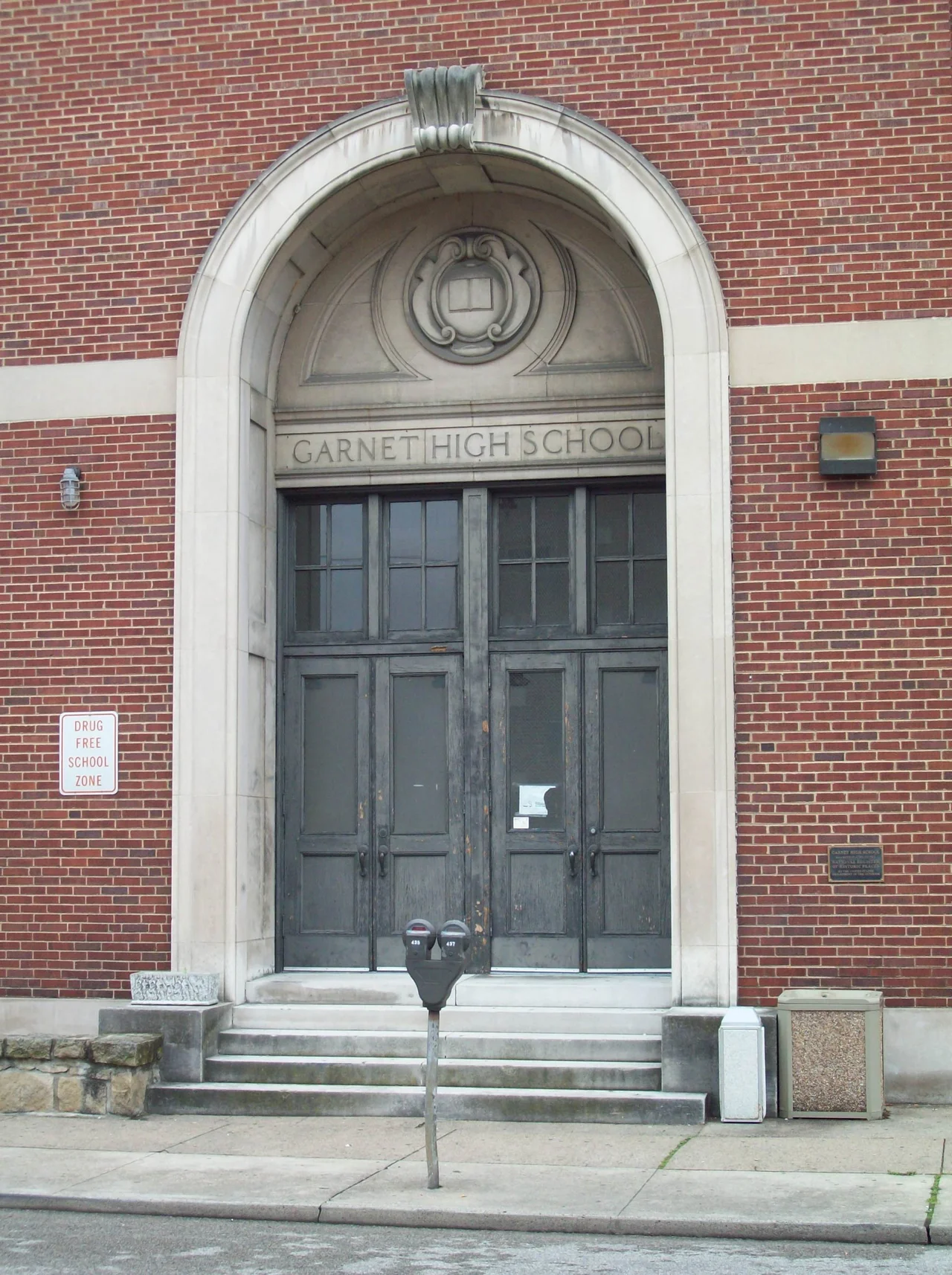

Garnet High School
Twelve African American students in Kanawha County passed a high school entrance exam in the early 1900s, and West Virginia, then a strictly segregated state, had to figure out what to do. The answer was Garnet - named for Henry Highland Garnet, the formerly enslaved man who became a Presbyterian minister, an abolitionist orator, and the U.S. Ambassador to Liberia. The current Garnet High School building in downtown Charleston went up in 1929. For the next twenty-seven years, until West Virginia desegregated its public schools in 1956, Garnet was where Black Charleston children went for high school. Among its graduates was Oscar Holmes, who would become the first African American Naval Aviator in U.S. history, and the first African American air traffic controller.
A School Named for a Diplomat
Henry Highland Garnet was born enslaved in Maryland in 1815 and escaped with his family at age nine. He was educated at the African Free School in New York City, became a Presbyterian minister, gave the famous 'Call to Rebellion' speech at the 1843 National Negro Convention urging enslaved people to resist their bondage, and in 1881 was appointed U.S. Minister to Liberia. He died in Monrovia within months of his arrival. Garnet was the kind of figure Black communities took particular care to memorialize, and across the United States in the late nineteenth and early twentieth centuries, his name was attached to schools and churches that served Black communities. The Kanawha County Board of Education chose the name for its dedicated Black high school. The school first operated in earlier buildings; the surviving structure on Dickinson Street in Charleston was built in 1929 by H. Rus Warne, a prolific Charleston architect, in a restrained Neoclassical style.
Inside Segregated Education
Garnet was the only public high school for Black students in Kanawha County for most of its operating history. Black students from across Charleston and the surrounding county attended; some commuted long distances. The school had to do, for its community, what several majority-white schools did for theirs. Garnet's faculty was Black. Its principals were Black. Its alumni included physicians, lawyers, journalists, ministers, and military officers who went on to lead Black civic life across West Virginia and beyond. Segregation imposed real material constraints - older textbooks, smaller budgets, less equipment - and Black teachers throughout the South and border states routinely worked to overcome those constraints through the application of pedagogical seriousness and personal investment in their students. Garnet's reputation among its graduates is that of a school whose faculty cared intensely about academic excellence as a form of resistance to the conditions of the era.
Oscar Holmes
Oscar Wayman Holmes Jr. was born in Dunbar, West Virginia in 1916 and graduated from Garnet High School. He went on to West Virginia State College, then earned a master's degree in chemistry from Ohio State University. In 1942, with the United States at war, Holmes entered Navy aviation training. The training program had not been formally desegregated, but Holmes - whose skin was light enough that the screening officers did not classify him as African American - was admitted. He completed the program and was designated a Naval Aviator on June 30, 1943, becoming the first African American to qualify as a Navy pilot. He flew the SNJ trainer and the F4U Corsair fighter. After the war he became one of the first African American air traffic controllers, working at La Guardia Field in New York. The Garnet High alumni roster has many distinguished names. Holmes's is among the most significant, because of what his presence in those cockpits ultimately meant for the integration of American military aviation.
Desegregation and Afterlife
After Brown v. Board of Education in 1954 and West Virginia's subsequent legal integration of its schools, Garnet High School closed as a high school in 1956. The building did not close, however. It was reopened as Garnet Career Center and later as Garnet Adult Education Center, continuing as a public educational facility serving a broader student body. The original brick building - with its Neoclassical entrance, central pediment, and rows of tall sash windows - was added to the National Register of Historic Places in 1990. The structure is still in use as an adult education center. The school continues to be a touchstone for African American Charleston: a place where reunions are held, where alumni gather, where a particular chapter of the city's history is still actively remembered. The 'Garnet' name persists. So does the memory of the students, the teachers, and the diplomat for whom the school was named.
From the Air
Garnet High School sits in downtown Charleston, West Virginia at 38.35 degrees north, 81.63 degrees west, on Dickinson Street a few blocks east of downtown and west of the State Capitol complex. Best viewed at 2,500 to 4,500 feet AGL: look for the rectangular brick school building among the East End street grid; the gold dome of the state capitol is a few blocks east along the Kanawha River. Yeager Airport (KCRW) is on the ridge just north of downtown. The Kanawha River and the capitol dome are reliable orientation landmarks.
Nearby Stories
- Mystery Hole 6.5 km away
- West Virginia Colored Children's Home 9.4 km away
- Clay, West Virginia 13 km away
- Staats Mill Covered Bridge 14 km away
- Hobet Coal Mine 23 km away
- Appalachia 23 km away
- Fred M. Vinson Museum and Welcome Center 30 km away
- Ponn Humpback Covered Bridge 43 km away