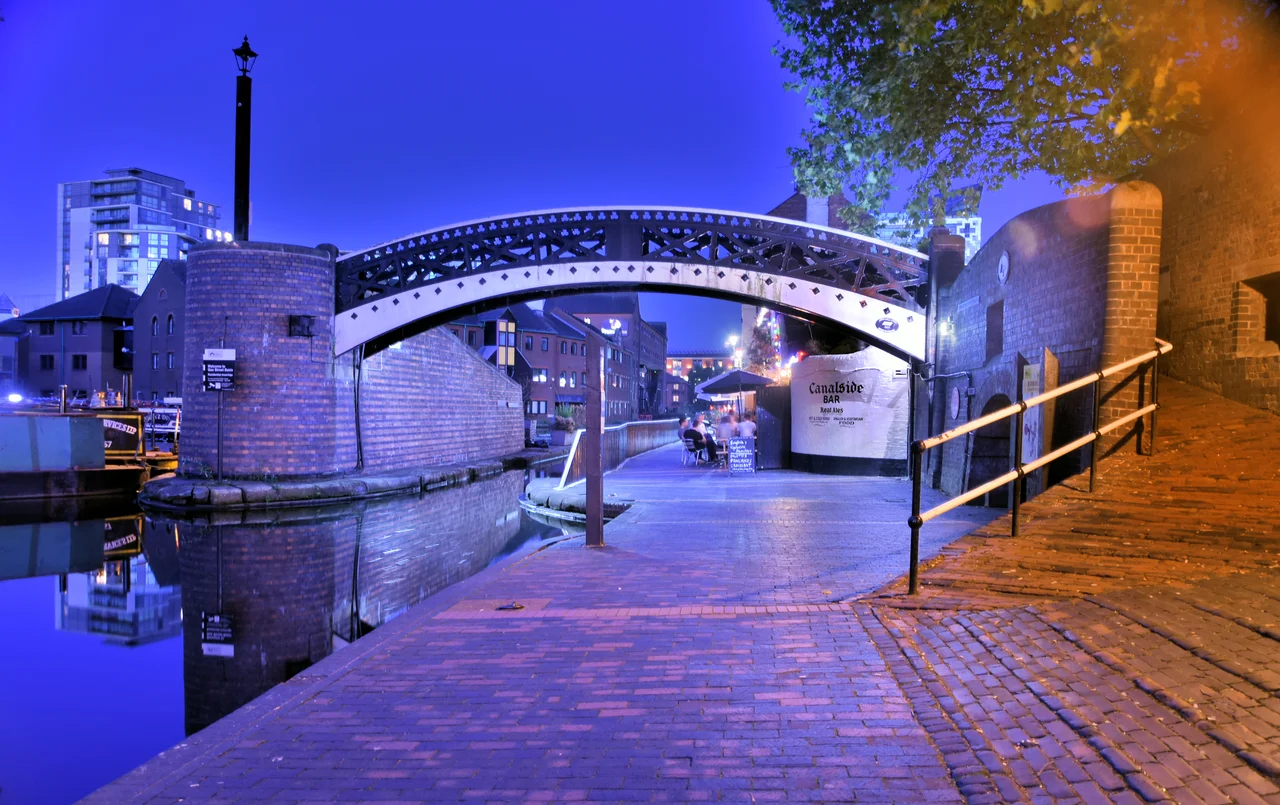

Gas Street Basin
For more than twenty years, two canals met in the centre of Birmingham and refused to touch. When the Worcester and Birmingham Canal arrived at this spot in 1795, the older Birmingham Canal Navigations company forbade them from connecting. The two waterways ran parallel for eighty-four yards with a stone wall seven feet wide between them, called the Worcester Bar. Boats coming from Worcester had to unload at one side and porters carried the cargo by hand to boats waiting on the other. Coal, iron, salt, and pottery moved in and out of Birmingham this way, lifted from one canal and dropped into the next, all because the BCN owners would not share their water. The barrier survived until 1815, when Parliament finally cut a lock through it.
Why the wall went up
Canals depended on water, and water was a scarce, jealously guarded asset. The Birmingham Canal had been completed in 1773 to bring coal from the Black Country mines into the city, and its owners had spent years getting the reservoirs and feeders right. When the Worcester and Birmingham Canal Company started digging a route south to the River Severn at Worcester, the BCN saw the danger immediately. Any boat passing between the two canals would carry BCN water away with it, a loss measured in lockfuls. So the BCN insisted on a physical barrier. Cargoes had to be manhandled across. It was slow, expensive, and infuriating to the ironmasters and coal merchants who paid the tolls, but the BCN held the upper hand for two decades.
The bar comes down
Pressure built throughout the early 1800s. The Worcester and Birmingham finally opened all the way to Worcester in 1815, and the lobbying by canal users became impossible to ignore. An Act of Parliament that same year forced the BCN to allow a lock through the bar, called the bar lock, with toll offices on either side so each company could collect its own dues. The Worcester Bar itself is still there. Modern narrowboats moor against both faces of it, painted in roses and castles, their chimneys smoking on winter mornings. A footbridge crosses from Gas Street to the bar, reconstructed to a 19th-century design by Horseley Ironworks in Tipton, whose elegant cast-iron canal bridges are scattered all across the West Midlands network.
From working basin to tourist heart
By the late 20th century Gas Street Basin had become a backwater in the literal sense. The factories that had filled the warehouses around the basin were closing, and most cargo traffic had long since vanished. Then in the 1990s Birmingham reinvented itself around its waterways. The basin was tidied, the warehouses refurbished, and new developments rose around the edges. The Mailbox, a giant former Royal Mail sorting office, became a shopping and hotel complex on the south side. Brindleyplace, named for the canal engineer James Brindley, climbed up on the north side with offices, restaurants, and the Ikon Gallery. Today the wall and ramp down from Gas Street, the Tap and Spile pub, and the neighbouring building are all Grade II listed, as is the Martin and Chamberlain building perched above the Broad Street Tunnel.
Pop culture and quiet evenings
Gas Street Basin had its small brush with show business in 1973, when it appeared in the Cliff Richard musical film Take Me High, in which Cliff plays a merchant banker sent to Birmingham who falls in love with a chef and helps her open a hamburger boat on the canal. The film is not a classic, but the basin photographs beautifully. A canal-side cottage at the basin also served as a character's home in the long-running ITV soap Crossroads, which was filmed in nearby studios from the 1960s through the 1980s. Most evenings the basin reverts to a quieter mode. Narrowboats line both sides of the bar, lights glow in cabin windows, and the only sound is water lapping against the hulls. A short tunnel under Broad Street leads through to Old Turn Junction, where the network spreads out into the Black Country beyond.
From the Air
Gas Street Basin sits at 52.4775 degrees north, 1.909 degrees west, in central Birmingham just south-west of New Street Station and the Bullring. From 1,500 to 2,500 feet AGL, look for the canal network forming a Y shape: the BCN Main Line heading north-west toward Smethwick, the Worcester and Birmingham heading south, and the basin where they meet. The Mailbox's brick mass and the modern glass blocks of Brindleyplace flank the water. Birmingham International (EGBB) is fourteen kilometres east-south-east, Coventry (EGBE) is twenty-five kilometres south-east. Birmingham's city-centre haze can reduce visibility on calm summer afternoons; winter brings frequent low overcast at 1,500 to 2,500 feet.
Nearby Stories
- Shepshed 8.5 km away
- Battle of Evesham 11 km away
- Hixon rail crash 12 km away
- Battle of Cropredy Bridge 12 km away
- Wenlock Priory 15 km away
- RAF Shawbury 16 km away
- Market Bosworth 17 km away