.jpg)
George Heriot's School
Cromwell's cavalry stabled their horses in the chapel. That is one way to begin the story of George Heriot's School, because it is one of the first things that ever happened inside it. The building was finished just in time to be commandeered as a hospital and barracks during the Cromwellian invasion of Scotland, and the children it was designed to shelter had to wait until 1659 to move in. They were thirty sickly orphans. The architect's drawings had imagined something grander. The institution itself turned out grander still.
The Goldsmith's Bequest
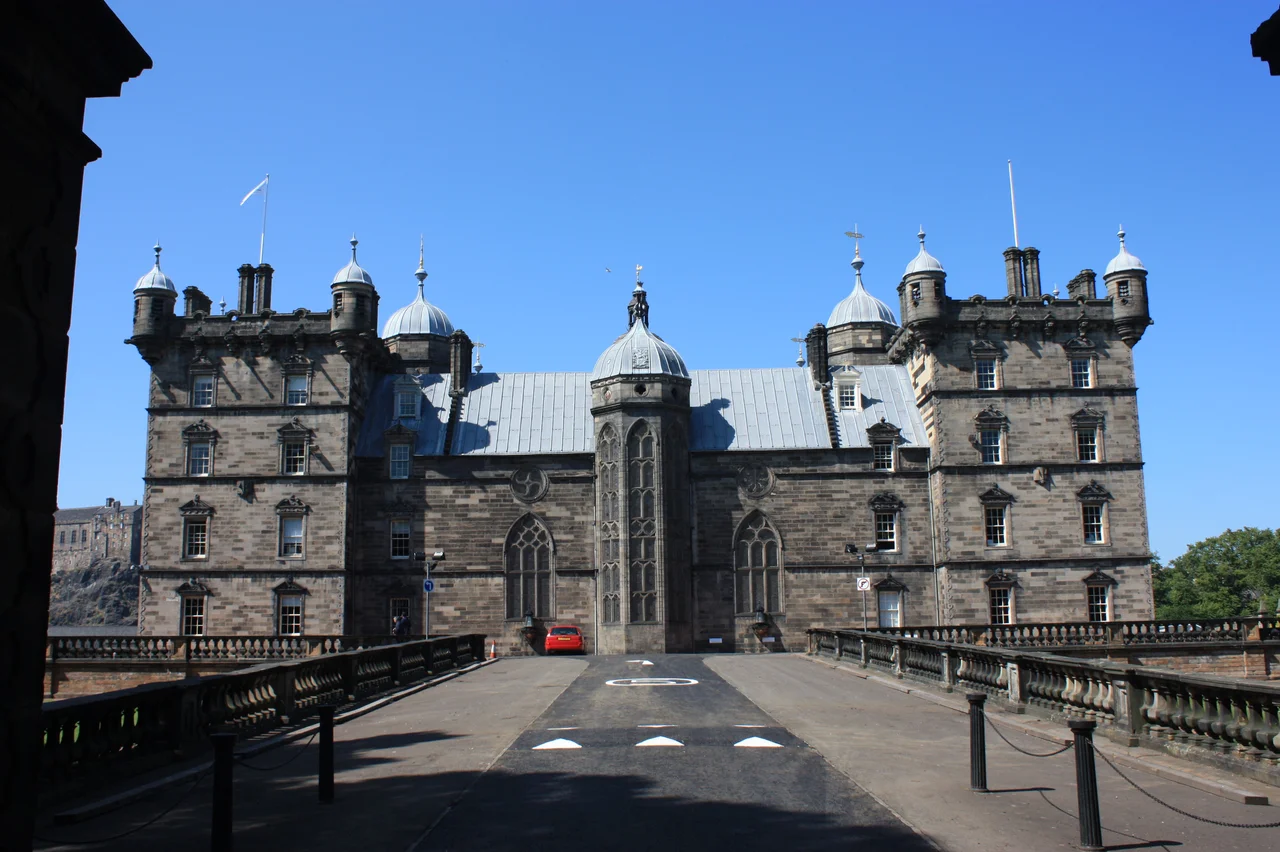
George Heriot was the royal goldsmith and personal banker to James VI of Scotland and I of England. When the king moved his court to London in 1603, Heriot moved with him, and made a great deal of money. When he died in 1624, he left his fortune to found a hospital - the seventeenth-century word for a charitable boarding school - that would educate poor fatherless boys of Edinburgh. Construction began on a site just outside the city walls in 1628. The master mason was William Wallace, working until his death in 1631; he was followed by William Aytoun, then John Mylne. In 1676 Sir William Bruce drew up plans for the central tower of the north facade, executed in 1693. The building rose as a turreted square around a great quadrangle, sandstone, foundation stone dated 1628. The boys who attended it called it the Wark - the Work.
Cromwell, Horses, Chapel
The Hospital was nearly finished when Cromwell's troops occupied Edinburgh in 1650, and the building made too convenient a barracks for the English forces to ignore. The chapel became a stable. Repairs followed. The Hospital opened to its first thirty children in 1659. As the Trust's investments grew over the decades, it took on more pupils than just the orphans for whom Heriot had specifically intended it - a slow drift from charity toward a more conventional school that would become contested ground in the nineteenth century. By the end of the 1700s the Trust had bought the Barony of Broughton outright, a huge tract of land on the slope below Edinburgh's new Georgian New Town. The rents from that land funded everything else. George Heriot's bequest had become its own ecosystem.
The Outdoor Schools
In 1846 fifty-two boys were dismissed for what the records call an insurrection - one of several disturbances of the 1840s that made critics question whether boarding orphans together was really good for them. Most of those boys turned out not to be true orphans but children whose families had used the Hospital as long-term care. Duncan McLaren, Lord Provost of Edinburgh and Chairman of the Hospital Governors from 1851, pushed to reduce numbers inside the Hospital and expand a separate network of free Heriot outdoor schools across the city. Between 1838 and 1885, the Trust built and ran 13 juvenile and 8 infant schools that took no fees at all. At their peak in the early 1880s these schools educated almost 5,000 Edinburgh children. Several of the school buildings - Cowgate, Davie Street, Holyrood, Stockbridge - copied architectural details from the original Lauriston Hospital. The mother building had become a city-wide pattern.
Reform and Heriot-Watt
The 1885 Balfour Commission imposed a settlement on the Trust. The Hospital became a day school charging modest fees. Up to 120 foundationers - poor boys aged seven and up, with preferential admission - continued to attend free. Greek was no longer taught. The outdoor school network was wound up. Some of the freed resources went to scholarships at the High School and the University of Edinburgh. Some went to a new technical college called Heriot-Watt - named for George Heriot and the inventor James Watt - which would become Heriot-Watt University in 1966. The split between school and college became formal in 1927. George Heriot's School and Heriot-Watt University are now separate institutions, but both still owe their existence to one childless goldsmith's will.
Foundationers, Still
Heriot's became coeducational in 1979. The school now has about 1,600 pupils and ranks consistently as one of Scotland's top performers in Higher exams. The original 1628 building, refaced in Craigleith ashlar in 1833, still surrounds its quadrangle just south of Greyfriars Kirk, with Edinburgh Castle towering directly to the north. The Telfer Wall - part of the seventeenth-century city defences - serves as part of the school's southern boundary. Notable alumni include the painter Sir Henry Raeburn, the Lord Chancellor James Mackay, the radio broadcaster Mark Goodier, the rugby internationalist Andy Irvine, and the rowing world champion Polly Swann. The school still admits foundationers - children who have lost a parent - free of charge. Carved over the main entrance is a depiction of a seventeenth-century classroom and the motto, in Latin, Deus nobis haec otia fecit. God hath given us this leisure. After 400 years, the leisure is still being given.
From the Air
George Heriot's School sits at 55.946N, 3.195W on Lauriston Place in central Edinburgh, in the Old Town just south of the High Street ridge. From the air look for the distinctive square Renaissance building with corner turrets surrounding a central quadrangle, directly south of Edinburgh Castle and adjacent to Greyfriars Kirkyard. Easy landmarks: the Castle is 200 m north, the Scottish National Museum and Chambers Street 300 m northeast, the Royal Infirmary site (now Quartermile) immediately south. Edinburgh Airport (EGPH) is 9 nm west. The school is overlooked by the castle from above, and itself overlooks the city. Best viewing altitude 2,000-3,000 ft. The building is most recognisable when sunlight catches the four corner turrets and the central tower simultaneously.
Nearby Stories
- Ardoch Roman Fort 2.2 km away
- Craignethan Castle 3.1 km away
- Haddington 3.8 km away
- Balvaird Castle 4.3 km away
- Battle of Kilsyth 9.4 km away
- Siege of St Andrews Castle 9.9 km away
- Neidpath Castle 11 km away
- Melrose Abbey 15 km away