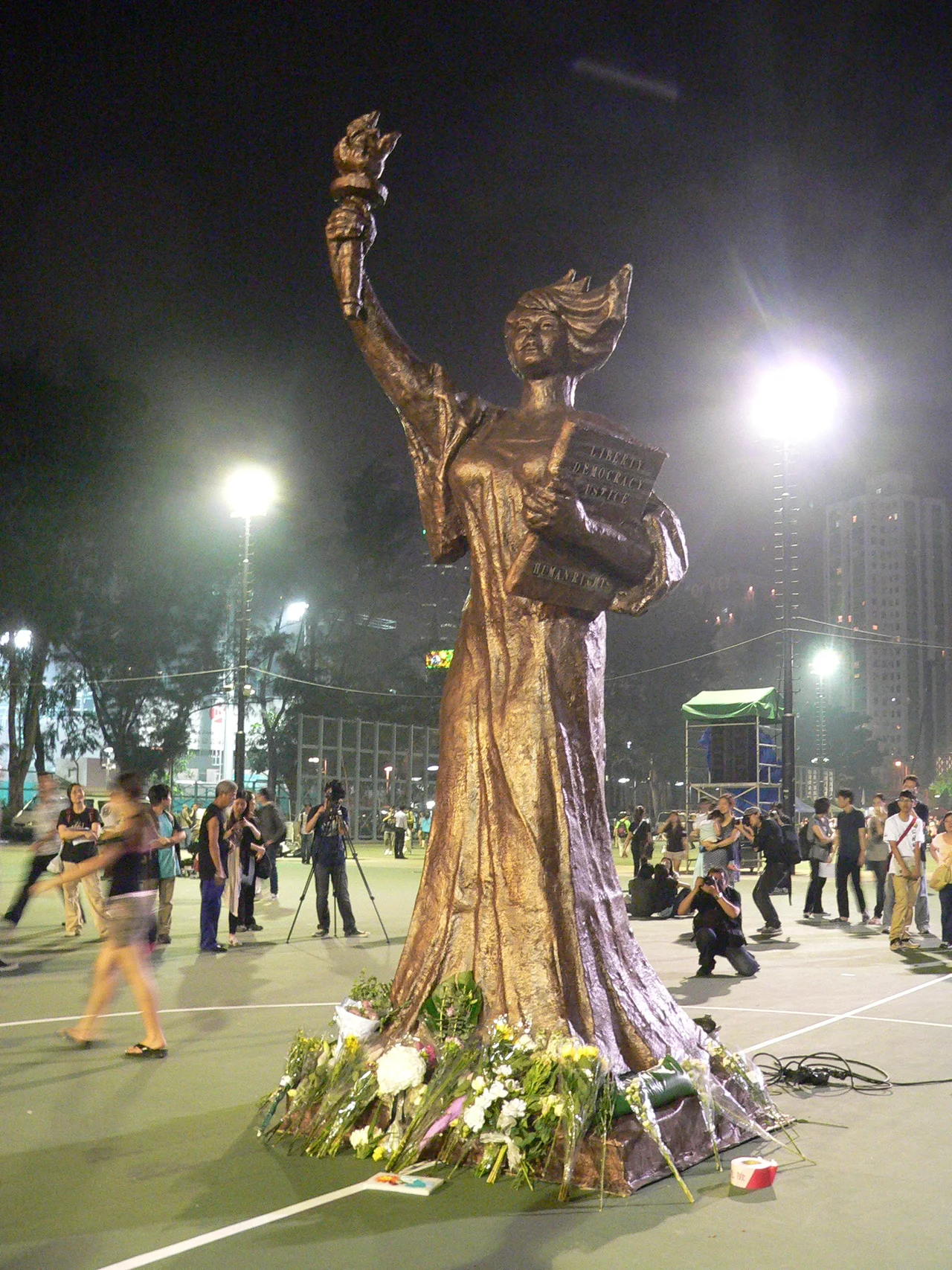

Goddess of Democracy (Hong Kong)
On the evening of June 4, 1989, soldiers destroyed a foam-and-papier-mâché figure in Tiananmen Square that students had spent days constructing by hand. The original Goddess of Democracy lasted less than five days. What followed, in the years and decades after, was a decades-long argument about whether that memory could survive — and in Hong Kong, that argument took on a peculiarly physical form: a 6.4-metre faux bronze statue sculpted by Chen Weiming, a US-based Chinese artist, that became the only replica of the original to find a home on Chinese soil.
The Statue and Its Meaning
Chen Weiming completed his statue in 2008, and before it arrived in Hong Kong it was displayed in front of the United States Congress. The dimensions were not accidental: 6.4 metres, matching the date of the crackdown — June 4. Every number carried weight. In mainland China, discussion of the 1989 protests is prohibited. But Hong Kong, under the principle of one country, two systems that followed the 1997 transfer of sovereignty from Britain to China, had maintained a different relationship with that history. For more than three decades after Tiananmen, Hong Kong held annual June 4 vigils — a tradition unbroken since 1989 — and the city's residents gathered by the tens of thousands in Victoria Park each year to light candles and observe a silence that the rest of China could not officially acknowledge.
Three Controversies in One Summer
In 2010, around the twenty-first anniversary of the Tiananmen crackdown, the statue became the centre of a sequence of political confrontations. Police seized it at a street rally in Times Square, Causeway Bay, citing safety regulations — a justification that protesters publicly called a pretext. Then Chen Weiming, traveling from the United States to inspect his work while it was in police custody, was turned away at the airport. His advocate, lawmaker To, was told at 3 am that no decision had been made; ten minutes before he received the legal expulsion order by fax, he was informed that Chen was already on a plane. University authorities at the Chinese University of Hong Kong initially refused to allow the statue on campus. Each refusal provoked a sharper reaction. By the time the annual vigil arrived, attendance had reached 150,000 — or 113,000 by the police's own count — a record attributed in large part to public anger over the seizures.
A Temporary Home That Lasted a Decade
Under sustained pressure from students, the Chinese University administration relented. The statue was given a 'temporary home' near the Chinese University exit of the MTR's University station, where it stood for over a decade. It was, for that time, an unusual thing: a public memorial to the Tiananmen dead that existed on Chinese soil, on a university campus, visible to anyone who passed through. Students and alumni treated it as a gathering point; families brought children to see it on June 4 each year. The word 'temporary' in the agreement always suggested the arrangement was provisional, contingent, subject to revision. That revision came on December 24, 2021, when Hong Kong authorities took the statue down.
What the Removal Meant
The removal of the Goddess of Democracy in December 2021 was one of several acts in a wider contraction of Hong Kong's civil space that accelerated after 2019. The night before, on December 23, the University of Hong Kong dismantled its own Tiananmen memorial — a column of bronze figures called the Pillar of Shame — that had stood on campus since 1997. The June 4 Museum, which had documented the events of 1989, closed under legal pressure. The annual vigil in Victoria Park, which had continued uninterrupted for 32 years, was banned, initially under COVID-19 restrictions and later as an ongoing prohibition. What had distinguished Hong Kong — the annual gathering, the museums, the statues — had, within a short span of time, ended. Chen Weiming's 6.4-metre figure is gone from the campus where it stood. The argument about memory continues elsewhere.
A Symbol That Outlasted Its Presence
The Goddess of Democracy is not a beautiful statue in the conventional sense. The original 1989 figure was built quickly, from available materials, by art students working in a square they knew might be cleared at any moment. Chen Weiming's replica carried that urgency forward — an artist in exile recreating something destroyed, measuring it in metres that spell a date. The fact that it became the centre of three overlapping controversies in a single month, that its seizure by police drew record crowds to a candlelit vigil, that its eventual removal made international news, suggests it succeeded as art in the deepest sense: it made people feel the weight of what it represented. The site at CUHK near the University MTR station is now empty. But people who passed it still remember where it stood.
From the Air
The Chinese University of Hong Kong campus sits at approximately 22.41°N, 114.21°E on the slopes above Sha Tin, in the New Territories. Flying from Hong Kong International Airport (VHHH) northeast toward Sha Tin, the CUHK campus is visible on the hillside above the Sha Tin valley at around 1,500–2,000 feet. The University MTR station — where the statue once stood near the exit — is identifiable along the East Rail line corridor. Sha Tin Hoi (Tide Cove) and Tolo Harbour lie to the east and north. The Lion Rock ridge marks the boundary between Sha Tin and urban Kowloon to the southwest.
Nearby Stories
- Chapel of St. Francis Xavier 3.5 km away
- Cuiheng 4.1 km away
- 2015 Shenzhen Landslide 16 km away
- Shunde 31 km away
- Wanshan Archipelago 37 km away
- Nanxiong Formation 96 km away
- Heyuan 149 km away
- Checheng Fu'an Temple 629 km away