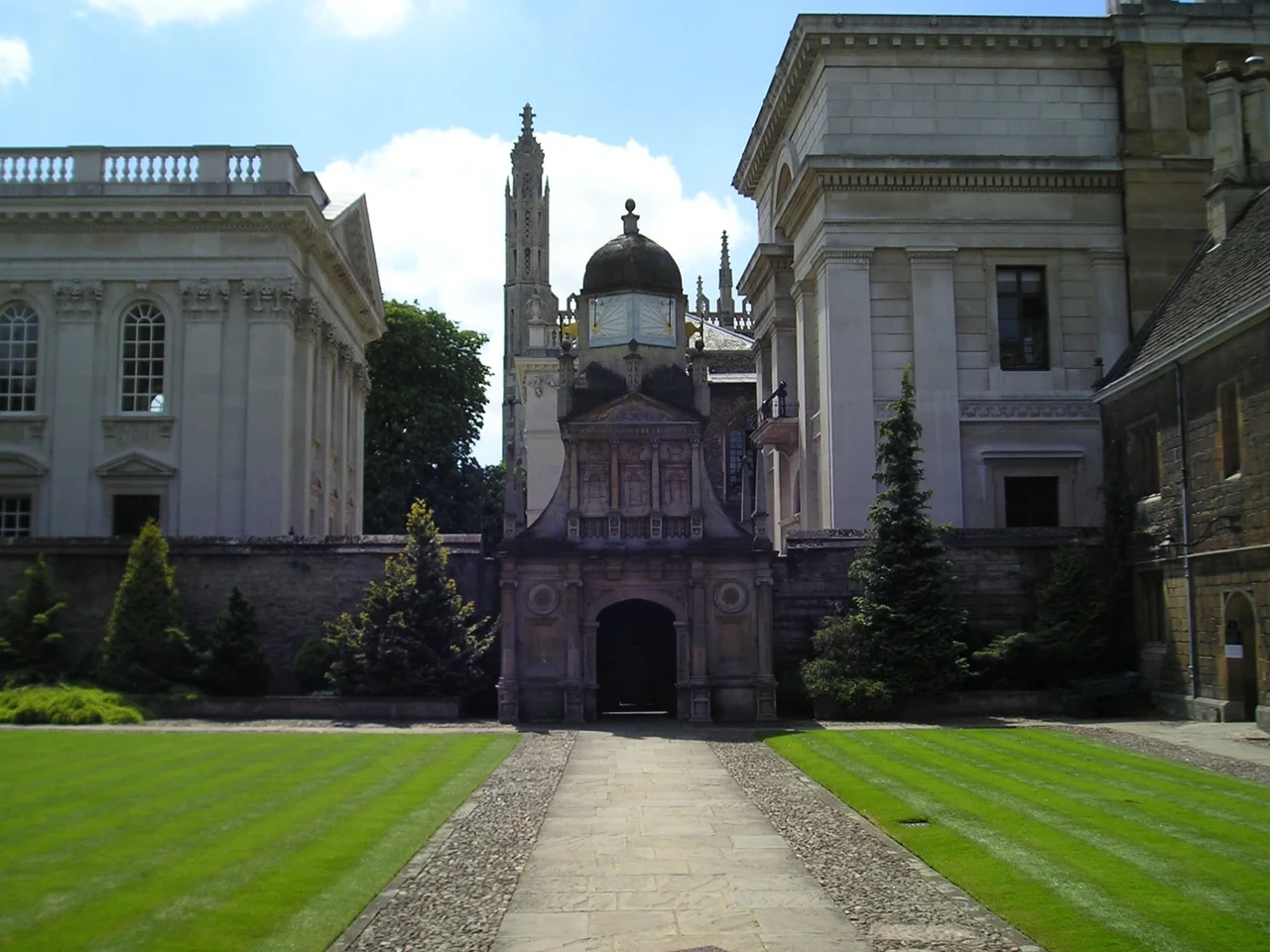

Gonville and Caius College, Cambridge
In January 1348, Edward III granted letters patent for a new college at Cambridge. In June of that same year, the Black Death arrived in England. Edmund Gonville had petitioned the king while plague was already crossing the Channel, and he got his college — twenty scholars, a modest beginning, tucked into the streets of a medieval university town that had no idea what was coming. Three years later Gonville was dead, possibly from the disease whose arrival coincided so precisely with his college's founding. The institution that bears his name, refounded two centuries later, has since sent fifteen Nobel laureates into the world, along with the co-discoverer of DNA, the man who proved penicillin worked, and the physicist who explained black holes from a wheelchair.
Edmund Gonville and the Plague Year
Edmund Gonville was a clergyman from a gentry family of French origin, wealthy enough to lend money to the king, and ambitious enough to petition for a college. He died in 1351, leaving behind a financially struggling institution that might have dissolved had the Bishop of Norwich not intervened. William Bateman stepped in, moved the college to its current location off Trinity Street, renamed it the Hall of the Annunciation of the Blessed Virgin Mary, and appointed his own chaplain as master. Bateman also took the opportunity to lease nearby land for his own college — Trinity Hall. The survival of what would become Gonville and Caius was not inevitable. It required a bishop with organizational energy, a willingness to share space, and the particular stubbornness that Cambridge colleges seem to breed.
John Caius and the Doctor's Rules
By the sixteenth century the college had fallen into disrepair. In 1557, it was refounded by Royal Charter under the name it bears today, through the efforts of alumnus John Caius. He had studied at the college in the 1520s and 1530s, then travelled to Renaissance Italy to study medicine at Padua under Andreas Vesalius — the great anatomist who had challenged the received wisdom of Galen. Caius returned to England as one of its most distinguished physicians, serving Edward VI, Mary I, and Elizabeth I. He refounded his old college, funded its expansion, and became its master — accepting no payment. He did, however, impose rules. Caius required that the college admit no one who was 'deformed, dumb, blind, lame, maimed, mutilated, a Welshman, or suffering from any grave or contagious illness.' He also built the college's famous three gates: the Gate of Humility, through which students entered; the Gate of Virtue, through which they passed daily; and the Gate of Honour, through which they received their degrees. He built a three-sided court, Caius Court, with an open side 'lest the air from being confined within a narrow space should become foul.' The man who had studied anatomy understood ventilation.
The Nobel College
Fifteen Nobel Prize laureates have studied or worked at Gonville and Caius — the second-largest number of any Oxford or Cambridge college. Francis Crick, who cracked the structure of DNA with James Watson, did his doctoral research here. James Chadwick, who discovered the neutron in 1932, was both a PhD student and later master of the college. Howard Florey, the Australian scientist who developed penicillin from Alexander Fleming's discovery into a usable medicine, did his doctoral work here. Antony Hewish won the Physics Nobel in 1974 for discovering pulsars. The economist Joseph Stiglitz, who wrote foundational work on information asymmetry in markets, held a fellowship here. Stephen Hawking, Lucasian Professor of Mathematics, was a fellow of the college from 1965 until his death in 2018. The Stephen Hawking Building, which opened in October 2006 on the college's West Road site, provides accommodation for 75 students and eight fellows.
A Flag at the South Pole
On the wall of the college's dining hall hangs a college flag — a small piece of cloth that travelled farther than most. In 1912, Edward Wilson, a Cambridge man and member of Robert Falcon Scott's Terra Nova Expedition, carried the Gonville and Caius flag to the South Pole. Wilson was one of the five men who reached the pole only to find that Roald Amundsen had beaten them by a month. All five died on the return journey. The flag came back to Cambridge. It hangs in the hall where, six nights a week, students in gowns sit at long tables, listen to the Latin benediction, and eat the three-course meal that the college has provided since the Middle Ages. The minimum dining requirement — 31 dinners per term — is still enforced. Some traditions at Caius are easier to understand than others.
From the Air
Gonville and Caius College is located at 52.2059°N, 0.1176°E in the heart of Cambridge, on Trinity Street just north of King's College. The college's historic court buildings are part of the compact medieval university centre that is identifiable from altitude by its distinctive spires and the River Cam running to the west. Cambridge is approximately 80 km north of London. London Stansted Airport (EGSS) is 40 km to the south; Cambridge City Airport (EGSC) is a general aviation field 3 km to the east. The Backs — the lawns and river behind the university colleges — are visible from altitude to the west of the historic core.
Nearby Stories
- Kentwell Hall 2.5 km away
- Thetford Hoard 2.8 km away
- King's Ely 6 km away
- Bedford 7.8 km away
- White House Farm murders 13 km away
- Oundle 14 km away
- Hemel Hempstead 14 km away
- North Weald Airfield 15 km away