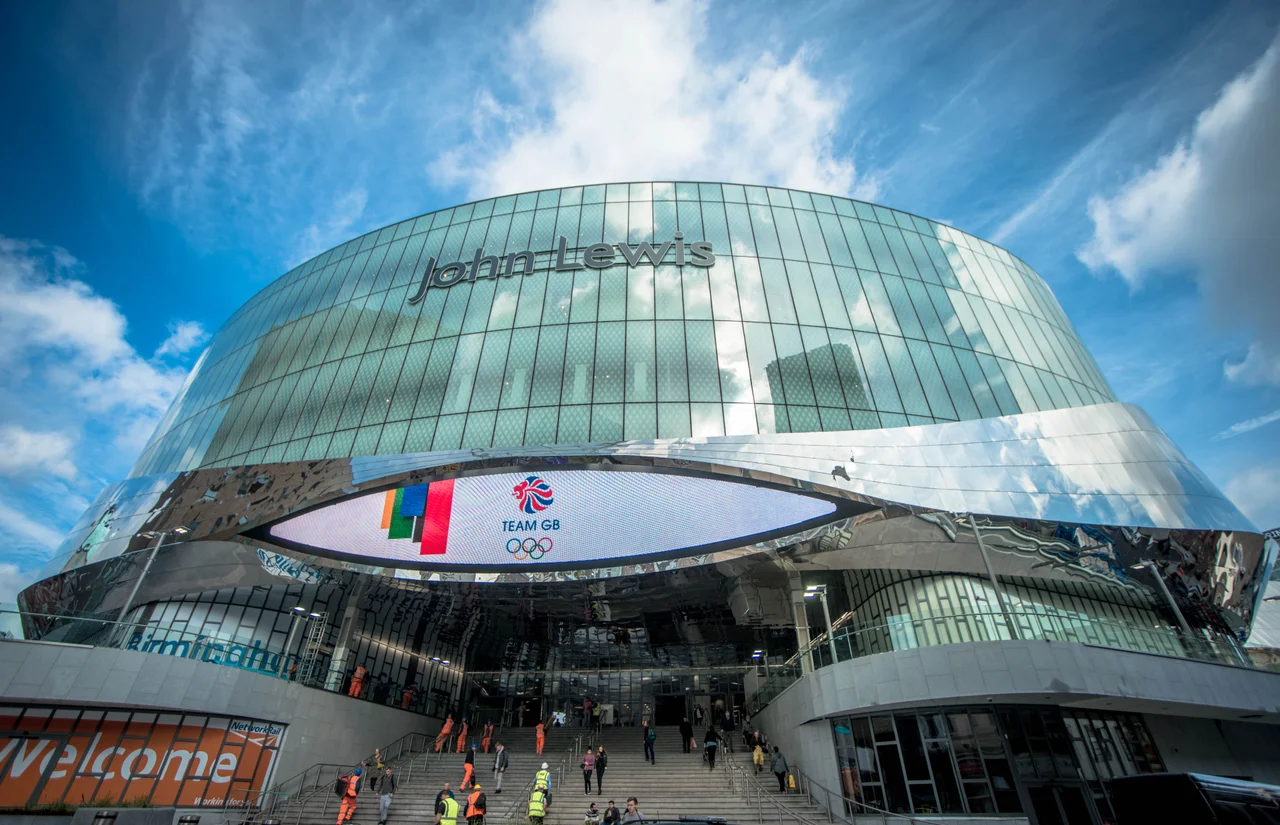

Grand Central, Birmingham
Most British shopping centres do not change their names. Most do not get torn open while trains continue to run underneath them. Grand Central has done both. When it opened in 1971 it was called the Birmingham Shopping Centre, a brutalist slab sitting on top of the rebuilt New Street Station. In 1988 someone decided it needed a more aspirational identity and renamed it the Pallasades. By the 2010s the Pallasades had become a byword for tired retail, the kind of place that local newspapers wrote about with the word grim. In 2014 Birmingham gutted it. When it reopened in September 2015 as Grand Central, the centrepiece was a soaring transparent atrium roof, and the trains underneath had never stopped.
The third time around
The original 1971 building came at the end of a long Birmingham reinvention. The Victorian New Street Station had been demolished in the late 1960s and replaced with a station and shopping deck designed in the spirit of Le Corbusier and the Smithsons. The shopping deck became the Birmingham Shopping Centre, then the Pallasades, then by general consensus a problem. The Gateway Plus redevelopment scheme, costing roughly six hundred million pounds across the whole site, took six years of enabling work by demolition contractor Coleman and Company before the new build could even begin. New Street itself was reclad in undulating stainless steel that locals quickly nicknamed the silver sausage. Grand Central rose above as a complete reset, with sixty stores across five hundred thousand square feet and John Lewis as anchor tenant.
The ETFE roof
The defining feature of the new centre is the atrium ceiling, a Texlon pillow membrane made of ethylene tetrafluoroethylene, a fluorinated polymer better known by its abbreviation ETFE. The same material covers the Beijing Aquatics Centre, the Eden Project domes in Cornwall, and Allianz Arena in Munich. It weighs about one percent of equivalent glass, transmits a remarkable amount of daylight, and self-cleans in the rain. Below it, the mall pulled in retailers and food chains new to the city, including Cath Kidston, The White Company, Kiehl's, and Tapas Revolution. The Grand Central tram stop on the West Midlands Metro opened across the street in May 2016, completing a transport interchange where rail, tram, taxi, and bus converge on a single quarter-mile.
John Lewis leaves, Hollywood arrives
Hammerson and the Canada Pension Plan Investment Board bought Grand Central from Birmingham City Council in January 2016 for 335 million pounds, packaging it with the neighbouring Bullring as the United Kingdom's largest city-centre shopping destination, branded Bullring and Grand Central and connected by a footbridge called LinkStreet. Then in July 2020 John Lewis announced that its Grand Central store, which had been closed during the COVID-19 lockdown, would not reopen. The loss of the anchor tenant rattled the city, although the empty floors were eventually backfilled. Birmingham got a different kind of headline in 2023 when Grand Central appeared in Mission: Impossible Dead Reckoning Part One, with Tom Cruise running and a chase sequence shot in the atrium. For a building still finding its identity, an action sequence under that white pillow roof was as good a confirmation as any.
From the Air
Grand Central and Birmingham New Street sit at 52.478 degrees north, 1.899 degrees west, dead-centre in the city. From 1,500 to 2,500 feet AGL, look for the silver undulating skin of the New Street facade and the white ETFE atrium catching daylight beside it. The Rotunda cylinder of the Bullring is a half-block south-east; the brutalist library replaced by the Library of Birmingham's terracotta circles is north-west. Birmingham International (EGBB) lies thirteen kilometres east-south-east, Coventry (EGBE) twenty-five kilometres south-east. Sunny days bring brilliant reflections off the metal cladding; overcast days are far more common. The Birmingham Snow Hill flight pattern can route VFR traffic over central Brum at low altitude on calm days.
Nearby Stories
- Shepshed 8.5 km away
- Battle of Evesham 11 km away
- Hixon rail crash 12 km away
- Battle of Cropredy Bridge 12 km away
- Wenlock Priory 15 km away
- RAF Shawbury 16 km away
- Market Bosworth 17 km away