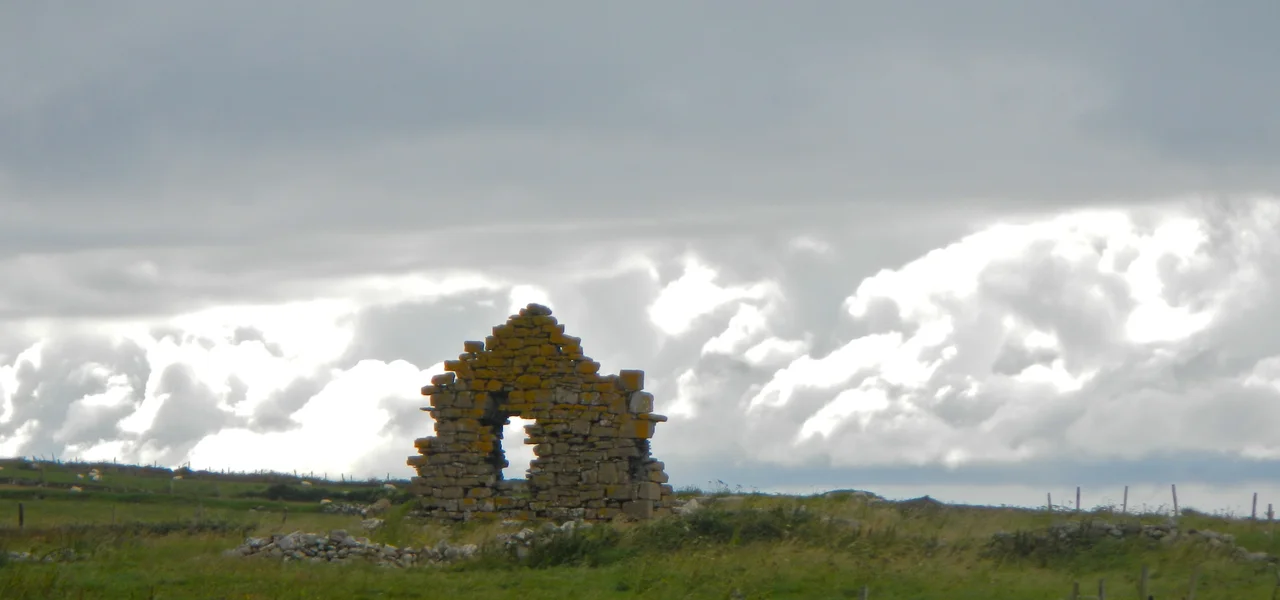

Grange
On a September night in 1588, three Spanish galleons broke up on the sand at Streedagh strand. La Lavia, La Juliana, and the Santa Maria de Vision had been driven north around Ireland by the same storms that had already shattered the Armada. Survivors crawled ashore into a country where English garrisons paid bounties for Spaniards. One of them, Captain Francisco de Cuellar, would survive somehow and write it all down. Four centuries later, in 1985, marine archaeologists found the wrecks where the captain said they had gone down, just off the sandy beach at the edge of a small Sligo village called Grange.
Between Benbulben and the Sea
Grange sits on the N15 between the limestone wall of Benbulben mountain and the long curve of the Atlantic. The old village is on the hill to the north of the present one. The land originally belonged to the Cistercian monastery of Boyle, off in County Roscommon, and through the medieval period the village was a stronghold of the O'Harte and O'Connor families. The O'Hartes provided cavalry for the O'Connor Sligo lords of Carbury-Drumcliff. The Annals of Ireland record that in 1604 a 'new castle and 7 cottages were built by Hugh O'Hart in the town of Grange.' After the 1641 rebellion, the land was granted to Thomas Soden, probably an officer in one of Colonel Richard Coote's Cromwellian regiments, in lieu of arrears of pay. The castle is gone now. The land remains.
Cuellar's Story
When La Lavia went down, Francisco de Cuellar clung to a hatch cover and washed ashore. Around him, hundreds of his shipmates drowned in the surf or were killed by locals stripping the dead for clothes and metal. The English garrison in North Sligo was hunting Spaniards. Cuellar made his way inland, naked, freezing, lucky to be alive. He found shelter with the chieftains O'Rourke and McClancy, who shared what they had despite the risk. He walked from Sligo to Antrim, took a boat to Scotland, and eventually made it home to Spain, where he wrote the only detailed first-person account of what happened to the Armada in Ireland. In spring 2015, after storms uncovered more of the wreckage, divers from the Department of Arts, Heritage, and the Gaeltacht recovered a bronze cannon decorated with an image of Saint Matrona of Barcelona. The maker's mark belonged to the Genoese gunfounder Girardi Dorino II. The cannon was cast in 1570, the same year La Juliana was built. The third wreck's identity, the Irish government declared, was now beyond doubt.
Eliza Becomes Lola
Eliza Rosanna Gilbert was born in Grange in 1821. By her mid-twenties she had reinvented herself as Lola Montez, an exotic Spanish dancer, and was performing across Europe with a backstory that contained almost no truth. In 1846 she met King Ludwig I of Bavaria. He was sixty, married, and besotted. He made her Countess of Landsfeld, then Duchess. Bavarian citizens tolerated their king's romantic adventures until his Irish-born duchess began meddling in state affairs. By 1848, Europe's year of revolutions, Ludwig had been forced to abdicate. Lola fled. She never saw him again. She kept the title. She lived another twenty-three years, lectured on her own scandalous life across America, and died in New York in 1861. Whatever Grange expected from one of its daughters, this was not it.
The Strand Today
Streedagh strand is now a Special Area of Conservation, a long sweep of sand with dunes behind it and a salt water lagoon. A monument near the beach commemorates the Armada wrecks. In 2018, a Spanish Armada interpretive centre opened in Grange's old courthouse. The strand is also one of the better surfing spots on the Sligo coast, though it sits in the shadow of bigger names just to the north at Mullaghmore and Bundoran. North Sligo Sports Complex sits in the village, with an indoor football pitch and a running track where North Sligo Athletic Club trains, including Mona McSharry, the Olympic medallist swimmer who grew up here. The local GAA club celebrated its centenary in 2007.
Modern Quirks
In January 2012, early-twentieth-century Mills type 36 grenades were discovered at a private home in Grange. In August of the same year, the village made national news when a herd of 105 sheep was stolen. In 2019, a sperm whale washed up on the shore. The Church of Mary Immaculate, with its five-bay nave and pyramidal roof topped with a limestone cross, combines modern construction with traditional lancet windows. North of the village, the pitch called Molaise Park is where the GAA teams train, named for the saint of nearby Inishmurray island. To the south is Drumcliff and Yeats's grave. To the north, Cliffoney and Mullaghmore. The N15 runs through all of them, threading a coastline that has been collecting stories for a very long time.
From the Air
Located at 54.40°N, 8.52°W on the N15 between Drumcliff and Cliffoney. Best viewed at 2,000-3,500 feet to catch Streedagh strand and the Atlantic on the west, Benbulben to the east. Nearest airport is Sligo (EISG), 15 km south; Donegal (EIDL) 40 km north. The long sand beach at Streedagh is the navigation landmark, with the village set back from the dunes.
Nearby Stories
- Roman Catholic Diocese of Killala 3.2 km away
- County Leitrim 6.2 km away
- Glencolmcille 8.3 km away
- Ballymote 8.5 km away
- Caves of the Tullybrack and Belmore Hills 15 km away
- Ballycastle, County Mayo 20 km away
- Castlederg 32 km away
- RMS Empress of Britain (1930) 80 km away