_p098_COBAR_CHESNEY_COPPER_AND_GOLD_MINE.jpg)
Great Cobar mine
Two Aboriginal men named Boney and Frank knew where the water was. In the winter of 1870 they were guiding three bore-sinkers - two Danes and a Scot - south through the dry country between waterholes, the kind of knowledge that meant the difference between life and death out here. Camped at the Kuppar waterhole, the party noticed blue and green streaks in the rocks. The colours were no secret: this was a campsite where local people gathered those very minerals for body paint. But the strangers saw money. From that waterhole grew the Great Cobar mine, and for half a century it was one of the great copper mines on Earth.
From Frying Pan to Fortune
The first proof was almost comically crude. One of the discoverers, Charles Campbell, smelted a sample of ore in Bourke "with the aid of a frying pan and the forge bellows" and pulled out an abundance of copper. In October 1870 the men pegged out forty acres around the outcrop, and a Bourke businessman named Joseph Becker paid ten pounds to secure it. None of the original discoverers made a fortune - they sold out, kept inns and hotels, and faded from the story. Only in recent decades have Boney and Frank, whose knowledge made the whole thing possible, been formally acknowledged for their part in the find.
The Hungry Furnaces
By the early 1880s the Great Cobar was a giant. Around 650 people worked it - miners hewing the lode, smelter hands tending the furnaces, and an army of 150 wood-carters hauling fuel. The furnaces were ravenous: fourteen of them burned through 70,000 tons of firewood a year, stripping the surrounding plains bare and forcing a steam tramway ever further out to reach standing timber. Water had to be bought and carted in by the tankload. At its height the mine led all of Australia in copper production, processing ore at a thousand tons a day, and producing gold and silver as a bonus - the copper here carried roughly two ounces of gold per ton, refined far away at a purpose-built electrolytic plant in Lithgow.
Boom, Bust, and the Mightiest Stack
Copper is a cruel master, its price swinging on distant manipulations in London and New York. The mine fell idle in 1889 when the price collapsed, roared back under a Sydney syndicate in the 1890s, then was sold to British investors in 1906 for 800,000 pounds. By 1912 the operation employed over two thousand workers and raised a 64-metre chimney stack - called in its day Australia's mightiest. But the new company was over-capitalised and badly run, and the First World War tipped it over. Great Cobar mine closed in 1919 and never reopened. What followed was devastating: by 1924, around 700 houses had been demolished and carted away, another 700 stood in ruins, and the manager's grand twelve-room residence could be rented for a shilling a week - with no takers.
What the Fire Left
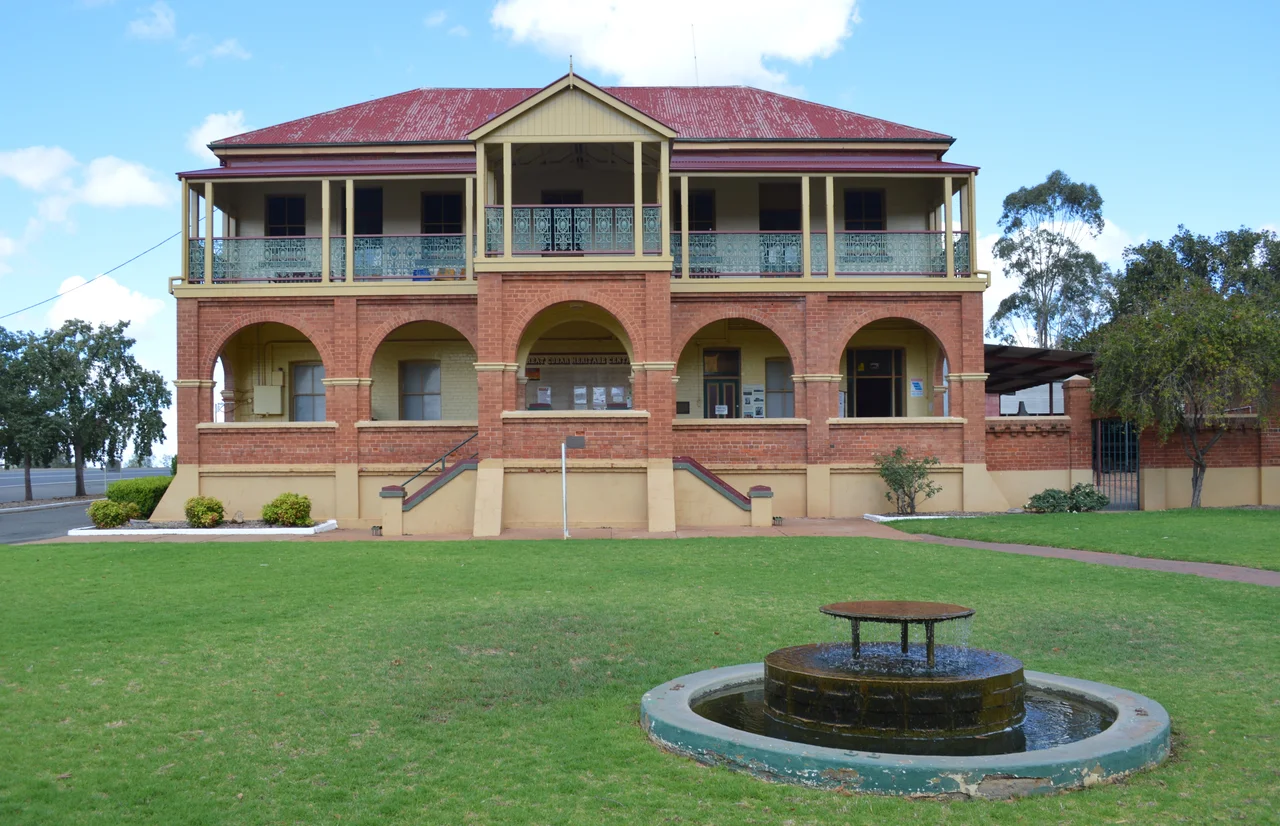
In September 1933 a deliberately lit fire tore through the abandoned works, setting the poppet head and ore bins ablaze and sending burning debris down the main shaft until the town choked on sulphurous smoke. The great chimney was later blown up for its bricks. Yet the site refuses to disappear. A vast black slag dump still spreads across the southern edge of town, its specimens streaked with copper colour. An open quarry has filled to become a lake. And the mine's 1912 administration office survives - saved by a local man who bought it in 1925 when it would otherwise have been demolished - now serving as the Great Cobar Museum and Visitor Information Centre. In 2022, planning permission was granted to mine copper, silver, and gold deep beneath the old workings once more, a kilometre down, leaving the historic site itself undisturbed.
From the Air
The Great Cobar mine site sits on the immediate southern and southeastern edge of Cobar township, at roughly 31.50 degrees S, 145.83 degrees E. From the air, the unmistakable landmark is the enormous dark slag dump and the water-filled open quarry beside it; the former administration office (now the Great Cobar Museum) stands at the site's northwestern corner near the town's entrance sign, itself supported on a relic mine structure. Cobar Airport (ICAO YCBA) is about 5.6 km southwest; Nyngan (YNYN) and Bourke (YBKE) are the nearest alternates. Skies are clear over 150 days a year. Note that much of the historic mine site is fenced and off-limits at ground level for safety reasons - best appreciated from altitude or from the museum.
Nearby Stories
- Mount Drysdale, New South Wales 19 km away
- Nymagee 47 km away
- Louth, New South Wales 87 km away
- Paroo-Darling National Park 123 km away
- Ivanhoe 147 km away
- Roxy Theatre and Peters Greek Cafe Complex 443 km away
- Bingara 454 km away
- Lake Burley Griffin 469 km away