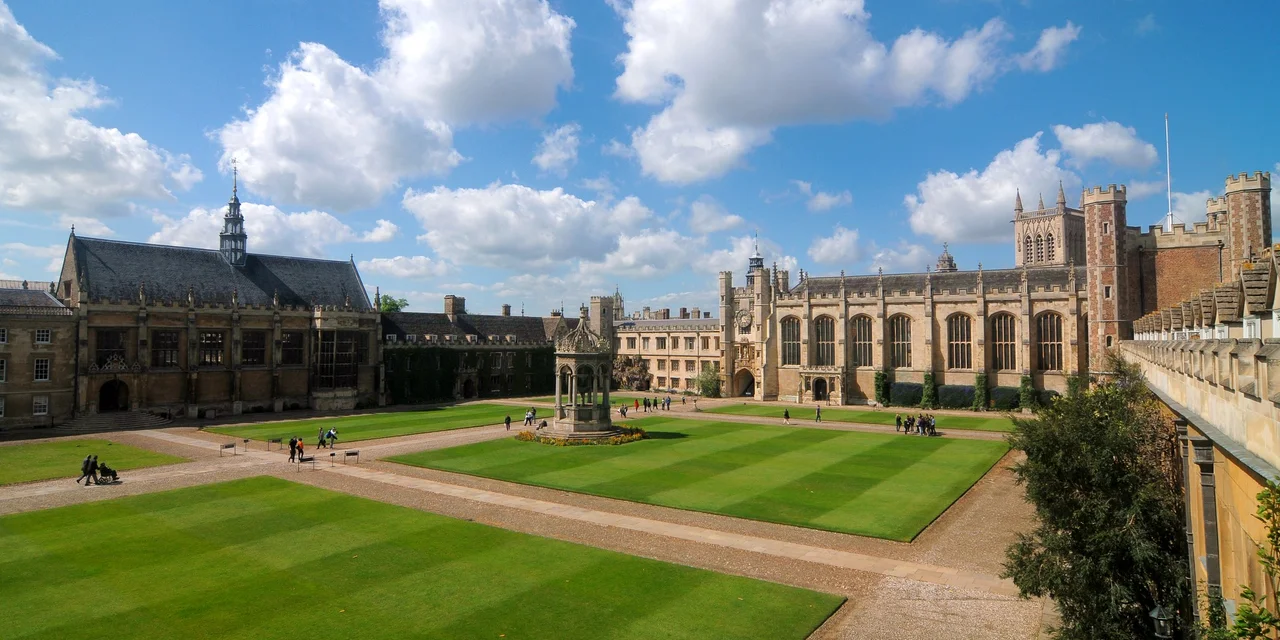

Great Court, Trinity College, Cambridge
Every year on the day of the Matriculation Dinner, a clock strikes noon — twenty-four chimes in all, because tradition demands it strike twice — and students hurl themselves around the cobbled perimeter of a courtyard in a desperate race against time. The Great Court Run is preposterous, beloved, and mostly unsuccessful. In the time it takes the Trinity College clock to ring out, a runner must cover 339 metres of flagstone. Only a handful of people have ever done it. The court itself, meanwhile, has been standing here since the early 17th century, magnificently indifferent to the spectacle.
The Largest Court in Europe
Thomas Nevile, Master of Trinity College, completed Great Court in the early 17th century by doing something ingenious and slightly maddening: he rearranged the existing buildings of several separate institutions into a single unified space. The result encloses approximately 1.8 acres — a space so large it is reputed to be the biggest enclosed courtyard in Europe. Four ranges of stone buildings frame the court, their sides measuring between 78 and 105 metres. At its heart sits an ornate Renaissance fountain, built during Nevile's time and fed by a pipe running all the way from Conduit Head in west Cambridge. The fountain still flows today. The Great Gate, begun in 1490, anchors the north range and contains the famous statue of Henry VIII — though the sceptre Henry holds is a chair leg, substituted by a student prank in the 19th century and never put right.
Newton's Rooms and the Clock That Strikes Twice
Isaac Newton had rooms at E staircase, in the northeast corner of the court. He lived and worked here during some of the most productive years in the history of science. In the centre of the north range, a clock chimes every 15 minutes and strikes the hour twice — once for Trinity, once for St John's College, because the Master who installed it in the 17th century wanted to honour both the college he led and the college where he had studied. The effect is that anyone counting the chimes gets twice the expected number, which is the entire point of the Great Court Run: noon brings not twelve but twenty-four strikes. Even Olympic athletes have fallen short. When Sebastian Coe attempted the feat in 1988, he crossed the finish line approximately 12 metres behind the final stroke — 46 seconds of running against 44.4 seconds of chimes.
Royal Foundations and a Chapel Worth Seeing
The chapel that closes the fourth side of the court was begun by Mary I in 1554, in memory of her father Henry VIII. Its ante-chapel contains statues of many of Trinity's most famous members, including Louis-François Roubiliac's celebrated sculpture of Newton — white marble against dark stone, depicting him at his most serious and most thoughtful. The chapel organ was built by the Swiss firm Metzler in 1975, one of only two instruments by this maker in Britain, and it sits within a restored case built by Bernard Smith in the late 17th century. Queen's Gate on the south range is named for Elizabeth I, a patroness of the college. Every corner and gateway here carries a name, a coat of arms, a story of royal or scholarly connection stretching back six centuries.
The Race and Its Legend
The Great Court Run was popularised, and then slightly misrepresented, by the 1981 film Chariots of Fire. The film shows Harold Abrahams attempting the race — in fact, Abrahams never ran it, and the footage was shot at Eton, not Trinity, because the college declined to allow filming. The true record of pre-2007 success belongs to Lord Burghley, who completed the circuit in 1927. Sebastian Coe came closest among modern elite athletes in 1988, falling just short. In 2014, student Cornelius Roemer beat the clock on the cobbles route, becoming the first person to complete the official run in the 21st century. In 2019, George Mears also beat the clock, though he was the first to note that the clock ran slow that year. The run is held every Matriculation Day. There is also a costumed version, open to all.
From the Air
Great Court lies at the heart of Trinity College, Cambridge, at approximately 52.207°N, 0.117°E. Cambridge city centre is clearly visible from low altitude; the college's distinctive courts and chapel can be identified from 1,000-2,000 feet in clear conditions. Cambridge City Airport (EGSC) is approximately 2 nautical miles to the east-northeast. The court itself is a large rectangle of pale stone and grass, easily picked out against the surrounding city.
Nearby Stories
- Kentwell Hall 2.5 km away
- Thetford Hoard 2.8 km away
- King's Ely 6 km away
- Bedford 7.8 km away
- White House Farm murders 13 km away
- Oundle 14 km away
- Hemel Hempstead 14 km away
- North Weald Airfield 15 km away