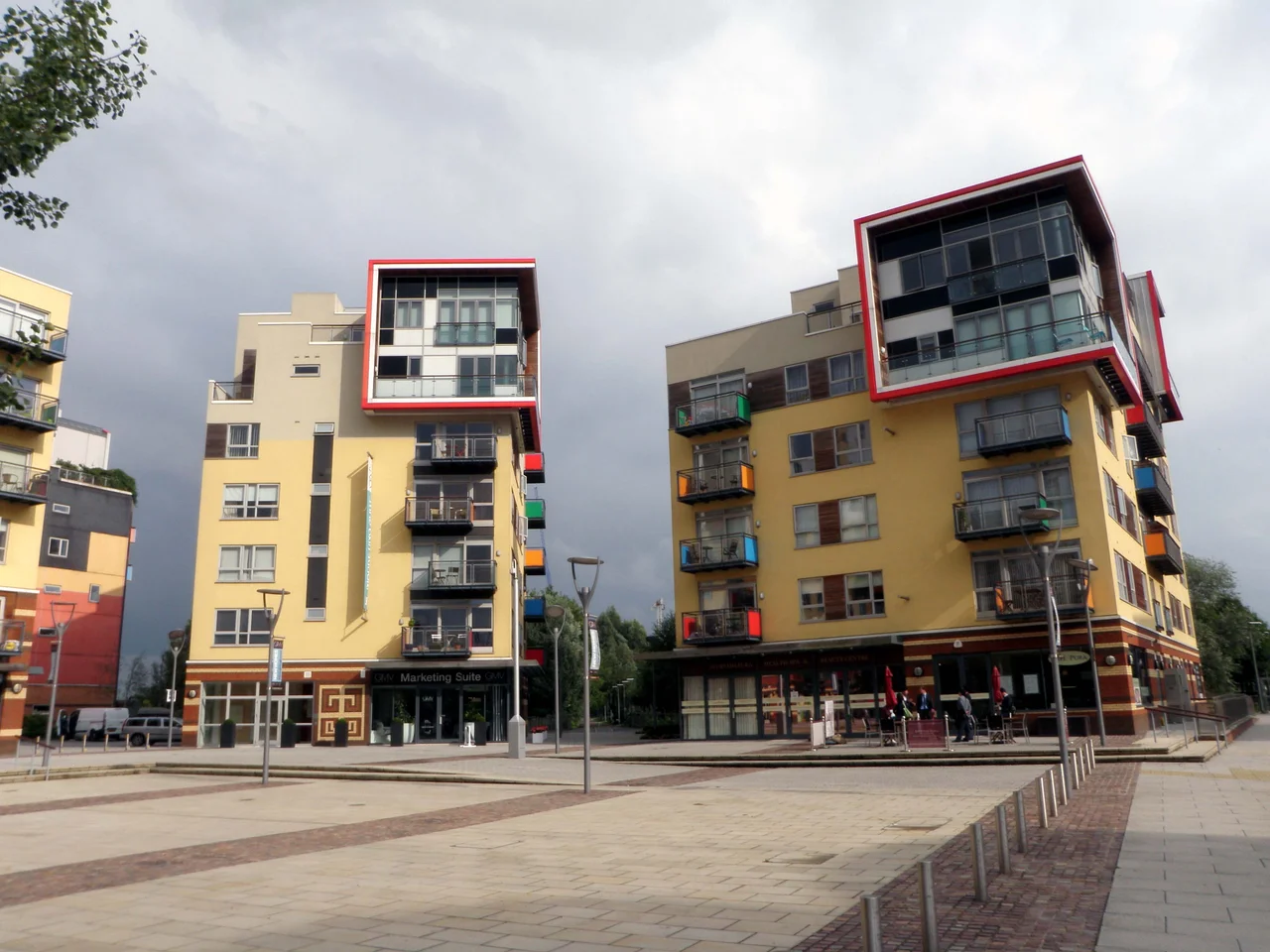

Greenwich Millennium Village
On a stretch of the Greenwich Peninsula that for over a century produced the gas that lit London - and the contamination that came with it - the new century built a village. Greenwich Millennium Village was meant to be a flagship: an urban village laid out on the brownfield site of East Greenwich Gas Works, with the explicit aim of cutting primary energy use by 80%, integrating affordable housing, and demonstrating that British cities could build sustainably and beautifully at scale. The architecture lead was Ralph Erskine, the British-born Swedish architect known for cold-climate housing, and the timing aligned with the larger Millennium Dome project on the same peninsula.
Why Here
The site sits on the southern banks of the River Thames, about one mile upstream (west) from the Thames Barrier and immediately south of the dome that became the O2. East Greenwich Gas Works had occupied the peninsula since the late nineteenth century - a vast industrial operation that ringed London with coal-derived town gas and left the peninsula thoroughly polluted. By the 1990s the site was effectively a contamination problem looking for a development solution. The Greenwich Peninsula regeneration, of which Millennium Village was one element, was the largest brownfield project in Europe at the time. Adjacent to the village, the Greenwich Peninsula Ecology Park was created on what had been industrial wasteland - a small, deliberate wetland that now supports kingfishers, dragonflies, and the kind of wildlife that nobody would have associated with this stretch of the Thames a generation ago.
Erskine, Energy, and the Plan
Ralph Erskine, who had spent most of his career in Sweden, brought a Scandinavian sensibility to the master plan. Erskine partnered with EPR Architects Ltd as executive architect. The development was funded under the Millennium Communities Programme through English Partnerships (now renamed Homes and Communities Agency). The targets were specific and ambitious: primary energy use cut by 80% using low-energy building techniques and renewable energy technologies. About 20% of the units completed are affordable housing, owned by a housing association which rents to those in social need and to key workers under shared ownership rent-to-buy purchase schemes. By 2010, 1,098 flats and houses had been built, along with a village square with shops, a primary school, and a GP surgery. The development was being delivered by a consortium of Countryside Properties and Taylor Wimpey, with completion of the full village planned for around 2015. Some early residents complained, in 2005, that the noise insulation in the Kilby Court blocks was inadequate - one of the small but real friction points of putting people into experimental architecture and then expecting them to live in it like everyone else.
Getting There
The transport links woven into the village were as much a part of the plan as the buildings themselves. North Greenwich station on the Jubilee line, opened for the dome in 1999, is the nearest tube. London buses fan out from there - routes 108, 129, 132, 161, 180, 188, 335, 422, 472, and 486 all serve the area. Charlton and Westcombe Park railway stations connect to Dartford, London Cannon Street, and London Charing Cross via Southeastern services. The North Greenwich pier handles Thames Clippers boats to Embankment, central Greenwich, and Woolwich Arsenal. In June 2012 the London Cable Car opened, connecting North Greenwich with the Royal Docks across the river - its southern terminal sits just north of the village, on Edmund Halley Way. For a small modern neighbourhood, the multi-modal transport saturation is unusual - reflective of the millennium-era ambition to make urban villages dense, walkable, and connected to the rest of the city by something other than the car.
Cameras and Quiet Life
Filmmakers found the development photogenic almost immediately. Lady Leshurr filmed the video for Queen's Speech Ep.4 here. The 2006 BBC One ident Windows - the one where residents seemed to use their windows to reflect sunlight into a ring - was filmed at Greenwich Millennium Village under director Matthias Hoene; it ran until 2008 to introduce daytime programming. Visually the village has the slightly impossible feel that flagship developments often do: too colourful for English understatement, too small for grand statement, but it is intentional. The buildings step around courtyards, with footpaths threading through, and the village square has the kind of cafe culture that London estate planners had been trying to import since the postwar era. Whether the village succeeded as a model is a question reasonable people answer differently. Energy targets were largely met. Affordable housing got built. People moved in, and stayed, and complained about noise insulation. A school, a doctor, shops, transport. Twenty-five years after the project was conceived, it has become what its planners hoped: an unremarkable neighbourhood. That, on what was once a contaminated gas works, is its own quiet kind of success.
From the Air
Located at 51.495°N, 0.014°E on the Greenwich Peninsula, in southeast London, immediately south of the O2 (formerly Millennium Dome). The closest airport is London City (EGLC) about 3nm east-northeast - close enough that overflight altitudes need careful attention to the EGLC traffic pattern. Biggin Hill (EGKB) lies 9nm south. Recommended viewing altitude is 1,500 to 2,000 feet AGL, with awareness of the London City class D control zone immediately east. Look for the unmistakable white teflon-coated tent of the O2 dome as your primary landmark - the Millennium Village sits immediately south of it on the peninsula. The Thames Barrier is visible about 1nm east downstream, and the colourful rooftops of the Erskine-designed housing distinguish the village from surrounding development.
Nearby Stories
- Hampton, London 1.1 km away
- Queenborough Castle 3.2 km away
- Groombridge Place 4 km away
- North Weald Airfield 4.9 km away
- Kings Langley Palace 8.3 km away
- White House Farm murders 11 km away
- Port Lympne Mansion 22 km away
- Amberley Museum & Heritage Centre 31 km away