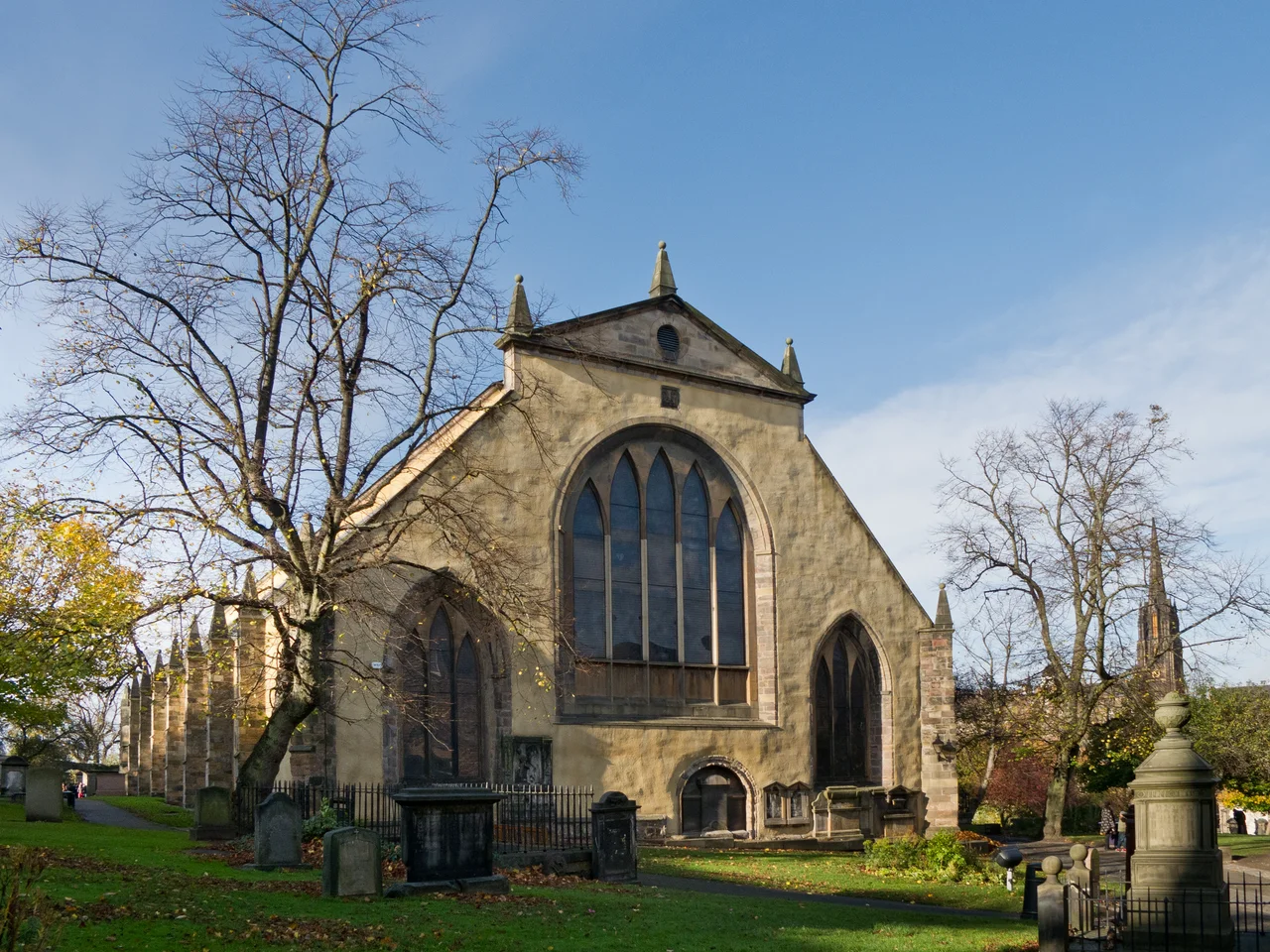

Greyfriars Kirk
On 23 July 1637, in the pulpit of Greyfriars Kirk, the minister James Fairlie attempted to read Charles I's new Service Book. The women in the congregation cursed him; he cursed them back. The next Sunday his colleague Andrew Ramsay refused to read the book at all and was deposed by royal authority. Eight months later, on 28 February 1638, gentry and nobility queued inside this same church to put their names to the National Covenant - the pledge that turned Scotland against its king. The Bishops' Wars followed. So did the Wars of the Three Kingdoms. So did everything else. A small kirk in Edinburgh started a revolution, and the building still stands.
Friars Before the Kirk
Observantine Franciscan friars arrived in Edinburgh from the Low Countries around 1447, six of them, led by a man named Cornelius of Zierikzee. They settled at the corner of the Grassmarket and Candlemaker Row a few years later. They wore grey habits - hence the name Greyfriars. The friary became fashionable: it hosted Mary of Guelders when she landed in Edinburgh in 1449, sheltered the exiled Henry VI of England, and counted James IV among its patrons. Friar Ranny served as the king's confessor. By the mid-sixteenth century there were always fifty to sixty friars in residence. Then came the Reformation. In June 1559 the Lord Provost abandoned his promise to protect the Grey Friars, and an Edinburgh mob ransacked the friary. By the following summer the Scottish Observantines had fled - some eighty friars in all - back to the Netherlands. By 1565 every stone of their buildings had been carted away to repair St Giles' walls.
A Church Built on a Graveyard
Mary, Queen of Scots gave the friary grounds to the town council in 1562 as a burial ground - the kirkyard of St Giles' had become impossibly overcrowded. Construction of the church itself began in 1602, paused, restarted, and finished in 1620. The first service inside its walls was not a Sunday worship but a funeral: William Couper, Bishop of Galloway, on 18 February 1619, with John Spottiswoode, Archbishop of St Andrews, preaching. Congregational worship began on Christmas Day 1620. The style is what historians call Survival Gothic - Gothic architecture continuing after the Reformation - fused with Baroque elements. It was the only formula then available in Scotland for a large parish church. The exterior walls are harled rubble with ashlar dressings; the church measures 162 feet by 72; external buttresses divide each bay and rise to ball-topped obelisk finials.
The Covenant and the Cavalry
Greyfriars' most famous moment came on 28 February 1638. Archibald Johnston of Warriston read the National Covenant from the pulpit. Then Scotland's nobility and gentry signed it - some inside the church, some out in the kirkyard, where there was more room. The Covenant rejected Charles I's attempts to impose English-style church government on Scotland and committed the signers to defend their reformed faith. The Bishops' Wars followed within a year. In August 1650, as Cromwell's army approached Edinburgh, all able-bodied men of the town were ordered to assemble in the Greyfriars kirkyard. The Covenanters lost at Dunbar shortly after, and Cromwell took the city. For three years, between 1650 and 1653, his cavalry used Greyfriars as a barracks and caused significant damage. Cromwell himself may have preached inside. The original copy of the 1638 Covenant is still on display in the church museum.
The Tower That Exploded
From 1706 the town council used the west tower of Greyfriars as a gunpowder store. At about 1.45 am on Sunday 7 May 1718, it exploded. The tower came down. The west end of the church was wrecked. A contemporary record describes the blast as having rent the western gable, broken all the glass windows, turned the slates, and broken a great deal of the lead high roof. While repairs went on, the congregation met in the chapel of George Heriot's School and in the Lower Commonhall of the University of Edinburgh. Alexander McGill oversaw the reconstruction. Rather than rebuild the tower, he added two new bays at the west and divided the interior with a wall, creating two churches in one building: Old Greyfriars in the east, New Greyfriars in the west. They would not be reunited for over two centuries. The duty on ale paid for the rebuilding.
The Greyfriars Revolution
On 19 January 1845 a boiler flue overheated and a fire gutted Old Greyfriars and damaged New Greyfriars. Some suggested it was divine judgement on the established church for the Disruption of 1843. After reconstruction, the minister Robert Lee began what became known as the Greyfriars Revolution. He introduced a service book of his own design, brought in prepared prayers, and asked his congregation to stand for praise and kneel for worship. These were astonishing innovations in Scottish Presbyterianism, where austere extemporaneous worship had been the norm for three centuries. Lee installed a harmonium in 1863 - the first organ in any Church of Scotland building since the Reformation - and a pipe organ in 1865. The General Assembly pushed back. He resisted. He died in 1868 before they could discipline him properly. Within decades his innovations had become commonplace across Scottish Presbyterianism.
What the Church Holds Now
Old and New Greyfriars united in 1929. Between 1932 and 1938 Henry F. Kerr removed the dividing wall and restored the church as one space. In 1979 the Highland, Tolbooth, St John's congregation joined, and the church kept its tradition of weekly Gaelic services - a Highland presence in Edinburgh that goes back to the early eighteenth century. The current 1989 Peter Collins organ has nearly 3,400 pipes; its carved details show Scottish flora and fauna, a Franciscan friar, and Greyfriars Bobby, the loyal Skye terrier who guarded his master's grave in the kirkyard outside. Among the church's treasures are an original copy of the National Covenant, four communion cups dated 1633, a 17th-century plaque to Margaret, Lady Yester, and an 1867 portrait of Bobby. The kirk continues missionary work in the parish through the Grassmarket Community Project. The Franciscans who gave the place its name are long gone. The work they began has never stopped.
From the Air
Greyfriars Kirk sits at 55.9466N, 3.1922W in the Old Town of Edinburgh, on the southern edge of the medieval city, immediately adjacent to George Heriot's School and 300 m south of the Royal Mile. From the air look for the rectangular church surrounded by the densely populated Greyfriars Kirkyard, with Edinburgh Castle visible to the north and the dome of the National Museum of Scotland to the east. Easy landmarks: the Castle is 400 m north, Princes Street Gardens 500 m north, the Royal Mile and St Giles' Cathedral 350 m northeast. Edinburgh Airport (EGPH) is 9 nm west. Best viewing altitude 1,500-2,500 ft, especially with low side light to pick out the steep roof and the buttressed bays. The statue of Greyfriars Bobby sits at the corner of Candlemaker Row and George IV Bridge, immediately opposite the kirkyard gate.
Nearby Stories
- Ardoch Roman Fort 2.2 km away
- Craignethan Castle 3.1 km away
- Haddington 3.8 km away
- Balvaird Castle 4.3 km away
- Battle of Kilsyth 9.4 km away
- Siege of St Andrews Castle 9.9 km away
- Neidpath Castle 11 km away
- Melrose Abbey 15 km away