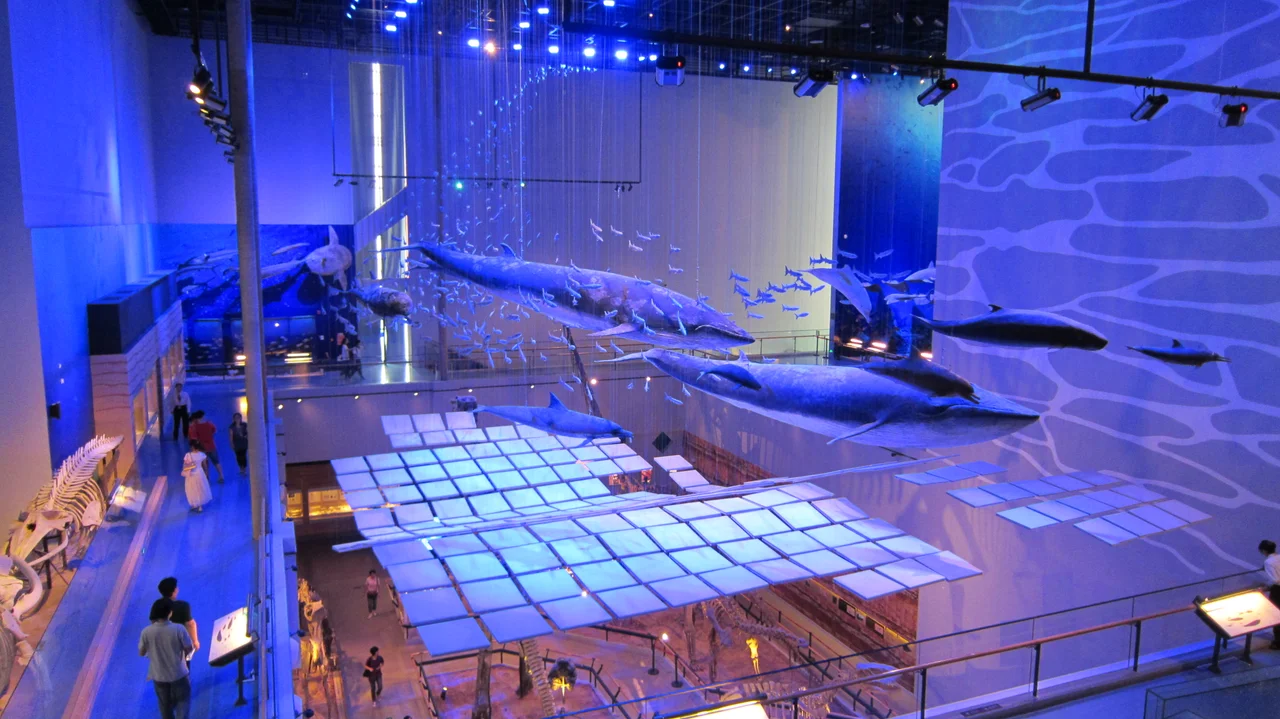

Guangdong Museum
Somewhere in the workshops of old Guangdong, a craftsman sat with an ivory sphere and began carving — not just one layer but nested concentric shells, each turning freely inside the other, each revealing a smaller world within. This was the *qiu*, the Cantonese puzzle ball, an object so intricate that foreign traders who first encountered it assumed it must involve some form of magic. Hong Kong architect Rocco Yim saw that object and recognized a blueprint. When Guangdong Province needed a museum worthy of its history, he designed a building that works the same way: transparent concentric layers expanding outward from a central atrium, each floor opening onto the next, the whole structure an homage to the very craftsmanship it houses.
A Province Distilled in Stone and Glass
Guangdong is China's most populous province and, for much of the past two centuries, its most outward-facing. The province gave the world Cantonese cuisine, the Canton trade system that shaped global commerce, and generations of emigrants who carried their culture from the Pearl River Delta to every continent. The museum that carries its name was founded in 1959, initially housed on the grounds of the original Sun Yat-sen University in Yuexiu District, where it occupied buildings once associated with the Kuomintang and a memorial hall dedicated to the writer Lu Xun. That first iteration was modest, spread across three parts — museum, historic relic, and memorial — on 43,000 square meters. It served the city for half a century before the province decided to build something commensurate with its ambitions.
Zhujiang New Town and the Cultural Cluster
In 2003, Guangdong's planners drew up a master plan for Zhujiang New Town, an emerging district they intended to make the cultural heart of Guangzhou. The vision called for a cluster of civic landmarks arrayed around a central plaza: the Guangzhou Opera House, a new public library, a youth activity center, and the new Guangdong Museum. By 2004 the old institution was slated for relocation, and a decade of construction followed. The new building opened in May 2010 — the same month the old museum closed permanently. Its footprint is remarkable: 41,000 square meters above ground, 15,000 more below, with an interior of nearly 67,000 square meters and viewing areas for patrons covering 21,000 square meters. A broad grass slope wraps the exterior, inviting the public even before they step inside.
The Puzzle Ball Made Habitable
Step into the atrium and the architectural concept becomes immediate. The building's design centers on a four-story atrium penetrated by a spiral staircase that climbs from the first floor to the top. Corridors on each level run outward from this core, separated from the atrium by transparent glass and iron curtain walls. The effect is of standing inside the ivory puzzle ball itself: each layer visible through the next, the whole organism legible at once. The concentric logic is not merely decorative — it organizes circulation, separating the permanent collections on inner floors from the changing exhibitions toward the periphery, and situating the administration offices quietly at the top.
What the Collections Hold
Three permanent collections anchor the museum's identity. The historical artifacts galleries trace Guangdong's role as a trading center from prehistoric times forward, displaying objects from the semi-colonial years — English postcards, commercial documents, imported goods — alongside Chaozhou wood carvings of extraordinary intricacy, screens and panels carved with a precision that seems to defy the hardness of the material. The nature exhibition takes a different register entirely, moving from geology and biodiversity to the coastal ecology of the Pearl River Delta. The vernacular art galleries display ceramic figures in the Shiwan style from Foshan, where each case is dedicated to a single artist with biography and examples of their work. Temporary exhibitions rotate in frequently, giving the museum a reason for repeat visits.
Craft as Content and Container
There is something satisfying about a museum that enacts its subject. Guangdong's cultural identity has always been grounded in exceptional craftsmanship — the lacquerware, the embroidery, the ivory carving, the ceramics. The building around which visitors now move was shaped by the same logic: material skill translated into spatial form. The ivory puzzle ball that inspired it no longer appears in new production — ivory carving has been banned in China since 2018 — but the tradition it represents persists in the museum both as artifact and as architecture. Walking the spiral staircase, passing from one transparent layer to the next, visitors find themselves inside an argument about what Cantonese craft has always known: that the most revealing thing about an object is often what you find when you look inside.
From the Air
The Guangdong Museum sits at approximately 23.117°N, 113.321°E in Zhujiang New Town, Tianhe District. Approaching from the south at 2,000–3,000 feet, the building's distinctive ring-layered facade is visible as part of a civic cluster also including the Guangzhou Opera House and Guangdong Library. The nearest major airport is Guangzhou Baiyun International (ZGGG), approximately 28 km to the north. The Pearl River runs roughly 1.5 km to the south, and the Canton Tower — Guangzhou's most prominent aerial landmark — stands about 3 km to the south-southwest.
Nearby Stories
- Shunde 12 km away
- 2015 Shenzhen Landslide 15 km away
- Mount Luofu 23 km away
- Qingyuan Maglev Tourist Line 32 km away
- Kaiping 56 km away
- Heyuan 90 km away
- Chikan, Kaiping 92 km away
- Erlitou Site Museum of the Xia Capital 1257 km away