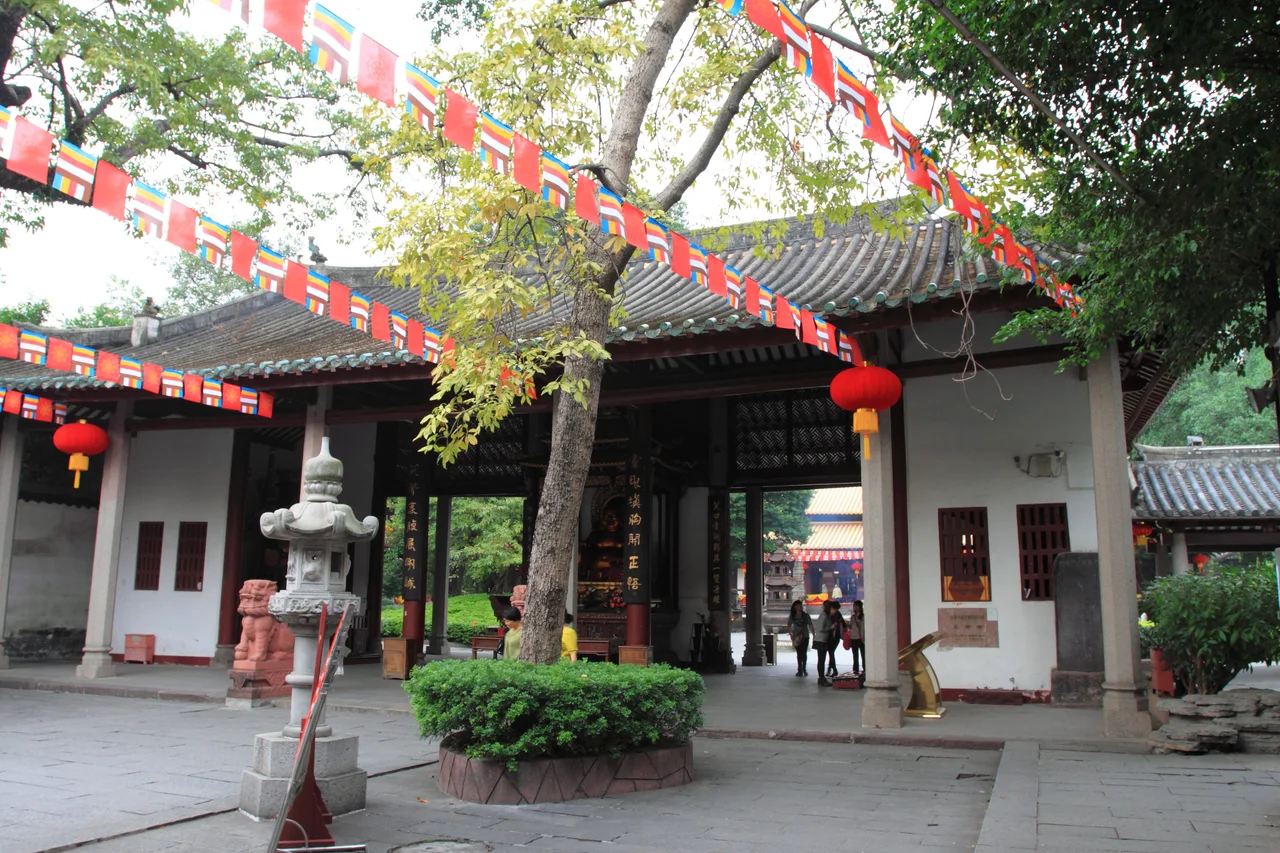

Guangxiao Temple
In 676 CE, a monk named Huineng stood beneath a Bodhi tree in what is now central Guangzhou and cut off his hair. He had traveled from the mountains where the fifth Chan patriarch had given him secret transmission of the dharma — making him, by that act, the sixth patriarch of Chan Buddhism, the tradition that would eventually shape Zen across Japan, Korea, and the world. The abbot who witnessed his ordination, Yinzong, built a small pagoda and buried the hair beneath it. That pagoda still stands. So does the temple around it — Guangxiao, one of the oldest places of Buddhist worship in China, carrying its history not in documents alone but in iron and stone and the rings of a Bodhi tree.
Before the Temple: A Royal Residence
The land beneath Guangxiao Temple has been significant for far longer than the temple itself. In the years before the common era it served as the residence of Zhao Jiande, king of the Nanyue kingdom, whose territory covered what is now Guangdong and parts of neighboring provinces. When Emperor Wu of the Han dynasty sent armies south to annex Nanyue in the second century BCE, the estate passed into different hands. During the Three Kingdoms period, a Wu scholar named Yu Fan was banished here — and when he died in 233 CE, his family donated the property to be organized as a Buddhist temple. The Zhizhi Temple, as it was first known, was renamed multiple times over the following centuries before settling into its present identity. The Chenghua Emperor of the Ming dynasty gave it the name Guangxiao in 1482 and carved that name personally onto a stele — and the name has held ever since.
A Crossroads for Buddhist Traditions
Guangzhou's position on the South China Sea made Guangxiao Temple a natural stopping point for monks traveling the maritime routes between India and China. Between the fourth and tenth centuries, the temple reached its peak influence, receiving monks from South Asia who brought new texts, new practices, new traditions of ordination. Here Amoghavajra, one of the masters responsible for transmitting esoteric Shingon Buddhism to East Asia, gave his first teaching in China. Here the Shurangama-sutra was translated — one of the foundational texts of Chinese Buddhism. Here Yijing, the scholar-monk who traveled to India and spent years studying in the Buddhist universities there, also worked on translation. The temple was not merely a place of worship; it was an active laboratory of Buddhist thought, where traditions from across Asia met and cross-pollinated.
The Hall That Has Survived Everything
The Daxiongbao Hall is the physical heart of Guangxiao Temple — and its age is remarkable. Originally built in 401 CE during the Eastern Jin dynasty by the monk Dharmayasas, who had traveled from the Western Regions, it was renovated across a dozen dynasties and last fully rebuilt in 1654 under the Qing Emperor Shunzhi. At 35.36 meters wide, 24.8 meters deep, and 13.6 meters high, it is described as the grandest hall in the entire Lingnan region. The eaves are broad and low, designed to manage the intense heat and rain of south China. Wooden windows — some fitted with translucent shells rather than glass — filter light with an effect that is, even now, startling in its gentleness. Inside, statues of Sakyamuni, Amitabha, and Maitreya face the entrance, as they have for centuries.
Iron Pagodas and a Hair Buried in Earth
Behind the Daxiongbao Hall, two iron pagodas stand that are considered the oldest iron towers in China. The West Tower dates to 963 CE, in the Southern Han dynasty; it was once seven stories but only three remain. The East Tower, built in 967 by Emperor Liu Chang and originally sheathed in gold, still stands at 7.69 meters with over 900 niches carved into its body, each containing a small Buddha figure. It was known when new as the Gilded Thousand Buddha Pagoda. Nearby, under the Bodhi tree, the Yifa Pagoda — the Hair Burying Pagoda — marks the spot where Huineng was ordained. Octagonal, seven stories, 7.8 meters high, erected between 676 and 679 CE, it is one of only five Tang dynasty pagodas surviving anywhere in Guangdong. These structures are not replicas or reconstructions; they are originals, worn smooth by the centuries and still standing.
Survival Against the Odds
Guangxiao Temple's survival is not accidental — it is testimony to repeated acts of preservation, sometimes against considerable pressure. The late nineteenth and early twentieth century brought campaigns to convert temple property into schools and public buildings, a movement that damaged many sites across China. The Cultural Revolution of 1966 to 1976 caused further harm: buildings were damaged, and some were occupied for secular purposes entirely. The temple sat largely empty of monks for years. In the 1980s, as China's religious policies shifted, Buddhist monastics returned. Dharma pillars were erected, an animal liberation pond was built, and reconstruction of damaged structures began. The temple today is smaller than it once was — the records from the eighteenth century describe a vastly larger compound — but what remains is genuine and tended. Visitors can walk ground that has been sacred for seventeen centuries.
From the Air
Guangxiao Temple is located at approximately 23.132°N, 113.251°E in the Yuexiu District of Guangzhou. The temple's walled compound and gardens are visible from lower altitudes as a patch of green amid the dense urban fabric of central Guangzhou, a few blocks north of Zhongshan Road. Guangzhou Baiyun International Airport (ZGGG) is about 22 km to the north-northwest. From the air, the Yuexiu District is identifiable by Yuexiu Park and its Five Rams Statue to the northeast; the temple sits in the older commercial district to the west of the park.
Nearby Stories
- Shunde 12 km away
- 2015 Shenzhen Landslide 15 km away
- Mount Luofu 23 km away
- Qingyuan Maglev Tourist Line 32 km away
- Kaiping 56 km away
- Heyuan 90 km away
- Chikan, Kaiping 92 km away
- Erlitou Site Museum of the Xia Capital 1257 km away