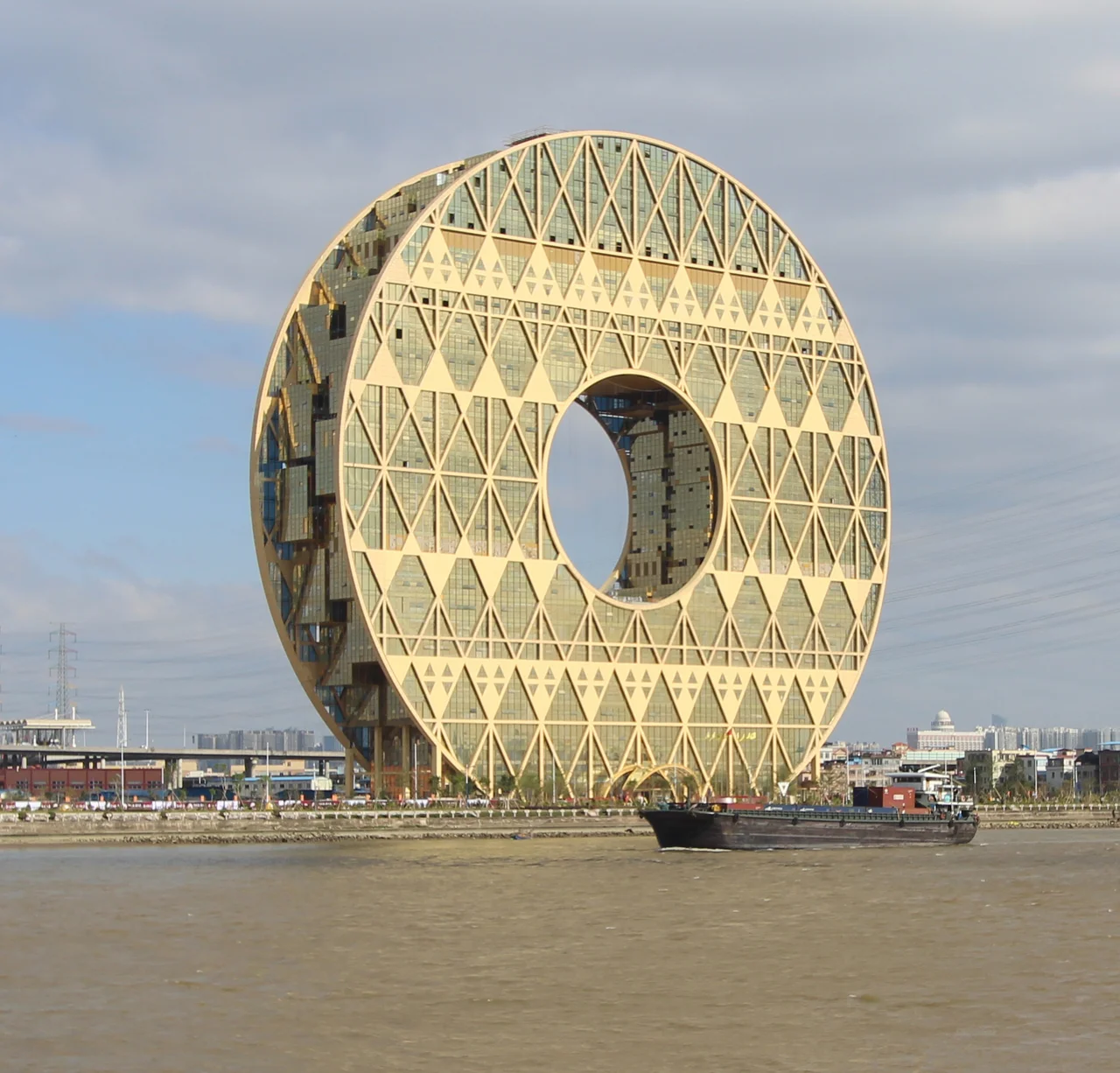

Guangzhou Circle
The brief handed to Italian architect Joseph di Pasquale was unusual: design a corporate headquarters for Guangzhou that draws on Chinese philosophy, ancient symbolism, and Renaissance mathematics — all at once, all in one building. The result, completed in December 2013 on the western bank of the Pearl River, is a 138-meter steel ring that punches a circular hole 48 meters wide through its own center. From a boat on the Pearl River, the building and its reflection form a perfect vertical figure-eight: two discs of jade, one real and one mirrored. It is either one of the most striking buildings in China or one of the most bizarre, depending on who is asked. Probably both statements are true.
The Meanings Stacked Inside the Ring
Di Pasquale has described his design process as beginning with what he called Oriental psychology and perception — studying how the Chinese written language encodes meaning in visual form. From that study came several overlapping symbolic frameworks. The most direct is the jade bi-disc, an ancient ritual object: a flat ring of polished jade that served as a royal symbol in Chinese dynasties ruling this region two thousand years ago. When the building reflects in the Pearl River, it replicates the bi-disc form exactly. The ring shape also corresponds to the number eight in Chinese numerology — a figure associated with prosperity and good fortune — and to the Western infinity symbol. Di Pasquale also drew on the Italian Renaissance concept of *quadratura del cerchio*, squaring the circle: the two circular facades contain suspended rectangular blocks of floors, their squared interiors fitting within the perfect circumference outside, making the interior spaces orthogonal and habitable.
Engineering the Impossible-Looking
Guangzhou Circle is 138 meters tall and 33 stories high. What makes the structure technically notable beyond its appearance is the open core: a circular void nearly 48 meters in diameter running through the building's center, with no glass sealing it. This distinguishes it from a similar circular building in Shenyang, whose core is filled. In Guangzhou, the ring is genuinely hollow — open to sky and wind. The two curved facades act structurally as supports for the suspended floor groups, which are cantilevered inward from the outer ring walls. The building cost approximately 1 billion RMB (roughly US$150 million) and sits on the southwestern edge of Guangzhou's urban area, directly on the Pearl River bank. The total floor area is substantial, serving as headquarters for the Hongda Xingye Group and the Guangdong Plastic Exchange (GDPE), which was, as of 2012, the world's largest trading center for raw plastic materials.
Controversy and Iconhood
Not everyone has been convinced. Critics placed Guangzhou Circle on lists of China's most bizarre buildings in the years following its completion — the gold-toned facade and the sheer audacity of putting a 48-meter hole in a corporate skyscraper attracted both admiration and ridicule in roughly equal measure. But cities often warm to the provocative buildings they initially mock. In the years since its inauguration, the image of the Guangzhou Circle has appeared on public information posters, in advertising campaigns, and on the poster for the nineteenth congress of the Communist Party of Guangzhou in October 2017 — repurposed as a civic symbol, the building it was designed to be. The public plaza and fountain at its base are open; the building itself, while primarily occupied by its corporate tenants, has become a landmark for photography along the Pearl River waterfront.
A River View Designed to Be Seen From the Water
The most famous view of Guangzhou Circle is not from street level but from a boat on the Pearl River — or from the opposite bank. From the water, the building's reflection creates the bi-disc image that Di Pasquale designed from the beginning. At night, the structure is lit in warm gold tones, and the circular opening reads against the sky, the effect changing with the angle of approach. Cruise boats on the Pearl River have adopted it as a standard photo stop. In a city whose riverfront has been transformed over the past two decades — with the Canton Tower, the Guangzhou Opera House, and the Guangdong Museum all reshaping the skyline — the Circle holds its own. The ring that frames nothing but air has become one of Guangzhou's most recognizable silhouettes.
From the Air
Guangzhou Circle sits at approximately 23.053°N, 113.254°E on the southwestern edge of the city along the Pearl River's north bank. From the air, the building's circular form and open core are unmistakable from altitudes below 3,000 feet — the ring structure casts a distinctive shadow and the reflective facade catches light at most times of day. Guangzhou Baiyun International Airport (ZGGG) is approximately 30 km to the north-northeast. The Canton Tower stands roughly 5 km to the east along the river as a secondary navigation landmark; Haizhu District's urban grid extends south across the water.
Nearby Stories
- Shunde 12 km away
- 2015 Shenzhen Landslide 15 km away
- Mount Luofu 23 km away
- Qingyuan Maglev Tourist Line 32 km away
- Kaiping 56 km away
- Heyuan 90 km away
- Chikan, Kaiping 92 km away
- Erlitou Site Museum of the Xia Capital 1257 km away