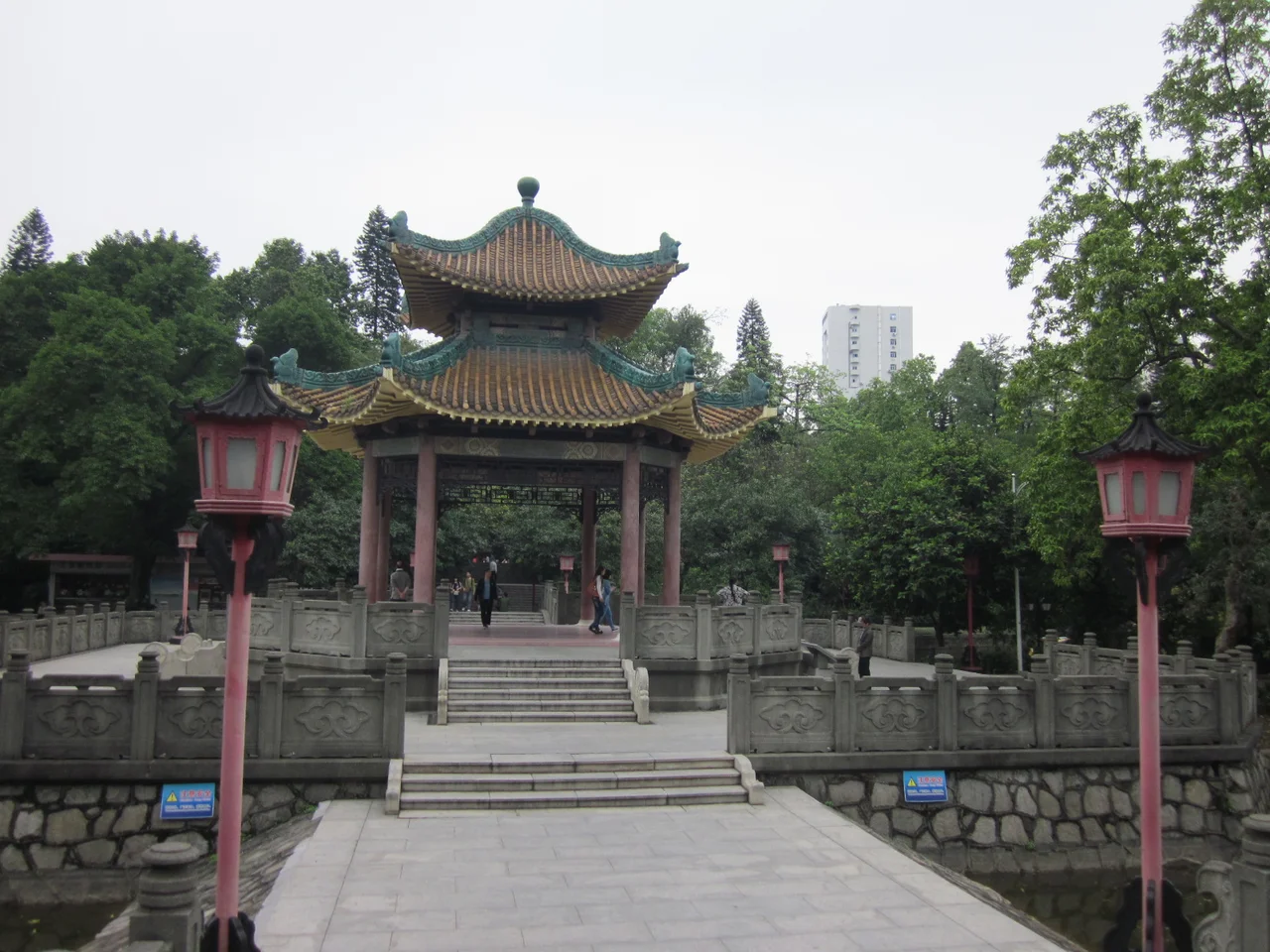

Guangzhou Martyrs' Memorial Garden
For three days in December 1927, Guangzhou was the site of an uprising — and then a slaughter. Workers and Communist Party members launched an insurrection on December 11, attempting to establish a commune in the city. By December 13, Nationalist forces had retaken control, and the killings began. Estimates of those who died in the five days of reprisals that followed range from 5,000 to 7,000 people — overwhelmingly workers and suspected Communist sympathizers, executed summarily or killed in street violence. Most of them had names, families, lives. Most of those names are now unknown. The Guangzhou Martyrs' Memorial Garden, opened in 1957, asks visitors to hold that weight before they enter: the stone gateway carries text reading "Guangzhou Uprising Martyrs Cemetery," inscribed by Zhou Enlai, China's first premier.
December 1927: Three Days That Left Thousands Dead
The Guangzhou Uprising was organized by the Chinese Communist Party in the days following the collapse of the broader revolutionary movement of 1927 — a year in which the alliance between the Communists and Chiang Kai-shek's Nationalists had shattered in a series of bloody purges across China. In Guangzhou, the Communists and their worker allies seized the city on December 11 and declared a commune. They held it for two days. When Nationalist troops recaptured the city on December 13, the retribution was severe. Thousands of people in Guangzhou who were identified — or merely suspected — as Communist supporters were executed. The exact numbers cannot be known with certainty; estimates collected by historians range broadly, but most fall between five and seven thousand deaths over those first days. Among the dead were Zhang Tailei, one of the uprising's leaders, killed in the fighting. The vast majority who died left no monument except this garden.
Building a Place of Memory
Construction of the memorial garden began in 1954, as the People's Republic of China entered its first decade. It was timed deliberately: the park opened in 1958, the thirty-first anniversary of the uprising. The choice of site in Yuexiu District, on Zhongshan 3rd Road, placed the memorial in the heart of Guangzhou — not on the periphery, but where the city passes by it daily. The gate in the stone wall carries the inscription by Zhou Enlai, whose own role in China's revolutionary history made his hand on the dedication stone significant. The park was designed as both a cemetery — with the commune martyrs' tomb and the Honghuagang four martyrs' tomb among its monuments — and a garden, so that the act of commemoration could take place in a space of living green rather than only bare stone.
What the Garden Holds
Within the garden's grounds stand several monuments that mark different threads of the 1927 events and their international connections. There is the pagoda commemorating Chinese and Korean people who died together in the uprising — a reminder that the Guangzhou Commune drew participants from beyond China's borders, including Korean revolutionaries who had found in Guangzhou a center of anti-imperialist activity. A second pagoda commemorates Chinese and Soviet people, reflecting the Soviet Communist Party's involvement in the failed uprising: Soviet advisors had been deeply embedded in the revolutionary movement, and several died in Guangzhou during those days. The Blood Sacrifice Xuanyuan Pavilion and the Guangdong Revolutionary History Museum, housed within the grounds, extend the record further. These are not abstractions. They mark specific people who chose to act, and died for it.
A Garden in the City, Open Every Day
Today the Guangzhou Martyrs' Memorial Garden operates as a public park. The Martyrs' Park Station on Guangzhou Metro Line 1 sits in front of the entrance, and the garden serves the Yuexiu District as an urban green space as much as a memorial site. People walk through it on their way between neighborhoods. Children come on school trips. Older residents sit on the benches in the shade. This ordinariness is not disrespectful — it is part of what memorials do when they work: they hold historical gravity within daily life, so that the past remains a presence rather than a separate, sealed-off thing. The stone gateway still carries Zhou Enlai's characters. The tombs are still tended. The pagodas stand.
From the Air
Guangzhou Martyrs' Memorial Garden is located at approximately 23.132°N, 113.279°E in the Yuexiu District of central Guangzhou. The walled garden compound is visible from low altitudes as a rectangle of dense green within the urban fabric, bordered by Zhongshan Road to the south. Guangzhou Baiyun International Airport (ZGGG) is approximately 22 km to the north. The garden sits roughly 2 km west of the Guangdong Museum cluster and 4 km north of the Pearl River. From the air, Yuexiu Park — with its distinctive reservoir and Five Rams monument — is a useful reference point about 1.5 km to the northwest.
Nearby Stories
- Shunde 12 km away
- 2015 Shenzhen Landslide 15 km away
- Mount Luofu 23 km away
- Qingyuan Maglev Tourist Line 32 km away
- Kaiping 56 km away
- Heyuan 90 km away
- Chikan, Kaiping 92 km away
- Erlitou Site Museum of the Xia Capital 1257 km away