
Guangzhou
A legend says five celestial beings descended on the land that is now Guangzhou, each riding a ram and carrying sheaves of rice. They blessed the people, gifted them the grain, and when they departed their rams turned to stone. The city flourished, and the story gave it several names it still carries: City of Rams (羊城), City of Sheaves (穗城), City of Five Rams (五羊城). Add City of Flowers (花城), for the blossoms that fill its parks and boulevards, and you have a place that has spent two thousand years accumulating identities without discarding any of them. Guangzhou was founded in 214 BC, has hosted Arab merchants and Portuguese traders and British opium dealers and African businesspeople, and today runs the largest trade fair on earth. The rams in the founding legend are still there, cast in bronze in Yuexiu Park—five of them, frozen mid-arrival, as if the celestial beings might return any moment to check on what their blessing produced.
Two Thousand Years at the Crossroads
Guangzhou entered recorded history as Panyu, founded in 214 BC. Its position near the Pearl River delta mouth made it a natural terminus for the Maritime Silk Road, connecting southern China to India, Southeast Asia, the Middle East, and the east coast of Africa. The trade routes brought more than goods. A mosque was established in the city in 627 AD, and a Muslim community has persisted here ever since. Bodhidharma—the Indian monk credited with founding Zen Buddhism—arrived in Guangzhou and taught here before his legendary journey north to Shaolin. The sixth Zen patriarch was born in the region. Robert Morrison, the first Protestant missionary to reach China, landed in Guangzhou in 1807. In 1514 Portuguese traders became the first Europeans to set foot in Canton, and the British East India Company opened a trading post in 1711. By 1757 the Chinese government had restricted all foreign trade to Guangzhou alone, making it the singular gateway between China and the world for nearly a century. That monopoly ended in 1842, when China lost the First Opium War and the Treaty of Nanking opened four additional ports. The loss of exclusivity stung, but it also pushed Guangzhou toward industrialization.
Cantonese and Canton: A Language That Traveled
When the West says 'Chinese food,' it almost always means Cantonese food. The waves of emigration from Guangdong province in the 19th and early 20th centuries seeded Cantonese communities across the United States, Canada, the United Kingdom, Australia, and Southeast Asia. The restaurants, the dim sum parlors, the roast duck hanging in storefront windows—these are Guangzhou's culinary exports, adapted to distant kitchens but still recognizable in their roots. At home, the tradition is more elaborate. Guangzhou's dim sum culture ('yum cha'—drinking tea) is a semi-formal institution: a pot of tea, small dishes arriving in bamboo steamers, hours of conversation. The Cantonese approach to ingredients is famously expansive; the well-known joke is that they eat anything with four legs except tables, anything that flies except airplanes, and anything that swims except submarines. 'Eating in Guangzhou' (食在广州) has been a Chinese saying for centuries, and it still holds. The city's cuisine also reflects its cosmopolitan history: the large African community that has settled here in recent decades has brought its own restaurants, adding another layer to the most internationally inflected food culture in China.
Shamian Island and the Colonial Shadow
The foreign trading houses that operated in Guangzhou were historically confined to a narrow strip outside the city walls—the Canton System. In the 19th century, European settlement coalesced on Shamian Island, a sandbar in the Pearl River connected to the city by two bridges. The British and French built their consulates, banks, churches, and clubs here in the neoclassical and colonial styles of the era; the island was, in effect, a small European city grafted onto the riverbank. Today Shamian's tree-lined boulevards and restored colonial buildings make it one of the more photographed corners of Guangzhou. The architecture is beautiful; the history it represents—the opium trade, extraterritoriality, the systematic humiliation of China's sovereignty—is not. Walking Shamian is a reminder that Guangzhou's openness to the world was not always voluntary, and that the city's current prosperity was built in part against the legacy of that period.
The Canton Tower and a New Skyline
The Canton Tower stands 600 meters above Haizhu District, a twisting lattice of steel and glass that briefly held the title of world's tallest tower from the time it topped out in 2009 until Tokyo Skytree surpassed it in 2011. It became operational on September 30, 2010, just in time for the Asian Games, whose opening ceremony was held on Haixinsha Island in the Pearl River below. The tower is the exclamation point at the end of Guangzhou's modern skyline, visible from the Pearl River night cruise boats that depart from multiple piers and trace the illuminated waterfront for an hour or two each evening. The city that grew up on maritime trade still orients itself to the river. From the tower's observation deck, the Pearl River Delta extends in every direction—Shenzhen and Hong Kong's light pollution visible to the south on a clear night, Foshan merging seamlessly into the western suburbs, and somewhere in the distance the hills of Guangdong province where the Cantonese people have lived, traded, and cooked extraordinary food for over two thousand years.
The Fair That Moved the World
Twice a year, Guangzhou fills beyond its already considerable capacity. The Canton Fair—formally the China Import and Export Commodities Fair—has been held every spring and fall since 1957. During the Maoist era, it was nearly the only sanctioned channel through which Chinese and foreign businesses could meet and make deals. After Deng Xiaoping's reforms it expanded into the largest trade fair in China, and possibly the world: the October 2012 fair occupied over a million square meters of exhibit space, drew more than 24,000 exhibitors, and attracted over 188,000 overseas buyers. Hotels book out months in advance. Taxis become scarce. The Pazhou Complex in Haizhu District, where the fair is held, becomes its own temporary city within the city. In 2019, Guangzhou's GDP surpassed that of Hong Kong—a milestone that would have seemed impossible to the merchants who once stood outside the city walls, allowed to trade but not to enter.
From the Air
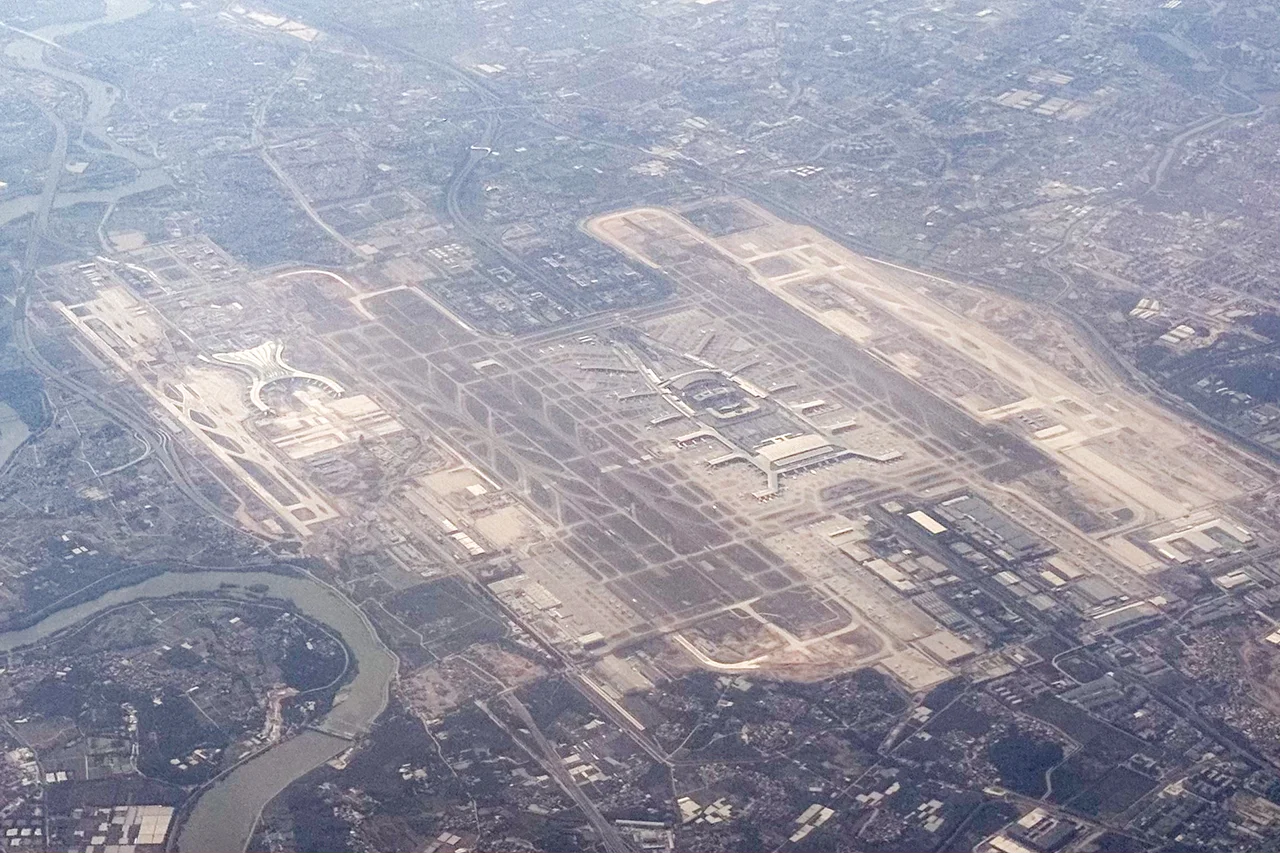
Guangzhou sits at 23.13°N, 113.26°E in the Pearl River Delta of Guangdong Province, southern China. Approaching from altitude the delta's waterways are immediately visible—the Pearl River's multiple distributaries braiding through flat alluvial land before opening into the South China Sea. The Canton Tower's distinctive twisted silhouette (600 m) is the easiest landmark: it stands on the south bank of the Pearl River in Haizhu District, south of Tianhe's dense commercial towers. Guangzhou Baiyun International Airport (ZGGG) lies approximately 28 km north of the city center. Shenzhen Bao'an Airport (ZGSZ) is about 90 km southeast; Hong Kong International Airport (VHHH) roughly 130 km south.
Nearby Stories
- Shunde 12 km away
- 2015 Shenzhen Landslide 15 km away
- Mount Luofu 23 km away
- Qingyuan Maglev Tourist Line 32 km away
- Kaiping 56 km away
- Heyuan 90 km away
- Chikan, Kaiping 92 km away
- Erlitou Site Museum of the Xia Capital 1257 km away