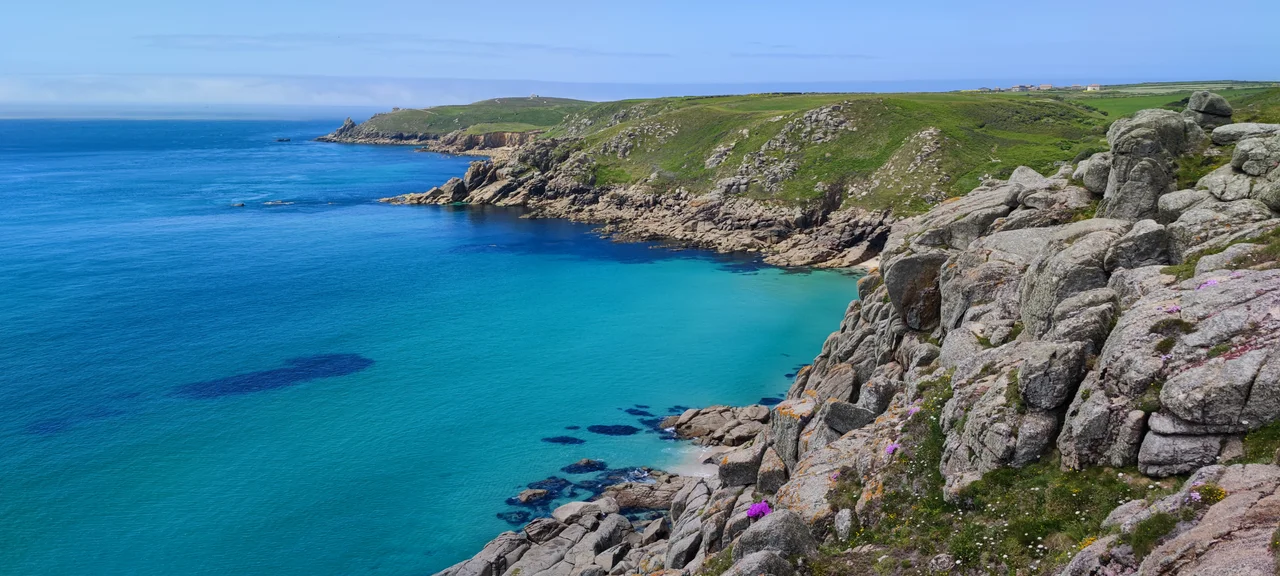

Gwennap Head
If you walk to the seaward edge of Gwennap Head on the right kind of August day, you may find a row of people who have not moved for hours. They have flasks of tea and battered tripods and old waterproofs the colour of granite. They are looking at empty sea. Then someone says, quietly, 'great shear, off the Runnel, just left of the cones,' and everyone shifts at once. A bird the colour of pencil shading skims across the swell three miles out, banks once and disappears. The watchers exhale. The Cornish name for this headland was Tol-Pedn-Penwith, the holed headland of Penwith, after the vertical blowhole that drops from the clifftop into a sea cave below. The English renamed it Gwennap Head in 1888. Local people kept calling it Tol-Pedn until the 1970s.
Two Cones and a Reef
Stand on the cliff edge facing west and you will see them: two cone-shaped daymarks, one painted red and the other striped black and white. They are not decorative. About a kilometre offshore lies the Runnel Stone, a partly submerged reef that has wrecked ships for as long as there have been ships in the western approaches. The Corporation of Trinity House erected the black-and-white inland cone in 1821, with a plaque on its back recording the date. The red seaward cone followed later. The system is elegant: from a vessel at sea, the black-and-white cone must always be kept in sight. If the red cone slides across and obscures the black-and-white one entirely, the vessel is on top of the reef and likely about to die. Hammond Innes used the markers in his 1940 thriller The Trojan Horse, calling them the Cones of Runnel. Ships still navigate by them today.
The Lookout That Refused to Close
The squat building on the headland began life around 1905 as a single-storey Coastguard lookout, in service by 1910. A second storey was added later, after a French trawler was wrecked at the foot of Wireless Point at Porthcurno in March 1956 and the watchers concluded they needed more height to see what was happening. The official Coastguard withdrew the station in 1994 as part of a national rationalisation, but the local community refused to leave the coast unwatched. On 21 October 1996 it reopened as NCI Gwennap Head, staffed by trained volunteers of the National Coastwatch Institution. They sit in shifts through the year, looking out for vessels in difficulty, swimmers in trouble, walkers on cliffs too steep for them, and the occasional bird so rare it stops the radio. The Runnel Stone Marine Conservation Zone, declared in January 2016, is measured as a 3.5-kilometre arc from this lookout.
The Bird-Watching Capital
Gwennap Head is one of the great seawatching stations of Britain. Its position at the south-western tip of Cornwall, jutting into the migration corridor for North Atlantic seabirds, brings to its cliffs an annual cast of gannets, Manx shearwaters, fulmars, guillemots, razorbills, shags, and cormorants, sliding past in their thousands. In July and August come the longer-distance travellers: great shearwaters bred on Tristan da Cunha in the South Atlantic, Cory's shearwaters bred on Mediterranean islands and in the Azores, both species drifting north in their summer migrations and rounding Cornwall on the way. From 2007 to 2011 a formal survey called Seawatch SW, led by Dr Russell Wynn, sat volunteers on the cliff edge twelve hours a day from mid-July to mid-October. Most of what they recorded was routine. On 28 August 2015, a red-billed tropicbird, a species that has no business at all in Cornish waters, sailed over the Runnel Stone.
The Vanishing Wreck Beneath Porth Loe
On the north flank of Gwennap Head a small stream drains into the boulder-strewn cove of Porth Loe. On the morning of 15 March 1905 the barque Khyber, sighted from the Wolf Rock the previous night, came ashore on those boulders and broke apart within fifteen minutes. The men still building the nearby coastguard houses ran with ladders and saved three of the crew. Twenty-three others did not survive. They are buried together in St Levan churchyard a few miles inland. The Cornish weather has scrubbed the rocks of any physical sign that the wreck ever happened. Almost everything in this landscape has a story like this attached to it, layered into the granite the way the maritime heath layers across the cliff tops: things that happened, in this exact place, that almost nobody who walks here today knows about.
A Flower Lost and Found
In 2010, two botanists named Helen and Laurie Oakes were poking around the maritime grassland near the cliff edge when they found perennial centaury, Centaurium scilloides, a small pink flower that had not been seen in Cornwall, or indeed anywhere in England, since 1962. It had survived in only one Welsh location. The rediscovery, after almost fifty years, was credited to the reintroduction of cattle grazing under a Higher Level Stewardship agreement; the cattle were keeping the sward open enough for the centaury to compete again. The grassland here is at its richest in late spring, when spring squill, thrift, sea campion and kidney vetch flower together against the granite, before the purple of the bell heather takes over in midsummer. A clouded yellow or a hummingbird hawk-moth may go past on the warm air. The headland is small, but it is genuinely full.
From the Air
Gwennap Head sits at approximately 50.04 degrees north, 5.68 degrees west, on the south coast of the Penwith peninsula, about 4 miles south of Land's End and 1 mile west-northwest of Porthgwarra. From the air the key markers are the two painted daymark cones on the headland and the offshore Runnel Stone reef breaking water about a kilometre south. Land's End Airport (EGHC) lies roughly 4 nautical miles to the northwest. The South West Coast Path traces the cliff edge, and the granite massif of Land's End rises immediately inland. Expect strong onshore winds, persistent Atlantic swell, and frequent low cloud that can engulf the headland with little warning.
Nearby Stories
- Mullion Cove 1.3 km away
- Great Wheal Charlotte 3.7 km away
- Castle Down 5.3 km away
- SS Georgia (1890) 30 km away
- Wheal Coates 41 km away
- 1979 Fastnet Race 55 km away
- HMS Affray 126 km away
- Routes of Santiago de Compostela: Camino Frances and Routes of Northern Spain 713 km away