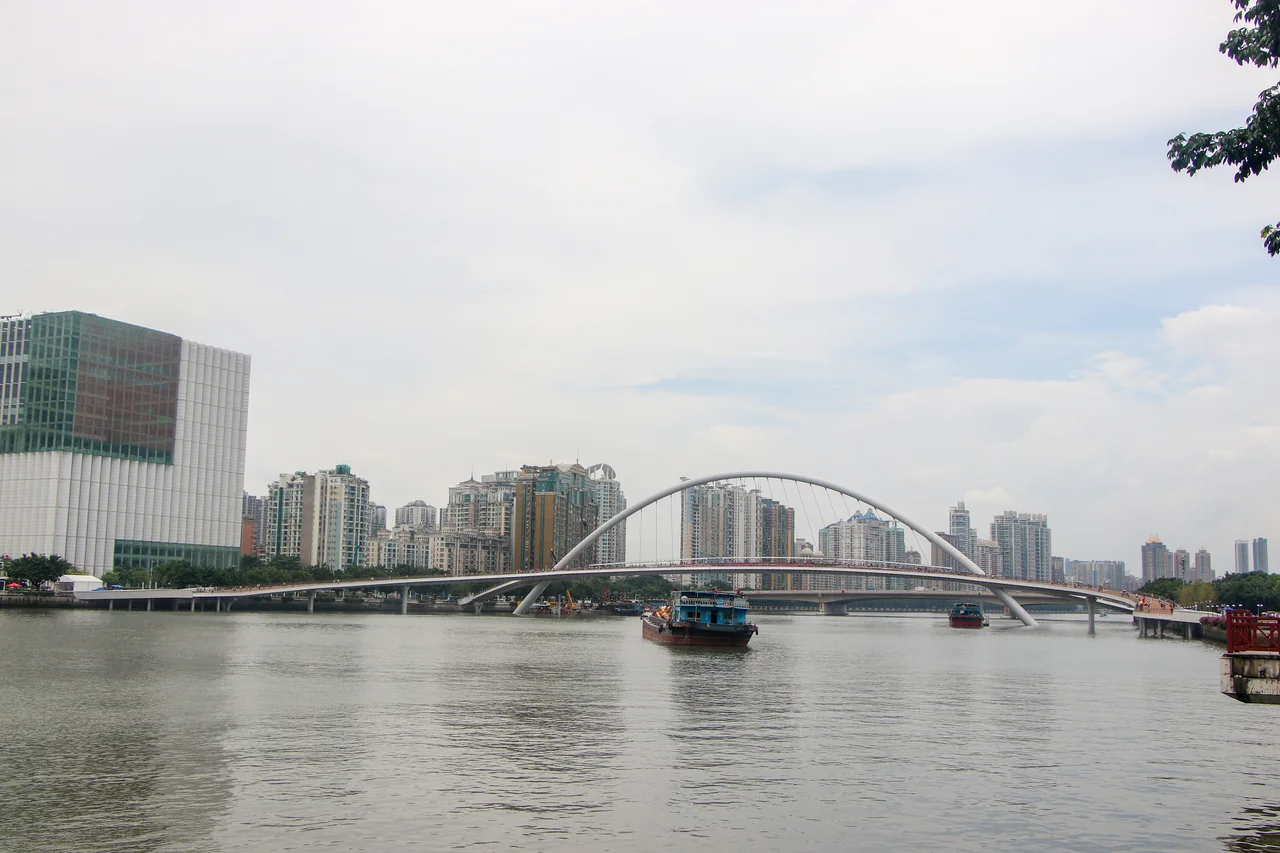

Haixin Bridge
The name the public chose means Sea Heart Bridge — 海心桥 — though people also call it the Little Phoenix Eye, or simply the Flower Bridge. It spans the Pearl River between Ersha Island and the area west of the Canton Tower, its single skewed arch tilted 10 degrees eastward, its deck curving in a flowing line that the designers traced from the swaying sleeve shapes of Cantonese opera. Opened on June 25, 2021, Haixin Bridge is not a simple pedestrian crossing. It is a building-length piece of cultural storytelling, drawn in steel across 198 meters of river, and it drew 3.4 million visitors in its first year.
From Blank River to Design Brief
The idea of a pedestrian bridge connecting Ersha Island to the Canton Tower district emerged in late 2019, when Guangzhou's municipal authorities solicited design proposals. The Pearl River at this point is a working waterway crossed by vehicle bridges, but the particular stretch between the island's eastern tip and the Haizhu District shore had no dedicated pedestrian link. Planning moved quickly: construction began in April 2020. By May and June 2020 the first temporary trestle works were in place. The lower pier structures on both banks were complete by December 2020. On February 8, 2021, the main arch was joined — the moment engineers describe as closing the span — and four months later the bridge opened to the public. The speed of construction, from first ground-breaking to opening, was under fifteen months.
Three Cultural Forms in One Bridge
Haixin Bridge's designers layered Lingnan cultural imagery into every element of the structure. The planform — the bird's-eye shape of the deck — was drawn from the flowing sleeves of Cantonese opera costume, the garment element most associated with grace and movement on stage. The arch itself echoes the body of a guqin, the ancient Chinese zither whose curved silhouette has been part of Chinese visual culture for millennia. The deck landscaping is themed after the flower-boats of the Pearl River — the decorated vessels that once served as floating restaurants and entertainment spaces, a tradition particular to Guangdong. None of these references are obvious signage; they are embedded in proportion and form, legible to those who know the cultural context and simply beautiful to those who do not.
Walking It: Two Paths, One Crossing
The bridge offers two separate pedestrian walkways, east and west, which differ substantially in character. The east-side walkway stretches approximately 500 meters — more than a quarter-mile — curving along the longer outer arc of the span. The west-side walkway is shorter, around 270 meters, following the more direct inner line. The central deck, where the two converge, runs 15 to 20 meters wide at its broadest point. The arch overhead is a tilted steel form, leaning eastward by 10 degrees, giving the crossing an asymmetric, kinetic quality — the bridge does not feel symmetrical as you walk it, which is part of the design. The Pearl River is wide here; on clear days, views extend west toward the city center and east toward the Canton Tower's spiraling white form.
Managing a Phenomenon
Haixin Bridge's popularity created immediate management challenges. Because it sits within the Canton Tower's managed tourist zone, authorities put access controls in place from the day of opening: timed reservations, staggered entry, capacity limits. A bicycle lane is marked on the bridge, but cycling was frequently prohibited in practice, drawing criticism that a bridge billed as a commuter-friendly crossing was functioning primarily as a tourist attraction. The debate continued for years. In November 2023 the bridge moved to unrestricted weekday access without advance reservation, though security checks and crowd controls remained. By January 2025 reservation requirements were reported to have been fully cancelled. The bridge that attracted 3.4 million visitors in its first year has, with time, settled into something closer to ordinary life on the river.
Recognition and What It Means
International bridge engineering organizations took notice. Haixin Bridge was shortlisted for an IABSE (International Association for Bridge and Structural Engineering) award in 2022 and won a gold World Pedestrian Bridge award in 2023. The awards acknowledge both the structural engineering — the skewed arch and curved-beam design are technically demanding — and the design integration of cultural motifs. A pedestrian bridge that wins gold in international competition is unusual; most great bridges are vehicle structures. But Guangzhou's bet that a walking bridge, built with intention and care, could become a civic landmark proved correct. The Little Phoenix Eye is, by any measure, one of the most visited structures in Guangdong.
From the Air
Haixin Bridge spans the Pearl River at approximately 23.111°N, 113.314°E, connecting Ersha Island in Yuexiu District to the north bank of Haizhu District, west of the Canton Tower. From the air the bridge is a clear landmark: the single curved arch and its reflected image in the Pearl River are recognizable from several kilometers at altitudes below 3,000 feet. The Canton Tower (the tall spiral lattice structure) serves as the primary aerial reference point, approximately 600 meters to the east-southeast of the bridge's southern end. Guangzhou Baiyun International Airport (ZGGG) lies roughly 26 km to the north-northwest. For pilots arriving from the south on visual approaches, the Pearl River and Canton Tower are the key reference landmarks for this area of Guangzhou.
Nearby Stories
- Shunde 12 km away
- 2015 Shenzhen Landslide 15 km away
- Mount Luofu 23 km away
- Qingyuan Maglev Tourist Line 32 km away
- Kaiping 56 km away
- Heyuan 90 km away
- Chikan, Kaiping 92 km away
- Erlitou Site Museum of the Xia Capital 1257 km away