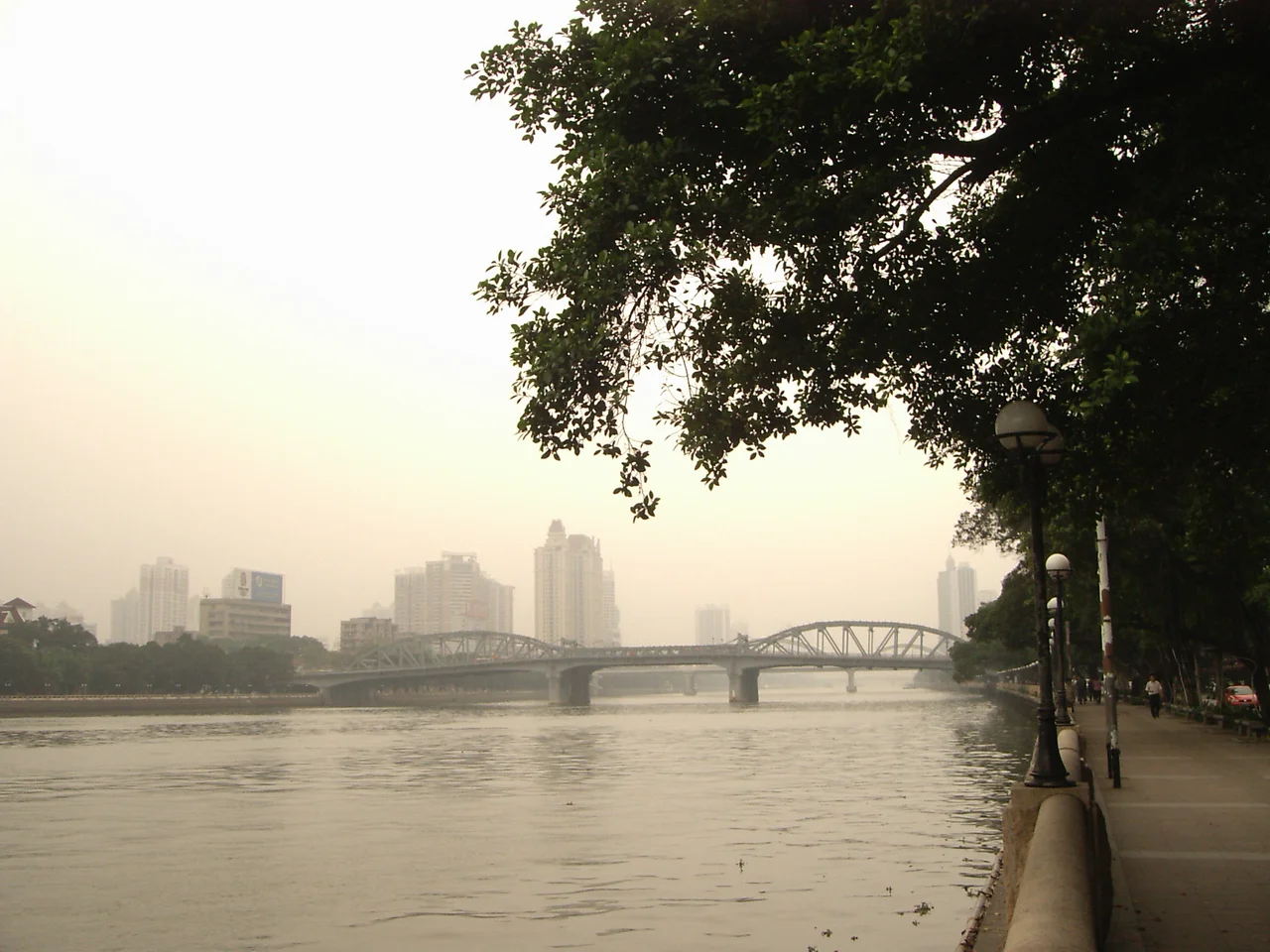

Haizhu Bridge
Before 1933, there was no fixed crossing of the Pearl River in Guangzhou. Ferries shuttled passengers and goods across the wide brown water while the city's two banks lived parallel but separate lives. Then the American firm Markton Company finished their iron bridge, connecting Haizhu Square in the north to Jiangnan Avenue in the south, and for the first time the river that had defined Canton's geography became something you could simply drive across.
Four Years in the Making
Work began in 1929, the year the Nationalist government was consolidating power in Nanjing and Guangzhou was riding a wave of modernization ambition. Construction took four years. The Markton Company, an American contractor, brought engineering expertise from abroad to a project that would transform daily life in a city of millions. When the bridge opened in 1933, it was not just an infrastructure achievement — it was a statement of modernity, a span of iron over a river that for two millennia had set the terms of how Canton worked. The bridge runs modest and utilitarian by the standards of grander contemporaries: a two-lane road, bidirectional, practical. But its position at Haizhu Square, at the foot of one of Guangzhou's main commercial corridors, made it immediately indispensable.
Two Destructions
The bridge survived barely five years before war came to it. In 1938, Japanese forces advancing on Guangzhou during the Second Sino-Japanese War damaged the crossing. Guangzhou fell that October, and the occupation that followed reshaped the city for years. The bridge was repaired under occupation, putting it back in use. Then came a second blow from an entirely different direction. In 1949, retreating Kuomintang forces destroyed it again as they fled the advance of the People's Liberation Army — using over a hundred boxes of explosives to drop the middle span into the river and collapse two piers. It was a pattern repeated across China in those final weeks of the civil war — infrastructure destroyed not by an enemy but by the side losing ground, denying what they could no longer hold. Reconstruction took six months. That Haizhu Bridge absorbed two such destructions and endured is a kind of testament to the durability of iron and to the city's determination to keep its river crossable.
The River Beneath
The Pearl River at Guangzhou is not pearl-colored. It runs wide and working, the color of milky tea, carrying the commerce of one of the world's great port cities toward the South China Sea. From the bridge's deck you look west toward the older parts of the city — the Xiguan district where merchants built their grand houses — and east toward the modern skyline that has risen since Guangzhou became one of China's manufacturing and trading centers. The bridge sits low over the water, close enough to feel the river's scale. Cargo vessels, pleasure boats, and tourist ferries pass beneath. At night the Pearl River's bridges light up in coordinated spectacle, part of the city's signature illumination along the waterfront, and Haizhu Bridge joins the chorus as it has for over ninety years.
A Bridge and Its Notoriety
In 2009, Haizhu Bridge gained unwanted international attention when a series of people threatened to jump from its railing, drawing crowds and eventually prompting a widely reported incident. The moment touched on currents running through Chinese society — rapid urbanization, economic pressure, the particular vulnerabilities of migrants far from home in a vast city. It was a human story enacted on a very public stage, and the bridge's location at the heart of the city made it impossible to ignore. Authorities eventually installed barriers. The episode passed. The bridge returned to what it had always been: a crossing, a connection between two banks, a piece of the working infrastructure of a city that has been trading, building, and reinventing itself for over two thousand years.
Still Crossing
Guangzhou today has dozens of Pearl River crossings — tunnels bored beneath the riverbed, suspension bridges with towers visible for miles, metro lines running underwater. Haizhu Bridge, with its two lanes and iron bones, is no longer the engineering marvel it once was. But it remains in service, carrying the same function it has carried since 1933: moving people and vehicles between Yuexiu and Haizhu districts, stitching north to south across the water that gives the city its character. History accumulates on old bridges. This one has absorbed a colonial-era construction project, two wartime destructions, the upheavals of the Maoist decades, and the extraordinary transformation of Guangzhou into one of the world's largest metropolitan areas. It still stands.
From the Air
Haizhu Bridge sits at coordinates 23.1153°N, 113.2617°E, spanning the Pearl River between Yuexiu and Haizhu districts in central Guangzhou. Approaching from the south at 3,000–5,000 feet, the Pearl River is the dominant geographic feature — wide, curving east-to-west through the urban fabric. The bridge is one of many Pearl River crossings visible from altitude, distinguished by its position adjacent to Haizhu Square to the north. The nearest major airport is Guangzhou Baiyun International (ZGGG), approximately 28 km north-northeast. At lower altitudes on a clear day, the river's north bank skyline — including the Canton Tower further east — provides strong orientation landmarks.
Nearby Stories
- Shunde 12 km away
- 2015 Shenzhen Landslide 15 km away
- Mount Luofu 23 km away
- Qingyuan Maglev Tourist Line 32 km away
- Kaiping 56 km away
- Heyuan 90 km away
- Chikan, Kaiping 92 km away
- Erlitou Site Museum of the Xia Capital 1257 km away