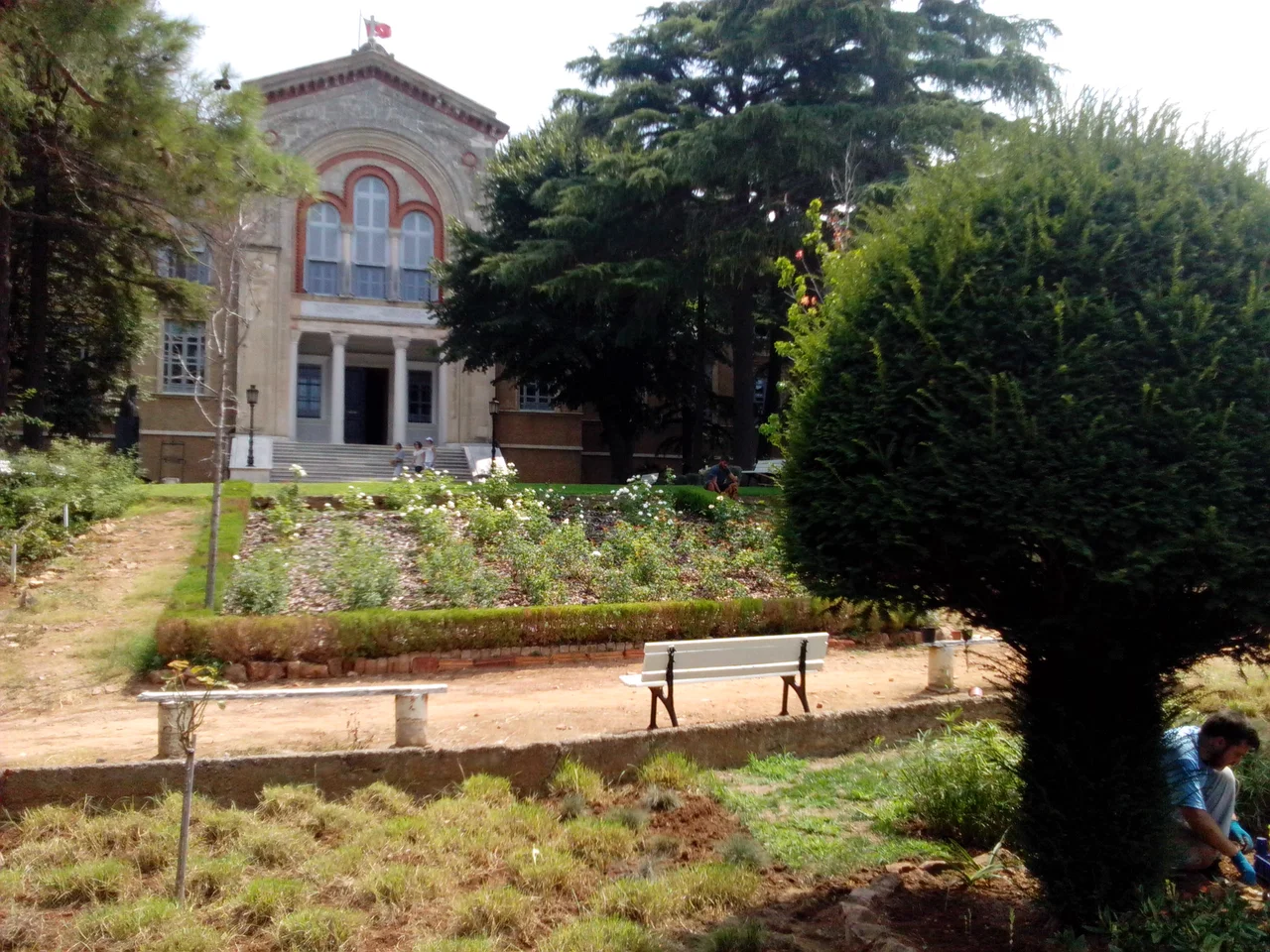

Halki Theological School Gardens
Cedar trees for self-discipline. Orange trees for prudence. A fig for gentleness, a pomegranate for courage, a peach for humility. These are not metaphors invented by a modern wellness brand. They come from a 12th-century Byzantine manuscript, Codex Oxoniensis Clarkianus 39, discovered in Oxford — and they now grow in a garden on a hillside in the Sea of Marmara, planted according to that ancient text's precise instructions. The Halki Theological School Gardens are among the most unusual garden projects in the world: a scholarly reconstruction of Byzantine monastic horticulture, created on the grounds of a seminary that has been closed to students since 1971, on an island at the center of an unresolved dispute between Turkey, Greece, the United States, and the Ecumenical Patriarchate of Constantinople.
The School on the Hill of Hope
Ümit Tepesi — Hope Hill — rises at the center of Heybeliada, the second largest of the Princes' Islands. On its summit sits the Monastery of the Holy Trinity, whose origins stretch back at least to the 9th century, when Patriarch Photios I of Constantinople was buried there. The monastery was rebuilt with an extensive library in 1550, burned in 1821, and reconstructed again in 1844, when it became home to the Halki Theological Seminary of the Ecumenical Patriarchate of Constantinople — for over a century the primary institution for training Greek Orthodox clergy in Turkey. The seminary educated generations of clergy until 1971, when Turkey's Constitutional Court ruled parts of the Private University Law unconstitutional, requiring all private institutions of higher education to join state universities or close. The seminary's Board of Trustees declined to merge with the University of Istanbul. The school shut its doors. It has not reopened.
Fifty Years of Silence in the Garden
After the seminary closed, the grounds fell quiet. The Byzantine Church of the Holy Trinity remained open to visitors, but the gardens that had once served a living monastic community lost their purpose and, over decades, lost their form. By 2013, the site retained no significant gardens worth the name. That year, the Abbot of the Monastery of the Holy Trinity and Bishop of Bursa, Elpidophoros (who would later become Archbishop of America), extended an invitation to Professor Nerantzia Tzortzi of the Landscape Architecture Laboratory at Neapolis University Paphos. The project that followed was not merely horticultural. It was an act of scholarly archaeology: reconstructing what a Byzantine monastic garden would have looked like, sounded like, smelled like — drawing on manuscripts, miniatures, religious icons, and archives from the Hellenic Institute of Byzantine and Post-Byzantine Studies in Venice, the Byzantine Research Centre at Oxford, and Dumbarton Oaks in Washington, D.C.
A Walk Through Virtues
The centerpiece of the reconstructed garden is the Trail of Virtues, a path planted according to instructions found in that 12th-century Oxford manuscript. Fourteen plants stand along the seminary's entrance path, each chosen for its association with a specific virtue in Byzantine moral theology. Cedar, Aleppo pine, and Mediterranean cypress together embody self-discipline. Orange trees signify prudence. A date palm represents justice. Lily — humility expressed as indigence. Fig for gentleness, grapevine for calmness, pomegranate for courage, peach for humility, oriental sweetgum for prayer, sarsaparilla for knowledge, olive for charity, raspberry for obedience. Walking through them is an experience unlike most garden visits: each plant is simultaneously botanical specimen, theological argument, and living quotation from a text copied by a medieval scribe who could not have imagined it being read — and planted — a thousand years later on an Aegean island.
Bible, Vineyard, and Byzantine Meadow
The garden does not stop at virtues. A Garden of Bible contains 66 of the 82 plants mentioned in scripture, planted around the Church of the Holy Trinity. A biodynamic vineyard anchors the edible garden at the perimeter — a reference to the medieval pattern called the Hortus conclusus, the enclosed garden of monastic self-sufficiency. Between the virtue trees, a Byzantine Meadow blooms with tulips, dandelions, and cyclamens, all plants that carried specific symbolic weight in the visual vocabulary of Byzantine art and theology. The entire project is self-managed and sustained by volunteer contributions from both Greek and Turkish participants — a collaboration that carries its own symbolic weight given the political context surrounding the seminary itself. All material for the garden has come from this shared effort.
An Open Question
The closure of the Halki Seminary has remained a point of contention involving the Ecumenical Patriarchate, the Turkish government, successive U.S. administrations, and the Greek government for more than fifty years. The Patriarchate holds that the closure prevents the Orthodox community from training clergy within Turkey, which it argues is essential to the continuation of the Patriarchate in Istanbul. Turkish authorities have argued, through Anadolu Agency and official channels, that the Patriarchate has declined a workable arrangement within Turkey's higher education framework. In 2021, President Erdoğan suggested that reopening might be possible if Greece improved conditions for the Muslim population of Thrace. As of this writing the seminary remains closed to students, though the monastery and gardens are accessible to visitors. The garden grows on regardless — tended, symbolic, patient.
From the Air
The Halki Theological School Gardens are situated at approximately 40.8825°N, 29.0953°E on the summit of Hope Hill (Ümit Tepesi, 85 meters / 278 feet) at the center of Heybeliada island. From the air at 2,000–3,000 feet, the white buildings of the Monastery of the Holy Trinity are visible as the highest structures on the smaller of the two prominent Princes' Islands immediately northwest of Büyükada. The nearest airport is LTFJ (Sabiha Gökçen International, Asian side of Istanbul, approximately 20 km north). The major hub is LTFM (Istanbul Airport, European side). The island cluster sits in the Sea of Marmara and is most clearly visible in the morning when sea haze has not yet built.
Nearby Stories
- Second Battle of Çatalca 1.5 km away
- Tarabya 4.1 km away
- Şile 7.9 km away
- Hereke Carpet 12 km away
- Battle of Melantias 19 km away
- Bursa 47 km away
- Bandırma 51 km away
- 2025 Kartalkaya Hotel Fire 192 km away