.jpg)
Hallaig
Hallaig is a place and a poem and a wound. The place is a green hollow on the eastern shore of Raasay, the small island between Skye and the Scottish mainland, where ruined stone walls trace the outlines of houses that have stood empty for nearly two hundred years. The poem was written in Edinburgh in 1954 by Sorley MacLean, born on Raasay in 1911, in the Gaelic he spoke at home. It is one of the great elegies in any modern European language. It is about the people who lived in Hallaig before they were forced out, and about the silver birch trees that grew back in their absence, and about how the dead are sometimes more present than the living.
The clearance
Between roughly 1852 and 1854, the Macleod laird who owned Raasay evicted the families living on the eastern townships of the island, including Hallaig, Screapadal and Leac. The land was wanted for sheep. The forced removal was part of the Highland Clearances, the long, brutal reorganization of the Scottish Highlands in which landowners replaced their tenant farmers with more profitable livestock. Some of the Raasay families were given a passage to Australia. Others crossed to the mainland with whatever they could carry. By the time MacLean was a child on Raasay in the 1910s, Hallaig was already a ruin. He grew up walking past the broken walls of the houses where his people had lived. The Gaelic poet John MacKenzie, his great-grandfather, was from there. The poem is the inheritance of that walk.
What the poem does
Hallaig was first published in the Gaelic literary magazine Gairm in 1954. MacLean wrote it in Edinburgh, where he was working as a teacher, and translated it himself into English. The Gaelic title is simply Hallaig. The opening line, "Tha tim, am fiadh, an coille Hallaig" - "Time, the deer, is in the wood of Hallaig" - sets the work's central image: time as a stag moving through the birches where the people used to live. The poem's astonishing turn is that the dead are not gone. They are there in the trees. "They are still in Hallaig... The dead have been seen alive." The cleared villagers walk among the birches as birches; the women MacLean's grandfather knew become rowans and hazels at the burn. The poem refuses the finality of the clearance. The wood is the people, made green again.
Sorley MacLean
Somhairle MacGill-Eain, the Gaelic name on his birth certificate, was born at Osgaig on Raasay on 26 October 1911. He spoke Gaelic as his first language. He studied at Edinburgh University and taught school for most of his life, including a long stretch as headmaster of Plockton High on the mainland. He fought in North Africa during the Second World War and was wounded at El Alamein. His poetry, much of it written in Gaelic at a time when the language was thought to be dying, transformed how Scottish literature understood itself. He wrote about love, about politics, about the land. Hallaig is his most translated and most read poem; Seamus Heaney made a celebrated English version. MacLean died in 1996, having lived long enough to see Gaelic poetry restored to the centre of Scottish culture, and his island ferry named for him.
The wood today
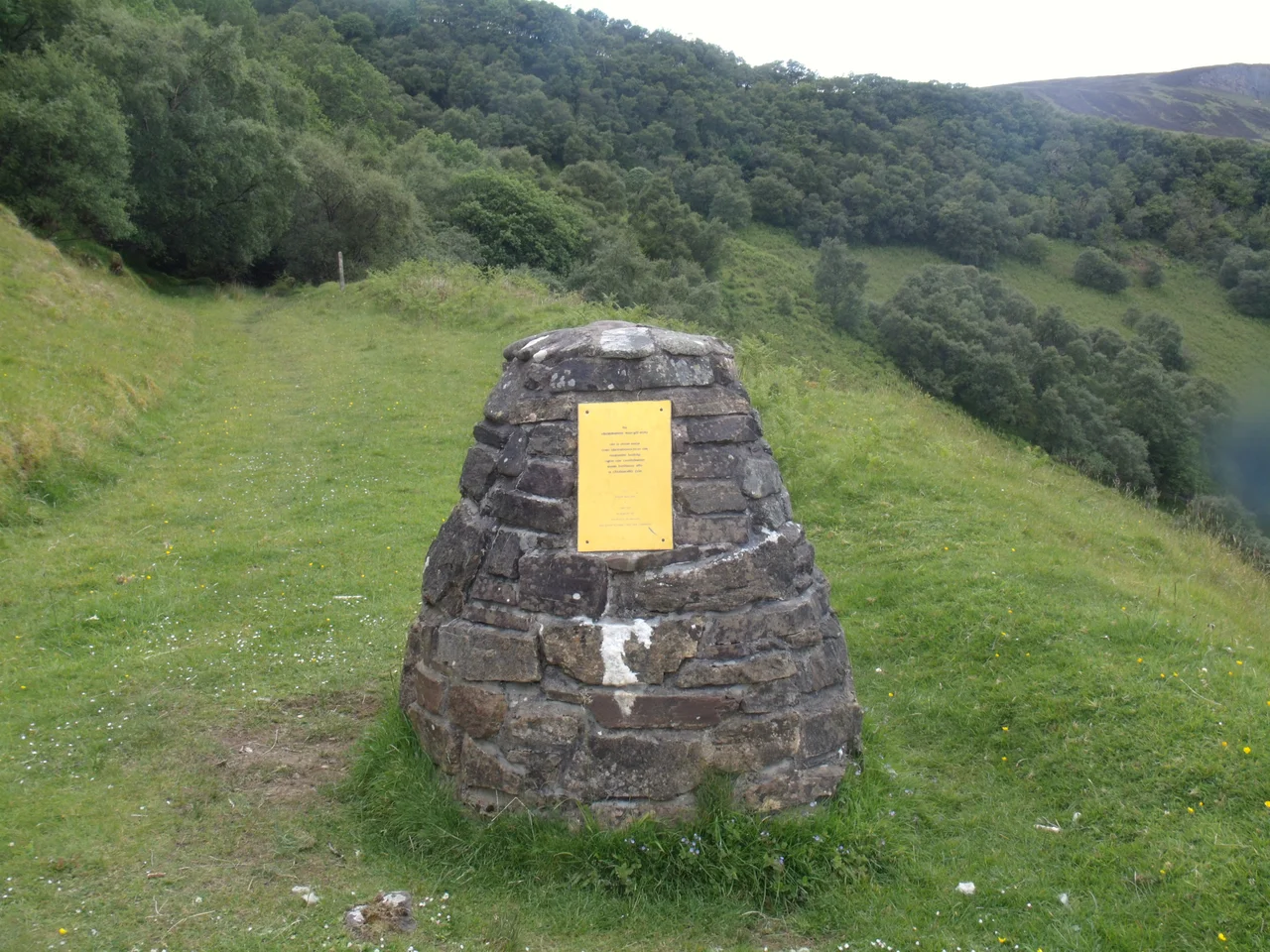
Hallaig is reached now by a footpath from the road, an hour's walk through bracken and birch. The path ends in the township: low ruined walls in lines, the dykes that once divided fields, the foundations of houses with the doorways still visible. Birches grow inside what used to be rooms. In late spring the bluebells come up between the stones. There is a memorial cairn with the opening line of the poem in Gaelic and English. Caledonian MacBrayne named their first hybrid-electric ferry Hallaig in 2012; she now runs the short crossing from Sconser on Skye to Raasay, named for the lost village she carries no one home to. The poem set there is incorporated into Peter Maxwell Davies's opera The Jacobite Rising. Martyn Bennett recorded MacLean reading it on his album Bothy Culture, the poet's old voice reading his own translation over electronic music. William Sweeney wrote an organ piece called Hallaig for Dunblane Cathedral. The wood, the poem, the people: still here.
From the Air
Hallaig is on the eastern shore of Raasay at 57.37 N, 6.01 W. Position is roughly halfway down the island, on the Sound of Raasay side facing the mainland. Nearest airstrip is Broadford on Skye, about 12 nm south-southwest; Inverness (EGPE) is approximately 70 nm east. The site itself is a green hollow visible from the air as a clearing among the birchwoods on the otherwise heather-covered slopes. The flat-topped Dun Caan, Raasay's highest hill at 444 m, sits a couple of miles south and is the island's most identifiable landmark.
Nearby Stories
- Strome Castle 5.6 km away
- Neist Point 7.2 km away
- Loch Maree Hotel Botulism Poisoning 7.8 km away
- Tarskavaig 10 km away
- Skye Trail 11 km away
- St Clement's Church, Rodel 19 km away
- Glenfinnan Viaduct 30 km away
- SS Politician 36 km away