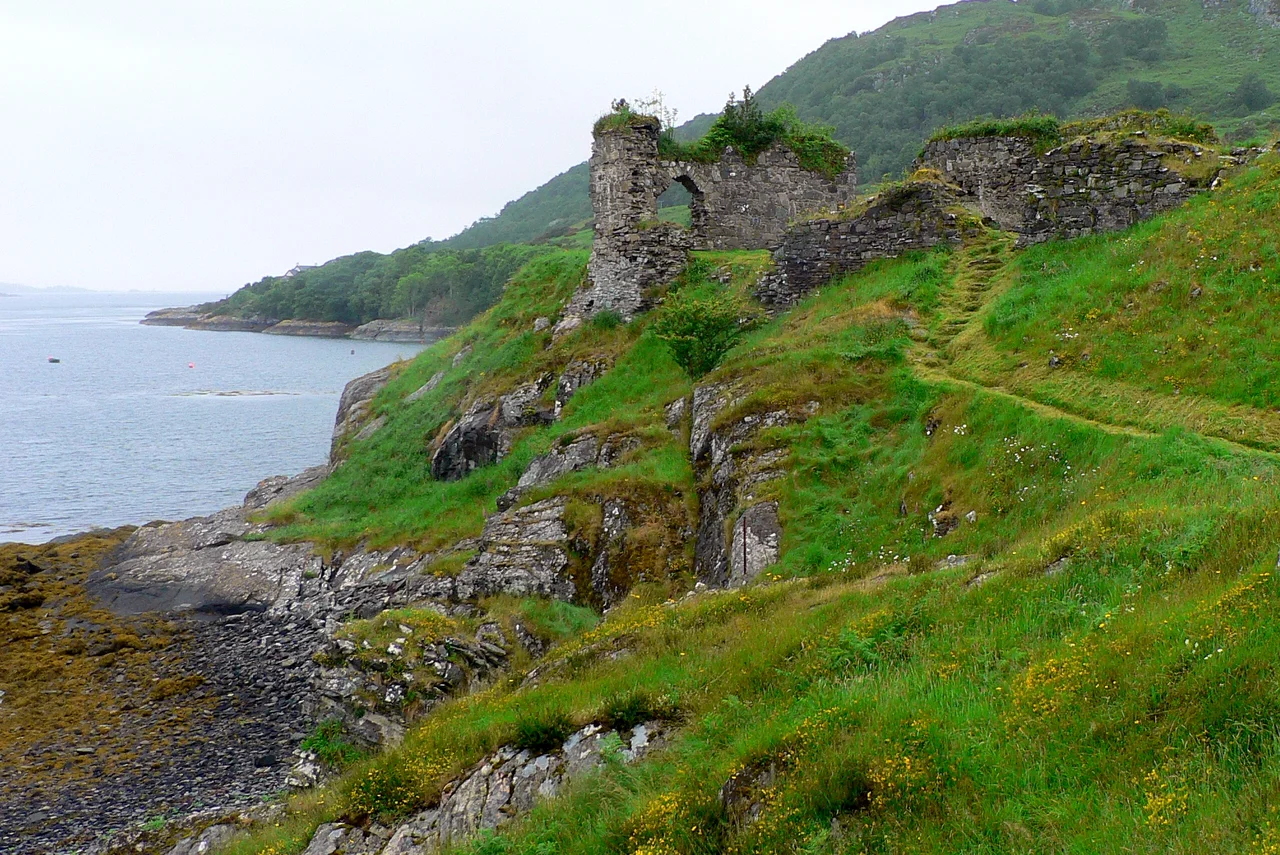

Strome Castle
In 1602 Kenneth Mackenzie, 1st Lord Mackenzie of Kintail, finished a job his father had started. Strome Castle, the MacDonell stronghold guarding the entrance to Loch Carron, had held out through siege; when the garrison finally surrendered, Mackenzie ordered the castle demolished and blown up with gunpowder so that it could never be used again. Four centuries later the stub of the square tower still stands on its headland between Loch Carron and Loch Kishorn - a small ruin in a vast sea-loch landscape, and a quiet monument to the clan warfare that defined this coast for two hundred years.
Built By The Lord Of The Isles
Strome Castle was originally built in the fifteenth century by Alexander MacDonald, Lord of the Isles and Earl of Ross. By 1472 the castle belonged to his eldest son Celestine of Lochalsh, founding figure of Clan MacDonald of Lochalsh. Alan MacDonald Dubh, twelfth chief of Clan Cameron, served as constable on behalf of the MacDonalds. The headland the castle sat on was deliberately chosen: any vessel sailing into Loch Carron had to pass within easy bowshot, and any party advancing overland from Lochalsh had to file along the narrow strip of shore beneath the castle walls. In an age when control of a sea-loch meant control of the fishing, the trade, and the cattle traffic that depended on coastal galleys, Strome was a piece of real estate worth holding. Which is exactly why other people kept trying to take it.
Granted, Seized, Disputed
In 1539 King James V of Scotland granted Strome to Clan MacDonell of Glengarry, with Hector Munro, I of Erribol of Clan Munro serving as constable for the new owners. The MacDonells held the castle for the next sixty years, but they were never far from trouble. The Mackenzies of Kintail to the south were ambitious and methodical; they had already taken control of much of Lochalsh through purchase, marriage, and force. In 1580 a full-scale feud erupted between the two clans. The Privy Council of Scotland tried to mediate, briefly detaining Colin Cam Mackenzie of Kintail in Edinburgh, but a royal pardon followed and the feud continued. The aftermath of the Battle of Morar in 1602 finally provided the Mackenzies with the opening they needed. Kenneth Mackenzie, supported by Clan Matheson and Andrew Munro of Novar, laid siege to Strome.
Demolished On Purpose
When the MacDonells of Glengarry surrendered Strome to the besiegers, Kenneth Mackenzie made a decision unusual for the period: rather than occupy the castle as a Mackenzie stronghold, he had it demolished and blown up with gunpowder. The logic was strategic. As long as Strome stood it would remain a focus of dispute, a place the MacDonells might try to recover or that other rivals might covet. A pile of ruined stone could not be garrisoned, refortified, or contested. The MacDonells of Glengarry built a replacement castle far inland at Invergarry, near the head of Loch Oich; the Mackenzies retained the headland but not the building. The act marked a turning point in West Highland clan politics, an early example of strategic demolition as a tool of consolidation. Castles, after all, were only useful while they had walls.
What The Sea Has Left
In 1939 the ruined Strome Castle was presented to the National Trust for Scotland. Today the site consists of a courtyard plot and the lower courses of a square tower, set on a small grassy promontory above Loch Carron with a single track winding down from the village of Lochcarron. There is no admission charge, no interpretation centre, no opening hours. Visitors park near the headland and walk down to the ruin past sheep and gorse. The light off the sea-loch is one of the best things about the place; in late afternoon the water turns the colour of brushed pewter and the surviving walls cast long shadows down the headland. Across the loch the village of Stromeferry sits quietly, named for the ferry that once ran from there to the Strome side before the road around the head of Loch Carron was opened. The castle has been quiet now for four hundred years. It seems likely to stay that way.
From the Air
Located at 57.3591 N, 5.5559 W on the south shore of Loch Carron in Stromemore, on the headland between Loch Carron and Loch Kishorn. Strome Castle appears as a small stone ruin on a low grassy promontory, 3.5 miles southwest of the village of Lochcarron. Distinctive aerial features: the narrowing of Loch Carron at Strome point (where the loch is at its tightest and the old ferry route ran), the Applecross peninsula immediately north across the loch, the road to Skye climbing southwest from the village along the south shore. Nearest aerodromes: Plockton airstrip approximately 15 km southwest; Inverness (EGPE) approximately 100 km east. Surrounding terrain: Bidean a' Choire Sheasgaich (945 m) and Lurg Mhor (986 m) rise inland to the south-southeast, the Applecross hills to the north. Loch Carron is a deep sea loch with high cliffs along parts of its south shore. Weather: westerly systems funnel directly up the loch, producing rapidly building sea-state and downdrafts off the Applecross peninsula. The ruin photographs best in late afternoon when slanting light catches the surviving walls against the silver of the loch.
Nearby Stories
- Tarskavaig 1.9 km away
- Hallaig 3 km away
- Loch Maree Hotel Botulism Poisoning 3.6 km away
- Affric-Beauly hydro-electric power scheme 11 km away
- Invergarry Castle 11 km away
- Knoydart 14 km away
- Skye Trail 21 km away
- Alladale Wilderness Reserve 29 km away