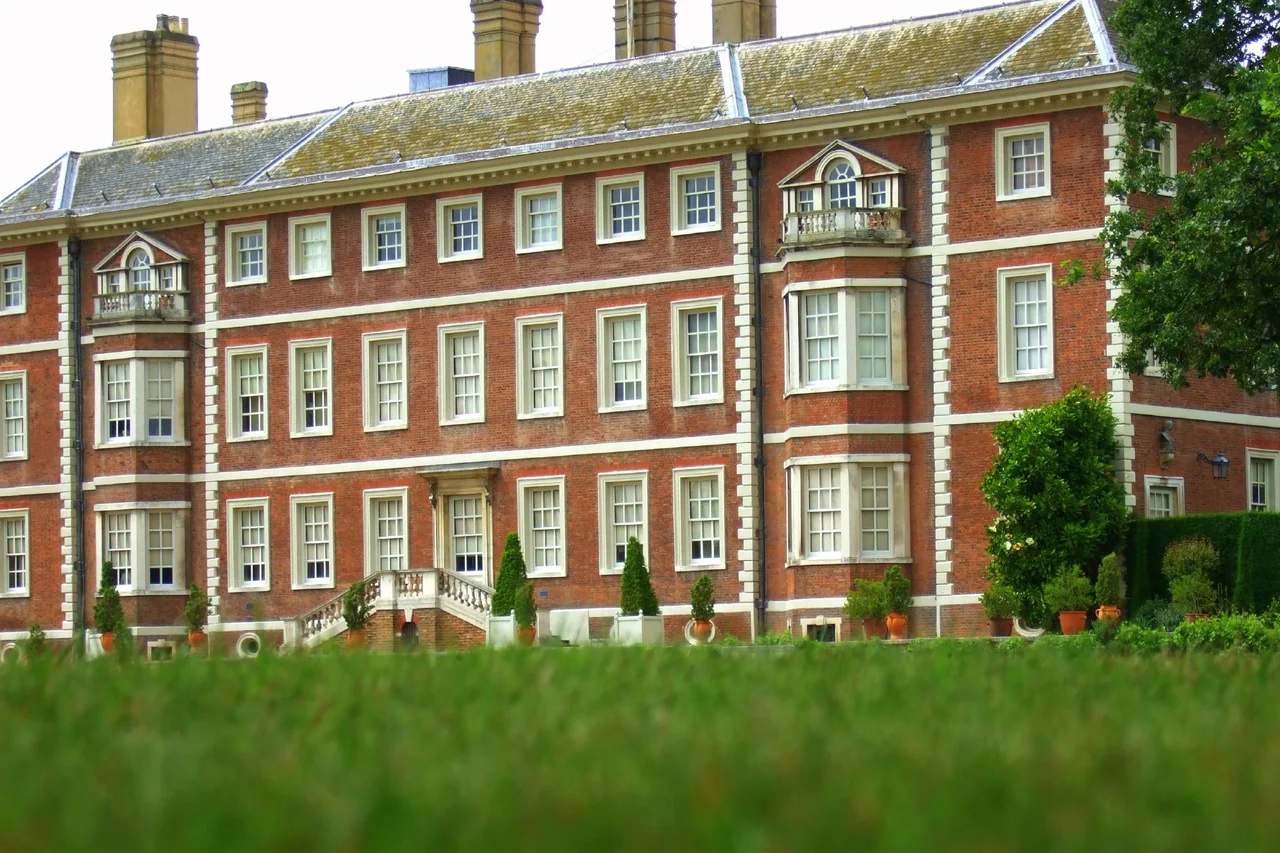

Ham House
Elizabeth Murray, Countess of Dysart in her own right, ran Ham House like an embassy and a fortress at once. Her father had been Charles I's whipping boy and confidant, but Elizabeth was the operator. During the Civil War she protected the estate by paying a Parliamentary fine. During Cromwell's Protectorate she cultivated a relationship with the Lord Protector himself, close enough that contemporary spies could never decide whose side she was on. When the king came back in 1660, she was still standing, still in possession of the manor, and ready for the second act of her life: marriage to one of the most powerful men in Britain, and the transformation of a modest Jacobean house on the Thames into a Restoration palace so opulent that even her admirers thought she had overdone it.
A Knight Marshal's Riverside House
The first Ham was finished in 1610 for Sir Thomas Vavasour, Knight Marshal to James I. He needed a base from which he could move quickly by river to the royal palaces at Richmond, Hampton Court, Whitehall, and Windsor, and the bend of the Thames just south of Richmond gave him exactly that. The original house was a tight, three-storey H-plan in red brick, nine bays wide. After Vavasour died in 1620 the lease passed eventually to William Murray, a Scot who had grown up beside the future Charles I and remained one of his closest companions. Murray hired the Anglo-German painter Francis Cleyn and the plasterer Joseph Kinsman, then very fashionable at court, to remodel the interior in the latest Caroline taste. The Great Staircase, with its panels of carved trophies of war, dates from this period and is, in the words of the historian Christopher Rowell, "apparently without a close parallel in the British Isles."
The Duchess Who Outlasted Three Regimes
Elizabeth Murray inherited Ham in 1655. Her first husband, Sir Lionel Tollemache, was a Royalist of useful neutrality; together they had eleven children, of whom five survived. Her second marriage was something else entirely. John Maitland was the Earl of Lauderdale, a member of Charles II's Cabal ministry, High Commissioner for Scotland, and the man who effectively ran Scottish government for the king. When he and Elizabeth married in 1672, he was created Duke. From that moment Ham became a stage. The Lauderdales nearly doubled the house's volume by filling in the south side of the H, commissioned a suite of state apartments good enough to host royalty, and accumulated paintings, tapestries, and lacquered cabinets from Mortlake, Japan, and the Northern Netherlands. The architectural historian Geoffrey Beard later wrote that they had furnished the place "with a lavishness which transcended even what was fitting to their exalted rank."
The Ivory Cabinet and the Tapestries
Walk through Ham today and the things that survive are extraordinary precisely because they were never thrown out. In the North Drawing Room stands an oak-and-cedar cabinet veneered in rippling ivory panels, opening to reveal fourteen drawers and a series of secret compartments. It first appears in the 1677 inventory and was probably made in the Northern Netherlands, inspired by furniture brought back from Dutch Brazil. The Long Gallery holds eleven portraits by Peter Lely, including the final painting of Elizabeth herself, painted around 1680 when her movements were already restricted by gout. A 17th-century portrait of John Maitland's father turned out, in a 2016 X-ray, to conceal an underpainting of Mary, Queen of Scots, dated 1589, two years after her execution. To paint such a thing in Scotland at that moment was a quiet act of dissent.
Sash Windows and Garden Geometry
The Lauderdales' south facade was an early experiment in something now utterly ordinary: the sash window. The French invention had only just arrived in England, refined here with weights and pulleys, and Ham was among the first houses to install it at scale. The east front still has many of its 17th-century panes. The gardens that wrap the house are an even rarer survival. Most great English gardens were swept away in the 18th century by the fashion for naturalistic landscapes; Ham kept its formal compartments, the Cherry Garden, the wilderness, the grass plats, and the long allees that draw the eye toward the river. Together with the original interiors, this makes Ham, as the critic John Julius Norwich put it, "a time machine, enclosing one in the elegant, opulent world of van Dyck and Lely."
The National Trust Years
Elizabeth died at Ham in 1698, aged 72. The house passed through her Tollemache descendants, who, in a useful eccentricity, mostly left it alone. The 5th Earl famously refused a request from George III to visit. The 9th Earl, the last to live there, died in 1935. In 1948 the family gave Ham to the National Trust along with most of its contents intact, which is the reason it remains the closest thing England has to a fully furnished Stuart house. Restoration scholars now arrive from across Europe to study the textile dyes, the auricular picture frames, and the bath house out behind the service yard. Period dramas film here constantly. The Thames, just beyond the north front, still does what it did for Thomas Vavasour: carries Ham, undisturbed, between Richmond and Hampton Court.
From the Air
51.4421 N, 0.3175 W on the south bank of the Thames between Richmond and Kingston, opposite Marble Hill House. The red-brick H-plan is easily identifiable in clear weather, set in formal gardens of grass plats and tree-lined avenues. Nearest airport: London Heathrow (EGLL) 6 nm northwest.
Nearby Stories
- Battle of Britain, Northfleet 1.1 km away
- Bayham Old Abbey 5.4 km away
- Catharine Macaulay 6.4 km away
- Hatfield rail crash 8.8 km away
- Chequers 8.9 km away
- Chelmsford Cathedral 10 km away
- Queen Victoria Hospital 13 km away
- Fishbourne Roman Palace 36 km away