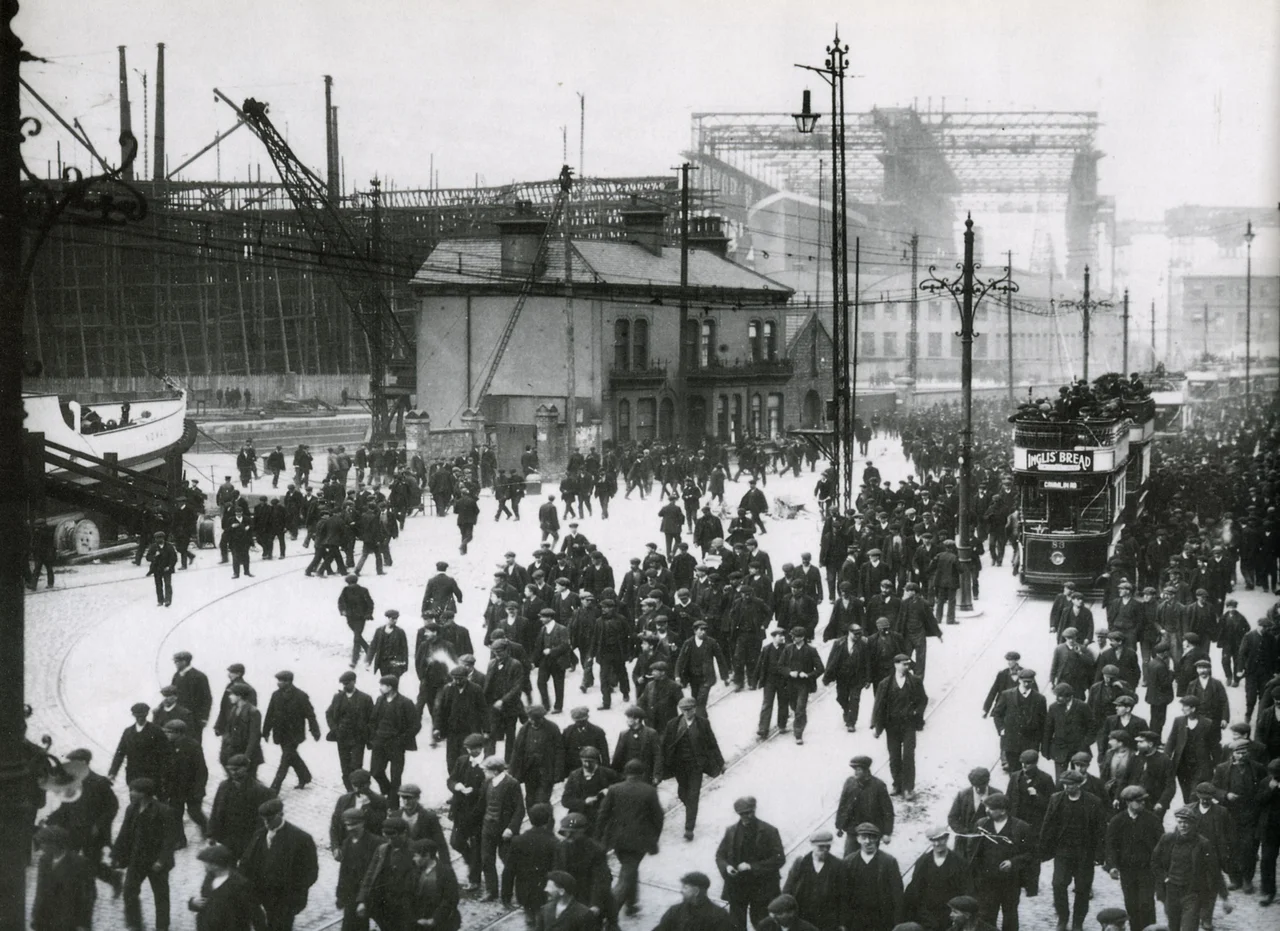

Harland & Wolff
Two yellow gantry cranes called Samson and Goliath stand on the eastern shore of Belfast Lough, each rising 96 metres into the sky, visible from forty miles away on a clear day. They were built by Krupp in 1969 and 1974 to lift the largest oil tankers ever assembled in Britain. They are still there. They do not lift much these days, but they remain the largest moving objects in Northern Ireland and the most photographed silhouette in the city. They mark the spot where, between 1909 and 1912, three teams of riveters working in twelve-hour shifts built the largest ship in the world and then her two sisters. The ship was the RMS Titanic. The yard was Harland & Wolff.
Two Men, a Yard, and a Welsh Investor
Edward Harland was an English-born shipbuilder who arrived in Belfast as the general manager of a small Queen's Island yard owned by Robert Hickson. In 1858 he bought the yard outright. Three years later, in 1861, he made his German-born assistant Gustav Wilhelm Wolff a partner. Wolff happened to be the nephew of Gustav Schwabe of Hamburg, a major investor in the Bibby Line - which is how the new firm got its first three orders. Harland's innovations were practical and game-changing: he gave hulls flatter bottoms and squarer cross-sections to increase cargo capacity, replaced wooden upper decks with iron, and turned out ships faster than anyone else in Britain. By the 1880s Harland & Wolff was the largest shipbuilder in the world. When Harland died in 1895 the chairmanship passed to William James Pirrie, and Pirrie's nephew Thomas Andrews - born in Comber across the lough - rose to become managing director and chief naval architect.
Olympic, Titanic, Britannic
The White Star Line was in a race with Cunard. Cunard had the Mauretania and Lusitania, the fastest liners on the Atlantic. White Star decided to compete on size and luxury instead. Between 1909 and 1914, Harland & Wolff built three nearly-identical Olympic-class liners under a vast new gantry structure designed by Sir William Arrol. The first was the Olympic, launched in 1910 and broken up in 1935 after an honourable career. The second was the Titanic, launched 31 May 1911, sunk by an iceberg 14 April 1912 on her maiden voyage, taking around 1,500 lives - including Thomas Andrews himself, last seen helping passengers into lifeboats. The third was the Britannic, launched 1914, requisitioned as a hospital ship, sunk by a mine in the Aegean in 1916. Three sisters. Three different endings. One yard.
The Protestant Closed Shop
There is a harder story under all the heritage. Harland & Wolff drew most of its workforce from the Protestant Shankill Road and east Belfast districts, and Catholics who tried to work there were never made welcome. In July 1912, in June 1898, and again during the loyalist riots of 1920 to 1922, Catholic workers, socialists and trade-union activists were physically driven from the yard - one period of expulsions left more than 5,000 Catholic and labour-movement workers locked out. The pattern repeated. In July 1970, during the early Troubles, around 500 Catholic workers were again expelled. Many never returned. The yard remained, for most of its life, a Protestant closed shop in the structural sense - hiring practices, apprenticeships, and informal networks all reinforced the same boundary. The official histories tend to celebrate the ships. The full history has to include the men who were locked out of building them.
The Blitz and the Long Decline
In April and May 1941, the Luftwaffe bombed Belfast. The Belfast Blitz killed around 1,100 people in two nights of attack - one of the worst civilian death tolls per capita anywhere in the UK during the war. The shipyard was a primary target. The yard's aircraft factory, where Short & Harland built Stirling bombers, was destroyed. The shipbuilding side was hit hard but recovered: through the rest of the war the workforce peaked at around 35,000, building six aircraft carriers, two cruisers, and 131 other naval vessels, repairing more than 22,000. Then came the long ebb. Jet airliners replaced ocean liners through the 1960s. The last great ship, MV Anvil Point, was launched in 2003. The yard nationalised in 1977, privatised again in 1989 under Norwegian magnate Fred Olsen, scraped a living off offshore oil platforms and bridge components and wind-turbine assemblies. By 2019 it had filed for administration.
The Spanish Era Begins
InfraStrata, a small London energy firm, picked up the Belfast yard for £6 million in October 2019. They renamed themselves Harland & Wolff Group Holdings, acquired the dormant Appledore yard in Devon and the BiFab yards at Methil and Arnish in Scotland, and tried to turn the company into a four-site fabrication group bidding for naval and renewables work. In 2022 they won a slice of a £1.6 billion Royal Fleet Auxiliary contract for three new Fleet Solid Support vessels. In April 2023 the Belfast yard launched its first new vessel in twenty years - a humble Cory waste barge, but a new keel nevertheless. By September 2024 the company was back in administration. In January 2025, Navantia - the Spanish state-owned shipbuilder, descendant of the yards that built the Armada that sailed against Elizabeth I in 1588 - completed its purchase of all four Harland & Wolff sites. The yellow cranes, Samson and Goliath, still stand. Whether new ships will rise beneath them again is the next chapter of a 164-year story that keeps refusing to end.
From the Air
Located at 54.605°N, 5.905°W on Queen's Island, the southern shore of Belfast Lough, immediately east of the River Lagan's mouth. From the air, the yard is impossible to miss: the two enormous yellow gantry cranes Samson and Goliath, each 96 metres tall, dominate Belfast's eastern skyline and are visible from miles out over the Irish Sea. They mark the former slipways where Titanic and Olympic were built; the Titanic Belfast museum, with its four iceberg-shaped silver prows pointing skyward, sits at the head of the old slipways at 54.608°N, 5.910°W. Belfast City Airport (EGAC) is immediately south-east of the yard with its runway running parallel to the docks. Belfast International (EGAA) is 13 nautical miles west-north-west. Recommended viewing altitude: 1,500-3,000 feet for the dramatic geometry of the slipways, cranes, and dry docks - lower altitudes are unsafe due to airport traffic.
Nearby Stories
- Larne 1.2 km away
- Ahoghill 3.5 km away
- Castleskreen 4.9 km away
- Lough Neagh 6.1 km away
- Kingsmill Massacre 14 km away
- Pasages (steam trawler) 23 km away
- Ballantrae Lifeboat Station 34 km away
- St Patrick's Isle 39 km away