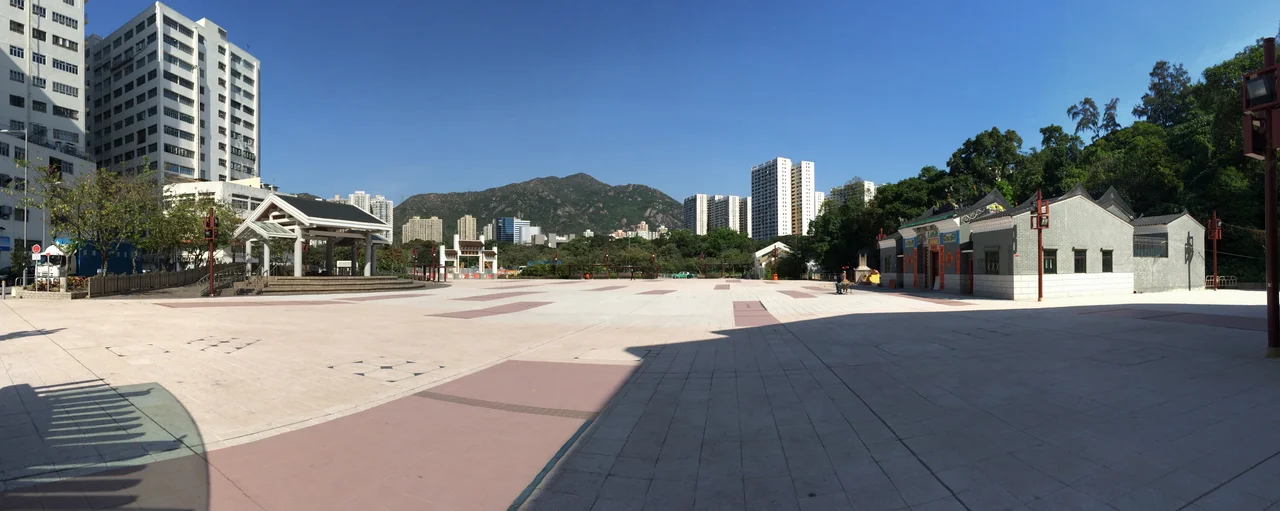

Hau Kok Tin Hau Temple
The sea used to come to this temple's doorstep. Fishermen built it in 1637 at the edge of Tuen Mun's shoreline, facing the water, placed where the goddess they worshipped could watch over every departure and every return. Since then, the land between the temple and the sea has grown by decades of reclamation, and the neighbourhood of Hau Kok that once felt the tides now sits surrounded by factories and roads. The water is gone from sight, but the temple remains — and on the twenty-third day of the third lunar month each year, the same prayers are offered that fishermen were offering when the Ming Dynasty was still in power.
The Heavenly Empress of Mariners
Tin Hau — known in Mandarin as Mazu — is the patron goddess of fishermen and seafarers throughout the coastal regions of southeastern China and across the Chinese diaspora. Her temples dot the shorelines of Guangdong, Fujian, Taiwan, Macau, Hong Kong, and port cities where Chinese sailors settled. The mythology holds that she was a woman of remarkable spiritual gifts who could project herself across the water to rescue sailors in distress, and her name, Tin Hau, means 'Heavenly Empress.' In Hong Kong alone, scores of temples are dedicated to her. The Hau Kok temple in Tuen Mun is one of the older surviving examples — established in 1637, during a period when Tuen Mun functioned as a hub of waterway transport and fish and salt trade through the Pearl River Delta. The fishermen who built it were not being metaphorical when they positioned it facing the sea. They needed her to see the boats.
Salt Merchants and Village Walls
The temple's early history ran alongside the commercial life of the region. During the Ming Dynasty, members of the To clan — engaged in the salt trade — migrated to Tuen Mun and formed relationships with the existing fishing communities. Salt and fish were the twin industries of this coastline, and those who depended on both had reason to propitiate the same goddess. Over time, people living in the walled villages of the area also contributed to the temple's renovation and maintenance, financing repairs on multiple occasions. This pattern of communal investment across clan and occupational lines gave the temple a broader constituency than any single family or trade, which may partly explain its survival. The temple was substantially rebuilt in 1989.
The Tin Hau Festival
The annual Tin Hau Festival, celebrated on the twenty-third day of the third month of the Chinese lunar calendar, brings the temple's courtyard to life in ways that have not fundamentally changed for centuries. Villagers and fishermen gather in the open space in front of the temple — now landlocked, now surrounded by factories, but still an open space — and stage thanksgiving opera performances, dragon dances, and lion dances. The performances are not entertainment in the commercial sense; they are ritual acts of gratitude, prayers offered in the form of spectacle. The Lunar New Year also brings a fair to the temple square each year. And periodically, the temple square hosts what is called an earthen pot gathering — a communal meal cooked in the traditional clay pots associated with Cantonese village cuisine. These recurring events connect the neighbourhood to cycles of time that predate every factory wall around them.
Stranded by the Changing Shore
What is strangest about the Hau Kok Tin Hau Temple today is the story its location tells without words. It was built at the sea's edge, facing outward. The reclamation work of the 1970s and 1980s pushed the coastline away, filling in the water, replacing tidal mud with industrial land. The factories that rose on reclaimed ground now surround the temple, which sits on Tin Hau Road — a road named for what the temple has always honoured. Tuen Mun station on the West Rail line is nearby; the Light Rail routes 610, 615, and 615P stop within easy walking distance. The temple that fishermen built to watch over the sea now sits in the middle of an industrial and transit district, which says something about the pace of transformation in Hong Kong's New Territories over the past half century. It also says something about the persistence of belief. The goddess the fishermen called upon still receives worshippers. The boats are simply somewhere else now.
From the Air
The Hau Kok Tin Hau Temple sits at approximately 22.39°N, 113.97°E in the Tuen Mun district of the New Territories, west of Hong Kong. From Hong Kong International Airport (VHHH) on Lantau, Tuen Mun lies about 10 km northeast across the mouth of the Pearl River estuary. At low altitudes on departure or arrival, the flat coastal strip of Tuen Mun is visible against the hillside of Castle Peak (Tsing Shan) rising behind it. The reclaimed industrial districts where the temple sits are identifiable by their dense factory-building grid east of the Tuen Mun waterfront. The Deep Bay shoreline extends northward toward the mainland border.
Nearby Stories
- Chapel of St. Francis Xavier 3.5 km away
- Cuiheng 4.1 km away
- 2015 Shenzhen Landslide 16 km away
- Shunde 31 km away
- Wanshan Archipelago 37 km away
- Nanxiong Formation 96 km away
- Heyuan 149 km away
- Checheng Fu'an Temple 629 km away