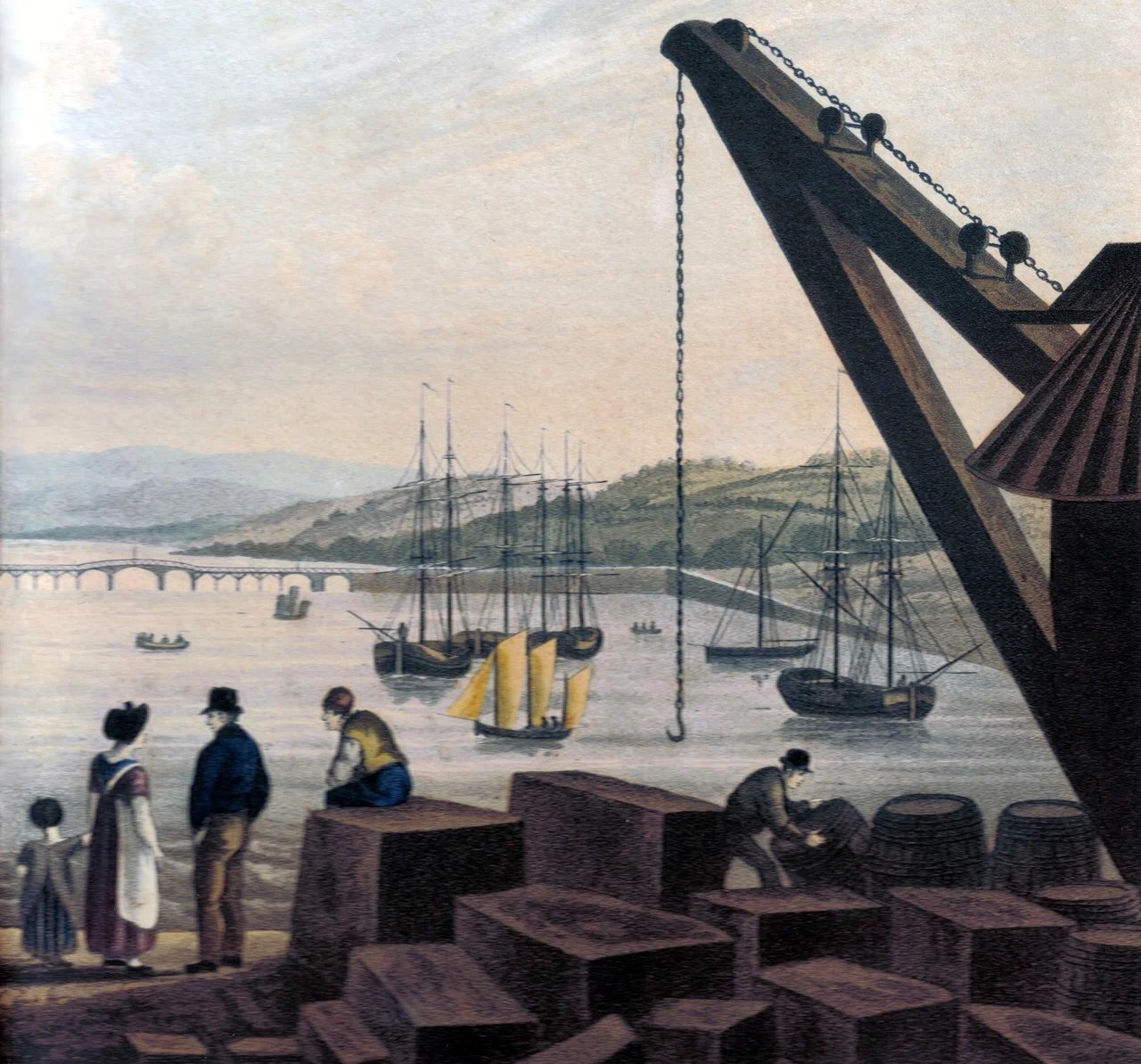

Haytor Granite Tramway
Most railways have iron rails. The Haytor Granite Tramway, opened on 16 September 1820, had rails of granite. The blocks were four to eight feet long and roughly a foot square, shaped to guide flangeless iron wheels along a 10-mile descent of 1,300 vertical feet from Dartmoor down to the Stover Canal. The logic was beautiful in its circularity: the tramway was built out of the very material it was built to carry. Two centuries later, with the canal silted up, the quarries closed, the horses long dead, and the iron wheels gone for scrap - the granite rails remain. You can still walk on them. They cross fields, climb through Yarner Wood, and lie scattered in the front lawn of a hotel near Bovey Tracey, indestructible.
Why Granite
In the 1820s Britain's growing cities had an insatiable appetite for granite - for public buildings, for embankments, for bridges. Cornwall produced it, and so did Dartmoor, but getting Dartmoor granite to market was an engineering problem. Reliable roads barely existed. Railways were a novelty. Coastal shipping worked, but only if you could deliver the stone to a navigable wharf. James Templer the second, of Stover House in Teigngrace, had solved part of that problem in 1792 by building the Stover Canal from Ventiford to the Teign estuary. His son George Templer inherited the quarries at Haytor and faced the harder question: how to move tons of granite down from the moor to his father's canal. The answer, opened in September 1820, was a tramway built from the cargo itself.
How It Worked
The track was a close cousin of the iron plateway, where L-shaped plates guided wagon wheels along a line. Here the plates were cut granite, shaped with a guiding flange on the inner edge. Twelve flat-topped waggons with iron flangeless wheels ran in trains. Eighteen horses, walking in single file, pulled them. Going up the moor the horses walked in front. Coming down with full loads they walked behind, acting as a brake. The wagons were about thirteen feet long, with wheels three inches across the tread - clearly adapted from road waggons. Loose axles. No flanges. The granite did the steering. From the canal basin at Ventiford the stone went by barge to the Teign, then to the New Quay at Teignmouth, built in 1827 specifically for export by sea. The chain ran from the quarry face to the deck of a coastal sloop without a road haul anywhere along the way.
Where the Stone Went
Haytor granite became London Bridge. The bridge designed by John Rennie, opened in 1831, was largely faced with stone quarried at Haytor. When that bridge was sold and dismantled in 1968 and reassembled at Lake Havasu City, Arizona in 1971, the granite went with it - which means a piece of Dartmoor is now sitting in the Sonoran Desert. Haytor stone also went into countless other public works of the early Victorian era. By 1850 the quarries employed about a hundred men. By 1858 they were closed. Cornish quarries with cheaper transport had undercut Devon. The trade had always been sporadic - between 1841 and 1851 no stone was produced at all - but the closing of the quarries this time was permanent. The horses were sold. The waggons broken up. The granite tramway, however, was too heavy and too oddly shaped to be worth lifting for scrap.
The Templer Way
Devon County Council now maintains the eighteen miles of the Templer Way as a public footpath and cycleway, retracing the tramway and canal route from Haytor down to Teignmouth. The best stretch of preserved granite track lies in Yarner Wood, where the rails curve through trees that have grown around and over them since 1858. Chapple Bridge, the only bridge on the tramway, still crosses the Bovey leat. Ventiford Cottages, built for the men who worked the canal and tramway, still stand. In late 2014 a previously unknown section of the track was uncovered at the Ventiford Basin terminus, the granite rails lying just below the surface where they had been buried for over a century. Worldwide, only one other significant tramway like this was ever built - the Weedon Stoneway in Northamptonshire, 1837. Haytor was an experiment so unusual that almost no one repeated it.
From the Air
The Haytor Granite Tramway runs from Haytor (50.586 N, 3.7656 W) east and south for ten miles down to the Stover Canal basin at Ventiford near Teigngrace. View from 2,000 to 3,500 feet to trace the route across moor, woodland, and farmland. Nearest airport is Exeter (EGTE), about 14 nautical miles north-east. The route is rarely a sharp line from the air, but the tramway's path is traceable through Yarner Wood as a clearing and across fields as a low embankment. Best with low-angle sun in spring or autumn when shadows pick out the embankment. The granite rails themselves are too small to see from altitude, but the wooded corridor of the Templer Way is unmistakable.
Nearby Stories
- Torcross 2.8 km away
- Cotehele 4.6 km away
- HMS Formidable (1898) 9.1 km away
- Holsworthy 9.4 km away
- Eddystone Lighthouse 11 km away
- Tiverton Castle 18 km away
- 1890 Norton Fitzwarren Rail Crash 24 km away
- Lyme Bay Canoeing Disaster 26 km away