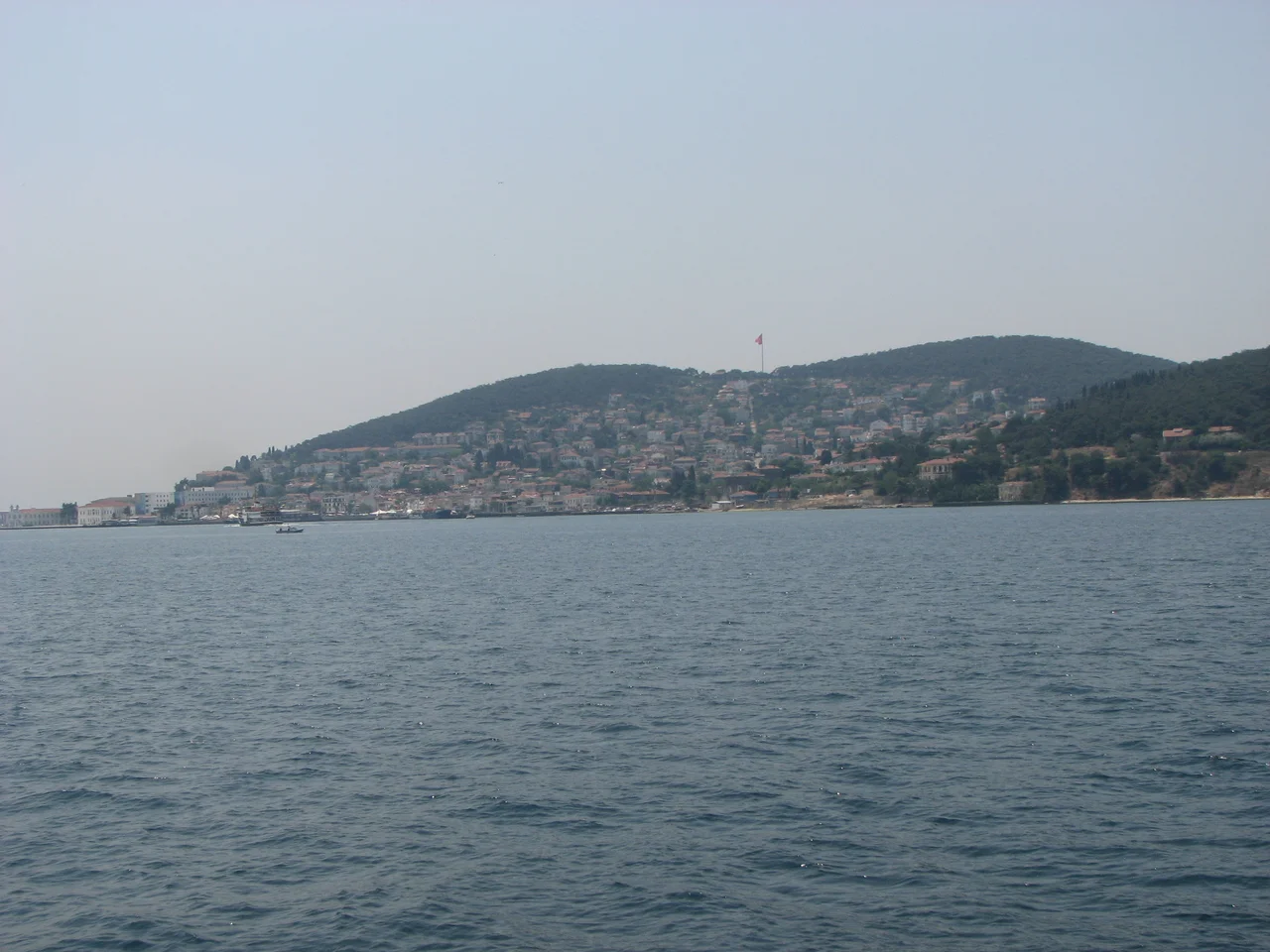

Heybeliada
The name means 'with a saddlebag' — a reference to the valley that pinches between two of its four hills, giving the island its distinctive silhouette from the sea. The ancient Greeks called it Halki, after the copper ore that once made it commercially valuable. Neither name quite captures what Heybeliada actually is: a small, densely layered island where Byzantine churches sit inside Turkish naval school grounds, where an Elizabethan ambassador is buried a few hundred meters from the seat of a 19th-century Greek Orthodox seminary, and where a winter population of roughly 4,400 swells each summer to nearly 30,000 people seeking the quiet that the island's car-free tradition long guaranteed.
Copper, Conquest, and the Long Byzantine Inheritance
In antiquity, Heybeliada was valued for its mineral wealth: copper and copper ores gave the island its Greek names, Halki and Halkitis, both derived from the Greek word halkos. The Romans knew it as Demonesos. The island passed through Byzantine and then Ottoman hands, each culture leaving deposits that have not quite dissolved into each other. The Naval High School that now dominates the approach to the jetty was originally founded in 1773, during the late Ottoman period, on a site that already contained history worth preserving: within the school's grounds stands Kamariotissa, the only remaining Byzantine church on the island, and according to the source article, the last church built before the fall of Constantinople in 1453. It is not open to the public. Nearby, the grave of Edward Barton — the second English ambassador sent to Constantinople by Queen Elizabeth I — marks the spot where Barton retreated in 1598 to escape a plague that was killing the city's residents. He did not survive.
A Navy, a Band, and the Rhythms of Island Life
The Naval High School gives Heybeliada a pulse that most resort islands lack. Each year on 29 October, Turkey's Independence Day, the school's naval band tours the island in a march that residents describe as one of the year's fixed pleasures. In summer, the sea comes back: open-air concerts, a swimming and fitness club at the water's edge, and the regular arrival of ferries from Kabataş, Eminönü, Kadıköy, and Bostancı on both sides of Istanbul. Until 2020, the only vehicles permitted on the island were emergency services; all other transport moved by horse-drawn phaeton. When animal rights concerns and the pressure of rising tourism ended that tradition, electric vehicles replaced the horses — a change that generated the same ambivalence here as on neighboring Büyükada. The phaeton had defined the islands' character for generations. Its absence still feels new.
The Seminary That History Cannot Quite Settle
High on Ümit Tepesi — Hope Hill, at 85 meters the lowest of the island's four hills — the Monastery of the Holy Trinity has accumulated centuries of damage and renewal. Rebuilt and given a library in 1550, burned in 1821, reconstructed in 1844, and then destroyed again by earthquake in 1894, the monastery rose once more in 1896 under Perikles Photiades. In its 1844 reconstruction it became home to the Halki Theological Seminary, the main Greek Orthodox seminary in Turkey and the primary institution for training Ecumenical Patriarchate clergy. The seminary operated for over a century until 1971, when Turkey's Constitutional Court ruled parts of the Private University Law unconstitutional, and the Halki Board of Trustees declined to affiliate the seminary with the University of Istanbul. The school closed. Efforts to reopen it have remained unresolved, with positions staked out by the Ecumenical Patriarchate, Turkish authorities, and successive U.S. and Greek governments. In 2021, President Erdoğan indicated reopening might be possible contingent on improved conditions for the Turkish Muslim population of Thrace. As of this writing the question remains open.
Writers, Presidents, and a Congregation of Notable Residents
Heybeliada has attracted an unusual range of residents over the centuries. Nicodemus I, Patriarch of Jerusalem, lived here. Metrophanes III of Constantinople, Ecumenical Patriarch, was connected to the island. The novelist and politician Hüseyin Rahmi Gürpınar — one of Turkey's most distinctive literary voices, celebrated for his satirical portraits of Istanbul life — made his home on Heybeliada for the last three decades of his life. İsmet İnönü, the second President of Turkey, kept a summer house here; it later became a museum. The island's cosmopolitan character is nowhere more quietly displayed than in the center of Halki Town, where the Greek Orthodox church of Hagios Nikolaos, built in 1857, stands near the Ben Yazkor synagogue and the Heybeliada Mosque — three buildings in close proximity, a reminder of the community that once mixed more freely here than it has in recent decades.
An Island That Wears Its Layers Lightly
What makes Heybeliada distinctive in the Princes' Islands chain is less any single landmark than the accumulation of lives the island has hosted. Its 19th-century mansions line Lozan Zeferi and Refah Şehitler Streets, detailed in John Freely's authoritative book on the islands. In 2006, American writer Mary Ann Whitten published a memoir about buying one of those old houses — an account of what it means to plant yourself in a place still sorting out who it is and who it has been. The island covers only 2.35 square kilometers, but it spans from an Elizabethan grave to a disputed seminary to a functioning naval school to a novelist's hilltop study with sea views. That range, compressed into an area small enough to walk across in an hour, is what keeps people coming back, and what makes Heybeliada genuinely difficult to describe in any single sentence.
From the Air
Heybeliada lies at approximately 40.875°N, 29.089°E in the Sea of Marmara, about 13 km southeast of central Istanbul, immediately northwest of Büyükada in the Princes' Islands group. From the air, it is recognizable by its four distinct hills and the relatively dense cluster of buildings at its northern port. The Monastery of the Holy Trinity on Ümit Tepesi (Hope Hill, 85 m) is visible on the island's central ridge. A viewing altitude of 2,000–3,500 feet gives a clear perspective on the island's saddle-shaped topography, which explains the Turkish name. The nearest airport is LTFJ (Sabiha Gökçen International, Asian side of Istanbul, approximately 20 km north). The major hub is LTFM (Istanbul Airport, European side, approximately 50 km northwest). The island cluster is most clearly visible in morning light before sea haze develops over the Marmara.
Nearby Stories
- Second Battle of Çatalca 1.5 km away
- Tarabya 4.1 km away
- Şile 7.9 km away
- Hereke Carpet 12 km away
- Battle of Melantias 19 km away
- Bursa 47 km away
- Bandırma 51 km away
- 2025 Kartalkaya Hotel Fire 192 km away