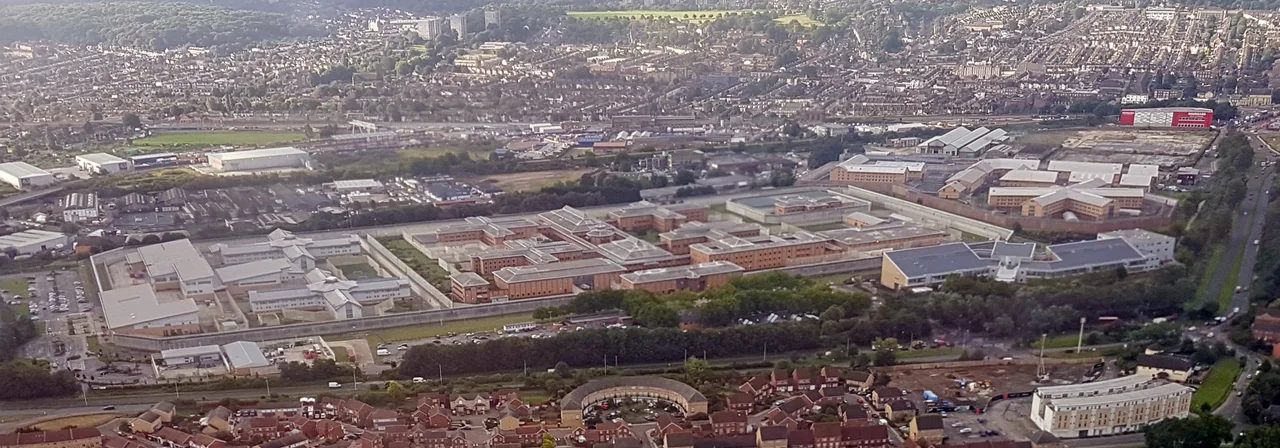

HM Prison Belmarsh
When the contractors broke ground at Belmarsh in the late 1980s, their excavators turned up a wooden trackway nearly six thousand years old, the second-oldest such structure ever found in the British Isles. The Neolithic walkway was carbon-dated, photographed, recorded, and buried again. Above it rose a Category A prison of grey brick and razor wire, opened on 2 April 1991 on the eastern fringe of the old Royal Arsenal in Thamesmead. The juxtaposition is hard to shake: the longest line of human passage on this site, beneath one of the most secure places in modern Britain.
A Prison for the Worst Cases
Belmarsh is one of England and Wales's high-security men's prisons, holding remand prisoners awaiting trial at the Old Bailey, alongside long-term inmates considered too dangerous for ordinary jails. Within the perimeter sits a separate compound, the High Security Unit, with 48 single cells designed for those whose escape would pose the gravest threat to the public. The first man held in the HSU, in 1991, was an armed robber named Ronnie Field, an associate of the London gangster Joey Pyle. He was followed swiftly by members of the Arifs, a Turkish Cypriot gang from south-east London, and by the men convicted of the 10 million pound Heathrow diamond heist. The pattern set in the prison's first months has not changed: organised crime, terrorism, sensational violence.
Hellmarsh
The nickname Hellmarsh was coined by Jeffrey Archer, the novelist and former Conservative peer who was sent here on his 2001 perjury conviction. He spent his first twenty-two days at Belmarsh before being transferred to lower-security prisons, but he kept detailed notes, and the resulting memoir, A Prison Diary, spread the nickname widely. Human rights groups picked it up. So did successive Chief Inspectors of Prisons. A 2009 inspection report criticised the extremely high amount of force used to control inmates, and noted that an unusually high number of prisoners reported being intimidated or victimised by staff. Belmarsh has rarely been out of the news for long. Between 2001 and 2002, under Part 4 of the Anti-terrorism, Crime and Security Act, the British government detained a group of foreign terrorism suspects here indefinitely without charge or trial. Critics called it the British Guantanamo Bay. The Law Lords, in their 2004 ruling in A v Secretary of State for the Home Department, found the regime discriminatory and incompatible with the Human Rights Act 1998.
Built on the Arsenal
Belmarsh sits on land that was once the eastern reach of the Royal Arsenal, where shells and cartridges were filled during two world wars. The wider site, stretching from Woolwich riverside to Plumstead Marshes, was for centuries closed to the public, ringed by a brick boundary wall built by convict labour in 1777. When the Arsenal finally closed as a manufacturing site in 1967 and the Ministry of Defence began disposing of land, parts of the eastern marshes became Thamesmead's housing estates. Other parts became the prison complex. HMP Isis, a young offender institution, opened within Belmarsh's perimeter wall in 2010. HMP Thameside, run by the private company Serco, opened alongside in 2012. Three prisons now stand where ordnance was once tested. Woolwich Crown Court, built next door, processes a steady flow of cases through the system.
The Names on the List
Some of the names that have passed through Belmarsh are nationally familiar. Michael Adebowale, convicted of the 2013 murder of Fusilier Lee Rigby, was held here before transfer to Broadmoor. Thomas Mair, who murdered the MP Jo Cox in 2016, spent time here before being sent to HM Prison Frankland. So did Wayne Couzens, the serving police officer who in 2021 used his warrant card to abduct Sarah Everard. Abu Hamza al-Masri, the cleric later sentenced to life imprisonment in the United States, was held here. So was Ian Huntley, convicted of the Soham murders. The list reads like a chronological index of Britain's worst recent crimes. Jenny Louis, when she was appointed governor in 2021, became Britain's first female black prison governor.
Looking In, Looking Out
From the air, Belmarsh is unmistakable: four residential blocks arranged inside a high wall, the High Security Unit a separate fortress within the larger fortress, Isis and Thameside as visible neighbours. The Thames Path runs along the river to the north, with Thamesmead's modernist housing blocks to the east. From the prison's perspective, the view outward is constrained. From the public's perspective, the view inward is constrained too. Few outsiders see inside Belmarsh except briefly, as visitors, lawyers, or inspectors. The wooden trackway is still down there somewhere, beneath the cells, the only ancient thing on a site otherwise devoted to keeping the present locked away.
From the Air
Located at 51.497 degrees north, 0.093 degrees east, in Thamesmead, south-east London. The prison complex sits south of the Thames between Woolwich and Erith, with the modernist housing estates of Thamesmead immediately east and the old Royal Arsenal redevelopment to the west. London City Airport (EGLC) is about 4 nautical miles northwest across the river. The four-block layout inside a high wall is visible from low altitude, but as a Category A prison it should not be lingered over.
Nearby Stories
- Hampton, London 1.1 km away
- Queenborough Castle 3.2 km away
- Groombridge Place 4 km away
- North Weald Airfield 4.9 km away
- Kings Langley Palace 8.3 km away
- White House Farm murders 11 km away
- Port Lympne Mansion 22 km away
- Amberley Museum & Heritage Centre 31 km away