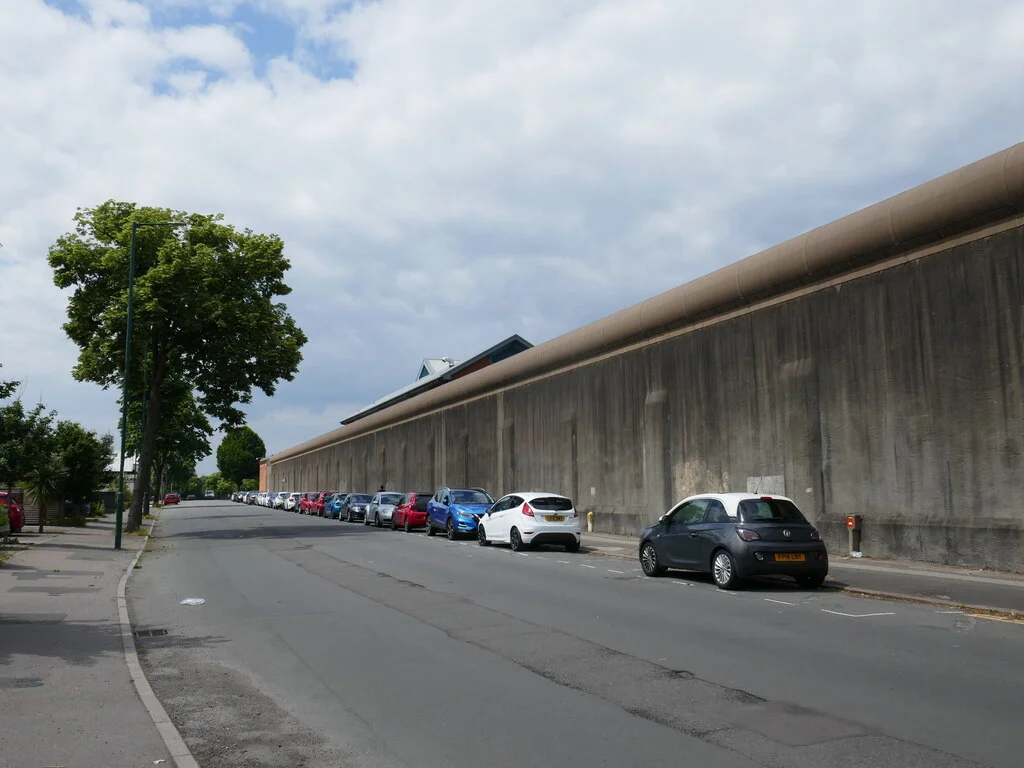

HM Prison Nottingham
In January 2018, Peter Clarke, the Chief Inspector of Prisons, wrote an urgent notification letter to the Justice Secretary about a building on Perry Road in the Sherwood district of Nottingham. He said the same thing he had said in each of the two previous inspections going back several years. The prison was, in his words, fundamentally unsafe. Inspection findings, he wrote, tell a story of dramatic decline since 2010. There was irrefutable evidence that previous warnings had not been acted on. It was, he added, extraordinary that there had failed to be a more robust response. HM Prison Nottingham was at that point holding around eight hundred men.
A Victorian Gaol Made Modern
The original prison opened in 1891 as the Nottingham city gaol. It was rebuilt in 1912 as a closed training establishment for adult men, a role it filled for most of the twentieth century. After 1997 it changed purpose: a category B local prison taking remand and convicted prisoners from the courts of Nottinghamshire and Derbyshire. In July 2004 the Independent Monitoring Board reported that the worn-out Victorian wing was unsuitable for accommodating anybody, particularly in winter, when temperatures inside could fall to ten degrees Celsius. The wing was shut down. In June 2008 the government announced a ninety-five million pound rebuild that would demolish the condemned Victorian block and double the prison's capacity. New accommodation went up in its place.
The Listeners
The prison has, throughout its modern history, run programmes that have worked. A voluntary drug-testing scheme established in 2004 was hailed as a success — participants underwent intensive therapy, with the prospect of early release for those who remained drug-free. The Samaritans Listeners scheme, supported by volunteers from the Nottingham Samaritans, trains prisoners to sit with other prisoners considered at risk from suicide or self-harm. Community projects bring local children with special needs into the prison for regular visits. Resettlement services offer advice on housing, debt management, and employment for men preparing to leave. These programmes exist because everyone involved understands what they are running up against: the prison's structural failure to keep its own inhabitants alive.
What Three Inspections Found
Over the autumn of 2017, five men died at HMP Nottingham within a single month. Four of them were believed to have taken their own lives. Deborah Coles of Inquest, the charity that monitors deaths in state custody, pointed out that these deaths happened within days of the men arriving at the prison — at the moment when prisoners are known to be at their most vulnerable, and when the duty to identify and manage risk is most demanding. The Chief Inspector's urgent notification of January 2018 followed. Another prisoner died in October 2018. Since 2016, at least eight men have taken their own lives inside the walls. Peter Clarke wondered aloud whether the men were choosing not to face another day inside what he called a drug-ridden jail.
The People Inside
Two of the men sent to Nottingham in recent years have made the papers for reasons unrelated to their treatment inside. Luke Foster, a former professional footballer, was jailed for three years for running a cannabis farm. Ian Paterson, a breast surgeon, was sentenced in 2017 to fifteen years — increased to twenty by the Court of Appeal — for wounding his patients with intent by performing unnecessary surgical procedures. But the prison's notable inmates are not, mostly, notable. They are men from Nottingham and Derbyshire courts, remanded or convicted, many with mental health needs, many with addictions, more than half supervised by prison officers with less than a year on the job. Clarke wrote that the problems at Nottingham seemed intractable — that staff there are unable to improve safety, despite the fact that this failing increases the vulnerability both of those who are held in the prison and of those who work there.
Sherwood's Walls
The walls themselves, seen from Perry Road or from Tring Vale to the south, are unremarkable: a brick perimeter, watchtowers, the new accommodation blocks behind. The Sherwood district that surrounds the prison is residential and quiet, north of the city centre, lined with terraces and corner shops. Pedestrians walk past on their way to the Mansfield Road tram stop. It is the kind of street that absorbs the institution at its end without making much of it. The prison is named for the forest of Robin Hood, who in the old ballads was said to free men from a less reformed kind of incarceration. The forest is mostly gone. The prison is still here, holding around eight hundred lives at a time.
From the Air
52.985 N, 1.155 W, in the Sherwood district of Nottingham on Perry Road, just north of the city centre. View from 1,500 to 3,000 ft AGL; the perimeter wall and twentieth-century accommodation blocks are visible. Nottingham/Tollerton (EGBN) is 4 nm SE; East Midlands (EGNX) is 10 nm SW. The Mansfield Road runs north-south past the site.
Nearby Stories
- Rutland Railway Museum 2.4 km away
- Welbeck Abbey 5 km away
- Lichfield rail crash 6 km away
- Peveril Castle 8.8 km away
- Grantham Rail Accident 11 km away
- Croxden Abbey 11 km away
- RAF Scampton 11 km away
- Leicester Abbey 11 km away