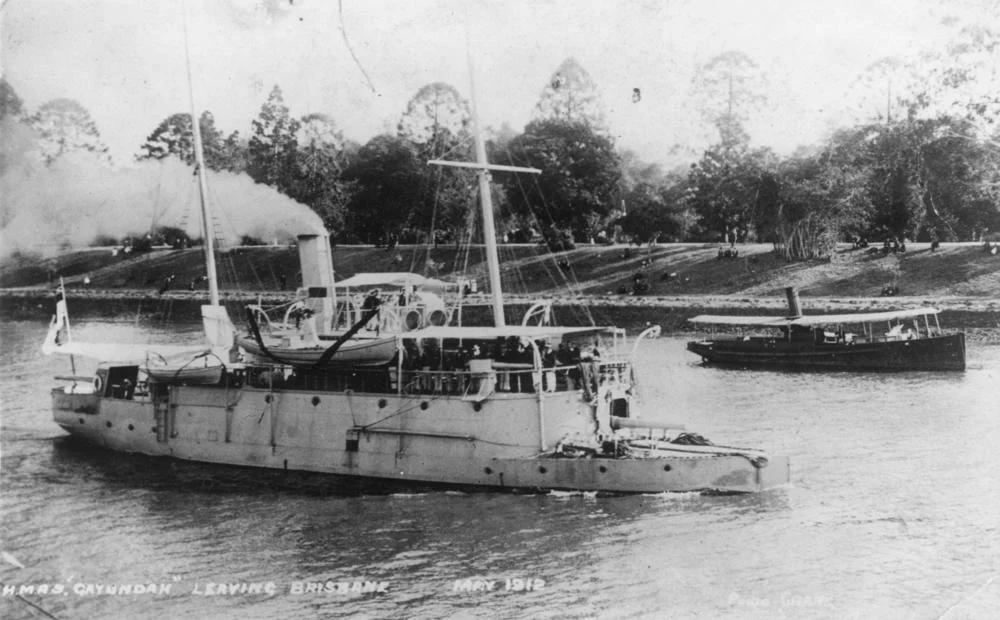

HMQS Gayundah
In October 1888 the captain of this gunboat trained her aft six-inch gun on the Queensland Parliament. Henry Townley Wright had been ordered to hand his ship to a junior officer; he refused, declared the handover a mutiny, arrested the man, and threatened to put to sea. The standoff ended when twenty armed police mustered in a Brisbane park, boarded the vessel, and escorted Wright ashore at gunpoint. The ship at the centre of that strange colonial drama still exists. She lies half-swallowed by mud and tide off Woody Point, near Redcliffe, a salt-eaten skeleton of riveted iron that thousands of people drive past without a second glance.
Lightning, Bought from Tyneside
Her name was an Aboriginal word for lightning, and in 1884 she was the pride of a colony arming itself against shadows. With Britain's military presence in Australia thinning and rumours of Russian warships prowling the Pacific, Queensland founded its own Maritime Defence Force and ordered two gunboats from Armstrong, Mitchell & Co. on the River Tyne. Gayundah was a flat-iron gunboat, low and stubborn, 120 feet of iron displacing 360 tons, built to carry a single heavy gun close inshore. Launched at Newcastle upon Tyne on 13 May 1884, she steamed out for the far side of the world that November, threaded the Suez Canal, and reached Brisbane on 27 March 1885. A colony of fewer than a million people had bought itself a warship for 35,000 pounds.
A Voice Across the Water
For all the theatre of the Wright affair, Gayundah's real claim sits in the quieter history of technology. On 9 April 1903 she transmitted the first wireless message received from a ship at sea by an Australian shore station. Her aerial was improvised genius: a tall bamboo pole lashed to the mast. The message that crackled into Brisbane was gloriously ordinary, a watch officer's shrug about the weather. "Gun drill continued this afternoon and was fairly successful," it began, "blowing squally and raining." It closed, simply, "Good night." Two decades before radio reached most Australian homes, a few mundane words travelled invisibly over Moreton Bay, and the modern world arrived in Queensland aboard an obsolete gunboat.
From Warship to Workhorse
Gayundah outlived her usefulness slowly. The 1888 standoff had ended without a shot, the police commissioner D.T. Seymour himself leading the boarding party that talked Wright down and walked him ashore, and the gunboat settled into a long, undramatic career. She trained sailors, patrolled Moreton Bay during the First World War, and in 1911 sailed all the way to Broome to police Australia's northern fishing grounds, seizing two Dutch schooners caught poaching sea cucumber and trochus shell. Paid off in 1918, she suffered the indignity reserved for old ships that refuse to sink: she went to work. Sold to Brisbane Gravel, she hauled sand and gravel up and down the Brisbane River for three more decades, a gun platform turned barge. She even sank once, at her moorings in 1930, and was simply raised and put back to work. By the 1950s even that was finished. Stripped of everything valuable, her hull was sold to the Redcliffe council for a final, humble job.
The Long Rusting
On 2 June 1958 they ran her aground beneath the cliffs at Woody Point to break the waves, and there she has stayed, dying by inches in the salt air. Walk the foreshore at low tide and you can pick your way out toward her: a corroded ribcage of plates and rivets, streaked orange, the bay washing through gaps where steel has simply dissolved. The deterioration never stops. In recent years the top of her bow has fallen away entirely. Her old six-inch gun survives in dignity at the Australian War Memorial in Canberra, but the ship herself is returning to the elements that carried her here, a piece of nineteenth-century iron quietly becoming part of the Queensland shoreline.
From the Air
The Gayundah wreck lies at approximately 27.262 degrees south, 153.107 degrees east, on the Redcliffe Peninsula at Woody Point, on the northwestern shore of Moreton Bay. From the air she appears as a small dark hull stranded close against the foreshore cliffs, most visible at low tide when the surrounding mudflats are exposed; best viewed at 1,000 to 1,500 feet. The peninsula juts into the bay just north of the Brisbane River mouth and the Houghton Highway bridges crossing to Brighton make an unmistakable landmark. Nearest major airport is Brisbane (YBBN / BNE), about 18 nautical miles south; Redcliffe's Caboolture aeroplane traffic and the bay's marine haze can reduce visibility on humid days.
Nearby Stories
- Bribie Island 12 km away
- Cressbrook Homestead 17 km away
- Beenleigh Rum Distillery 18 km away
- Main Range National Park 39 km away
- 2010-2011 Queensland Floods 47 km away
- Cape Byron 115 km away
- Cape Byron Light 145 km away
- HMS Porpoise (1799) 570 km away