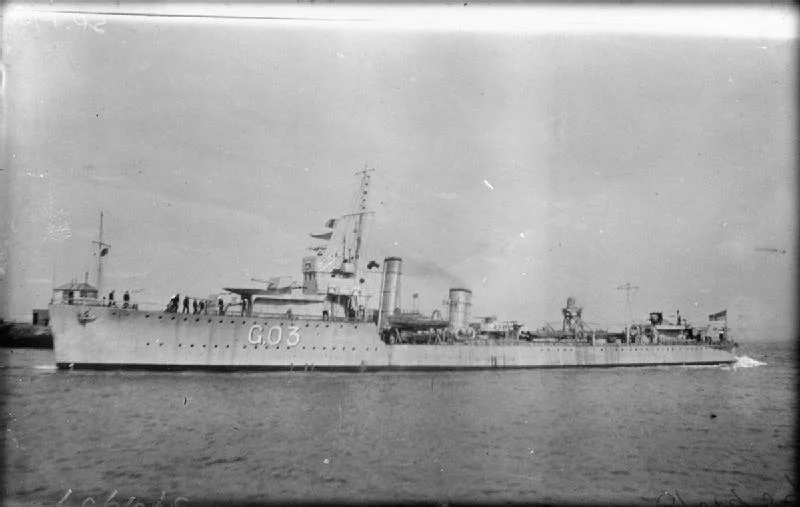

HMS Vortigern
Just before two in the morning on 15 March 1942, the German motor torpedo boat S104 fired a torpedo into the side of HMS Vortigern as she screened a coastal convoy off Cromer. The destroyer was nearly twenty-five years old, a survivor of the First World War and the interwar years, called back into service in 1939. The torpedo struck and she went down quickly in the cold March sea. Of her ship's company of one hundred and twenty-four, only fourteen men were pulled from the water. One hundred and ten died. The Cromer lifeboat H F Bailey III recovered eleven bodies from the waves the next day. Twelve of the dead are buried at Lowestoft, one at Cromer, and the rest stayed with the ship on the seabed.
Built for the Last War
Vortigern was ordered from J. Samuel White at Cowes on the Isle of Wight under the 1916-17 programme, when the Royal Navy was racing to replace destroyer losses from the First World War. Her keel was laid on 17 January 1917 and she was launched on 5 October 1917, commissioned 21 January 1918. The Admiralty named her for Vortigern, the legendary British ruler who, in early medieval chronicle, was said to have invited Hengist and Horsa across the North Sea, with consequences he came to regret. She remains the only ship of the Royal Navy ever to carry the name. By the time she was ready for sea, the war had less than a year to run. She saw out the final months and was redeployed to the Baltic in 1919.
Reserve and Recall
The years between the wars were lean for Royal Navy destroyers. Vortigern served briefly with the 1st Destroyer Flotilla, then was paid off into the reserve fleet. There she sat through the 1920s and 1930s, her crew of fitters and skeleton hands keeping the boilers warm and the machinery turning, while the Navy tried to decide which of its older boats would be modernised, scrapped or kept. In August 1939, with war approaching, King George VI reviewed the reserve fleet, and Vortigern stood among the ships drawn up for inspection. Within weeks she was at sea with the 17th Destroyer Flotilla at Plymouth, hunting submarines in the South Western Approaches and the Channel. She would not see Plymouth quietly again.
Gibraltar, Mers-el-Kebir, and Home
In January 1940 Vortigern was nominated to the 13th Destroyer Flotilla at Gibraltar. For five months she ran convoys back and forth between Britain and the Rock. Then on 3 July she was present at Mers-el-Kebir, the painful operation against the French fleet at its Algerian anchorage after the fall of France, designed to keep the French ships out of German hands. Three days later she was screening capital ships, including Hood and Ark Royal, for air strikes on Cagliari, until heavy Italian air attack forced the operation to be abandoned. She returned to Britain in mid-July and joined the long, unglamorous work of convoy escort in the North Western Approaches and then, after a Short Range Escort conversion in late 1940, the North Sea coastal route between Rosyth and the south.
The Last Convoy
On 9 December 1940, off Aldeburgh in Suffolk, a German seaplane attacked one of Vortigern's convoys. She fought it off. She continued running convoys up and down the east coast through 1941 and into 1942, a routine of cold, wet, dark watches in waters that the Kriegsmarine harassed with mines, aircraft and the fast Schnellboote known to the British as E-boats. By March 1942 the E-boat threat in the North Sea was at its sharpest. On the night of 14-15 March, Vortigern was escorting another east-coast convoy when the boats came in. S104 found her in the dark, fired, and ran. Her torpedo struck home. The destroyer broke up and sank within minutes. Most of those aboard never reached the surface.
A Protected Wreck
When dawn came, the Cromer lifeboat went out and found wreckage and bodies spread across the swells. The H F Bailey III, a 41-foot motor lifeboat that would itself become famous for wartime rescues, brought in eleven men who had died waiting. The fourteen survivors carried home what they knew of the last minutes of one hundred and ten shipmates: stokers, signalmen, gunners, a captain on the bridge, mess decks of young sailors. In 2008 the wreck was designated a Protected Place under the Protection of Military Remains Act 1986. She lies in the North Sea where she fell, a war grave, undisturbed by divers. The memorial graves at Lowestoft and Cromer mark a few of those who came ashore. Most of HMS Vortigern's people remain at sea.
From the Air
HMS Vortigern was sunk at approximately 53.08N, 1.37E in the North Sea off Cromer, Norfolk. From altitude on a clear day the Norfolk coast at Cromer is identifiable by its bluffs and the long pier; the wreck lies offshore in waters traversed by north-bound coastal traffic. Norwich Airport (EGSH) is about 25 miles to the south-west. The protected wreck is not visible from the air, but the coast that bears her memorial is unmistakable from the cliffs north-east of Cromer town.
Nearby Stories
- Castle Acre Castle and Town Walls 3.5 km away
- Brancaster 5.8 km away
- City of Norwich Aviation Museum 6.8 km away
- HMS Cobra 21 km away
- Alford Windmill 35 km away
- Battle of Lowestoft 83 km away
- SM U-97 95 km away
- Battle off Texel 119 km away