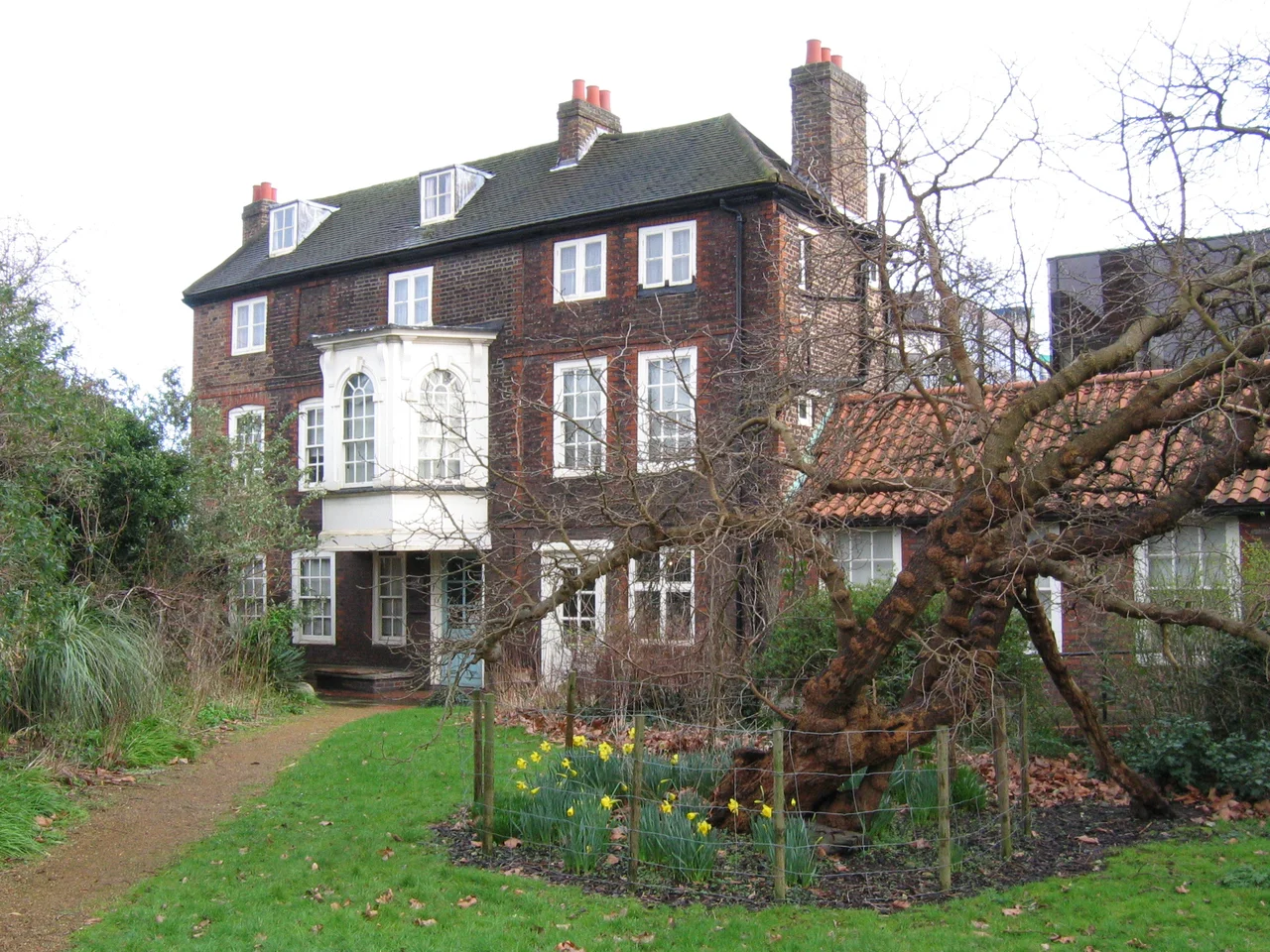

Hogarth's House
A mulberry tree still grows in the walled garden behind Hogarth's House, and it is almost certainly the last living thing from the orchard that stood here in the 1670s - older than the house, older than William Hogarth himself. The tree was nearly killed by a parachute mine that fell nearby in September 1940. Arboriculturists from Kew brought it back. That mulberry is probably the best summary of the place: stubborn, scarred, still standing while London races past on the A4 a few yards beyond the garden wall.
When Chiswick Was Country
Built between 1713 and 1717 in the corner of an orchard owned by the Downes family, the house was intended as a country retreat - because in the eighteenth century Chiswick was country. London ended somewhere out east; this was a separate village, reachable by carriage along the river road. The first occupant was Reverend George Andreas Ruperti, a Lutheran pastor who used the rooms to coordinate help for thousands of Rhineland refugees who reached London during the famine years of 1708 and 1709. His careful lists of their names and trades, kept partly here, would later prove invaluable to family historians tracing ancestors who scattered to America and Ireland.
The Painter Buys the Place
The Hogarths bought the house in 1749 from Ruperti's son. By then William Hogarth was already the satirist of Georgian London - the engraver behind A Harlot's Progress, A Rake's Progress, and Marriage a-la-mode, prints that lacerated the manners of his age while making him rich. He extended the house in 1750 and built himself a painting room above the coach house at the foot of the garden, far enough from the main rooms to work undisturbed. He shared the place with his wife Jane, her mother, her cousin Mary Lewis who helped run the business, and his own sister. He kept it until his death in 1764, then was buried in nearby St Nicholas's churchyard under a monument whose obituary was written by his close friend, the actor David Garrick.
Layers of Tenants
After Mary Lewis died in 1808 the Hogarth connection ended, but the house kept attracting people drawn to its quiet rooms. From 1814 to 1833 the curate of St Nicholas's, Henry Francis Cary, lived here while completing his celebrated translation of Dante's Divine Comedy - a translation Samuel Taylor Coleridge personally championed into bestseller status. Then came the Wicksteads, who emigrated to Australia in 1840. By 1890 the house was in such disrepair that local printer Alfred Dawson stepped in to rescue it. When he sold up in 1900 and developers circled, a campaign by artists and writers failed to save it. The buyer who did, in the end, was Lieutenant-Colonel Robert Shipway, who restored it, furnished it with replica pieces drawn from Hogarth's own prints, photographed it for the guidebook himself, and opened it as a museum in 1904.
The Bomb and the Fire
Twentieth-century London was hard on Hogarth's House. In September 1940 a Luftwaffe parachute mine exploded nearby, shredding the single-storey extension and battering the rest. Repairs took until 1951. The house was barely settling into a new century when, on 14 August 2009, fire broke out in the empty building. Smoke and water damage compounded charred timbers; the staircase and one room were badly hurt. But the prints had been moved out for refurbishment, and nothing of the collection burned. Restoration turned into research: paint analysis informed the redecoration, original window shutters and floorboards reemerged, and the house reopened on 8 November 2011, more carefully understood than at any time since Hogarth himself walked its rooms.
What's Inside Now
Two floors are open today, free to anyone who walks in off the A4. The displays present the building as a working home - the kitchen, the parlour, the dining room - alongside cabinets of Hogarth's most famous engravings. Visitors can study the precise moral catastrophes he constructed in eight plates of A Rake's Progress, the silent humiliations of Marriage a-la-mode, the relentless decline of A Harlot's Progress. The top floor is a research study used by appointment. And out in the walled garden, the mulberry leafs out each spring, scarred bark and all - the same tree that fruited when Hogarth came home from London with sketches in his pocket.
From the Air
Coordinates 51.4871 N, 0.2589 W in Chiswick, west London, immediately adjacent to the A4 road. From altitude the most obvious landmark is the Thames sweeping south of the site and the green of Chiswick House Gardens to the southwest. Nearest airport London Heathrow (EGLL) about 7 nm west. Clear days reveal the broad curve of the Thames and the parallel ribbon of the M4 farther west.
Nearby Stories
- Battle of Britain, Northfleet 1.1 km away
- Bayham Old Abbey 5.4 km away
- Catharine Macaulay 6.4 km away
- Hatfield rail crash 8.8 km away
- Chequers 8.9 km away
- Chelmsford Cathedral 10 km away
- Queen Victoria Hospital 13 km away
- Fishbourne Roman Palace 36 km away