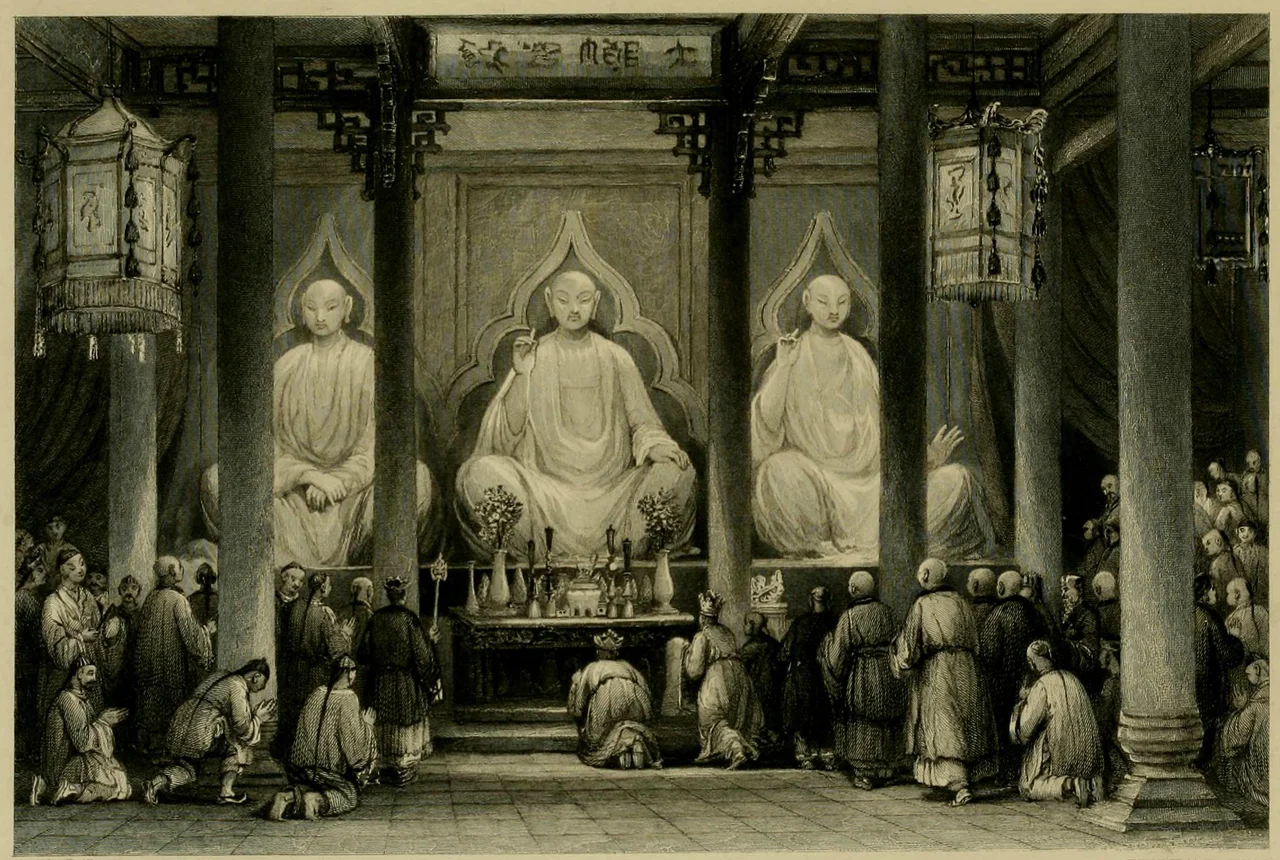

Hoi Tong Monastery
The name carries a quiet grandeur: Hoi Tong, the Cantonese rendering of Sāgaradhvaja — "Ocean Banner" — a devout monk who appears in the Flower Garland Sutra as a student of the Heart Sutra. The monastery on Henan Island that bears his name has outlasted dynasties, foreign invasions, and a century of radical transformation, surviving as one of Guangzhou's oldest active religious sites, its grounds still shaded by the banyan trees that were already ancient when Western merchants first sailed up the Pearl River.
A Name with Layers
The monastery goes by many names, and each one is a small history lesson. The English form "Hoi Tong" follows Cantonese pronunciation. Mandarin speakers know it as Haichuang. Western sources from the colonial era sometimes wrote "Hoy Hong Temple" or "Haizhuang Temple," phonetic approximations that drifted with each transcription. From its position on Henan Island — the great sandbar south of the Pearl River that foreigners called "Ho-nam" — it was also simply the Temple of Honan. All these names point to the same place: a complex of halls, courtyards, and gardens where monks have lived and chanted since the tenth century, surrounded by roots and shadows of enormous banyans.
A Thousand Years of History
The monastery traces its origins to the Southern Han, a short-lived Tang successor state whose capital sat at what is now Guangzhou. Founded as the Qianqiu Temple, it occupied land south of the walled city across the Pearl River — already a liminal position between the urban core and the wider world. By the end of the Ming dynasty, the complex had become the private garden of a man named Guo Longyue, who renamed it after the Buddhist monk Sāgaradhvaja. Under the early Qing, it flourished. Jin Bao — a former minister of the Yongli Emperor, the last serious claimant of the Ming — retired here after the dynasty's collapse, finding in the monastery's quiet a kind of dignified refuge. The Kangxi Emperor's reign brought continuous expansion under the monks Azi, Chee Yut, and others. At its height, around a hundred monks lived within its walls, though the monastery's internal life was not egalitarian: wealthy and poor members were treated very differently, a hierarchy that mirrored the society surrounding it.
The Foreign Visitors
Before the First Opium War, foreigners in Canton were confined to a narrow strip of waterfront. The factory district — the row of trading houses facing the river — was their world. Beyond it, the city was largely closed to them. Hoi Tong Monastery was one of the few exceptions, a rare place where Western visitors could actually enter, sit, and observe something of Chinese religious life. Lord Amherst and his retinue rested here for three weeks in January 1817, from the 1st to the 20th, before sailing home via Macao after their failed diplomatic mission to Beijing. The Mahavira Hall's large Buddha statues were temporarily moved to other temples to accommodate the party. The French artist Auguste Borget came repeatedly during his world tour, and left behind a description that still resonates: "The noise outside the temple was so great and the silence inside the temple was so solemn, that I believed myself transported to another world." Borget's paintings of the monastery became part of the fifteen recognized classes of Qing export art — images of China made for Western buyers, and Hoi Tong was considered picturesque enough to earn its own category.
Regulated Access, Lasting Impressions
The monastery's openness to foreigners had limits. By 1831, official regulations restricted non-Chinese visitors to three days of each lunar month: the 8th, 18th, and 28th. The access was permitted but controlled, a window opened on schedule and closed again. This was Canton's broader arrangement with the outside world made small — trade allowed, contact managed, boundaries maintained. Even within those constraints, the monastery left deep impressions. Before photography arrived in China, paintings made at Hoi Tong circulated widely as documentation of a world few Westerners could otherwise see. The monastery stood facing those factory buildings on the waterfront, close enough to observe the commerce of empire while remaining apart from it — a space of contemplation at the edge of the most consequential trading city in Asia.
Henan Island Today
Henan Island — now known as Haizhu District — has transformed almost beyond recognition since the days of the factory trade. What was a quiet area south of the city is now densely urban, tied to the mainland north by bridges and metro lines. The monastery persists within it, one of Guangzhou's working Buddhist temples rather than a museum piece. The banyan trees that made it famous — those massive, root-dropping figs that can live for centuries — are part of what remains of the original atmosphere. Visitors still come, some for the religion, some for the history, some simply drawn to the particular stillness that Borget noticed two centuries ago: the way a courtyard full of old trees and old stone can hold silence even when the city pushes in from every direction.
From the Air
Hoi Tong Monastery sits at 23.1078°N, 113.2538°E on Henan Island (Haizhu District), south of the Pearl River in Guangzhou. Approaching from the south at 3,000–4,000 feet, the Pearl River is the primary navigation reference — Henan Island lies between the main channel to its north and the secondary channels to the south. The temple grounds are difficult to distinguish from altitude but are located in the older, lower-density residential fabric of northern Haizhu. Guangzhou Baiyun International Airport (ZGGG) is approximately 27 km to the north-northeast. The Canton Tower to the east, and the Pearl River bends, provide strong orientation landmarks at cruising altitude.
Nearby Stories
- Shunde 12 km away
- 2015 Shenzhen Landslide 15 km away
- Mount Luofu 23 km away
- Qingyuan Maglev Tourist Line 32 km away
- Kaiping 56 km away
- Heyuan 90 km away
- Chikan, Kaiping 92 km away
- Erlitou Site Museum of the Xia Capital 1257 km away