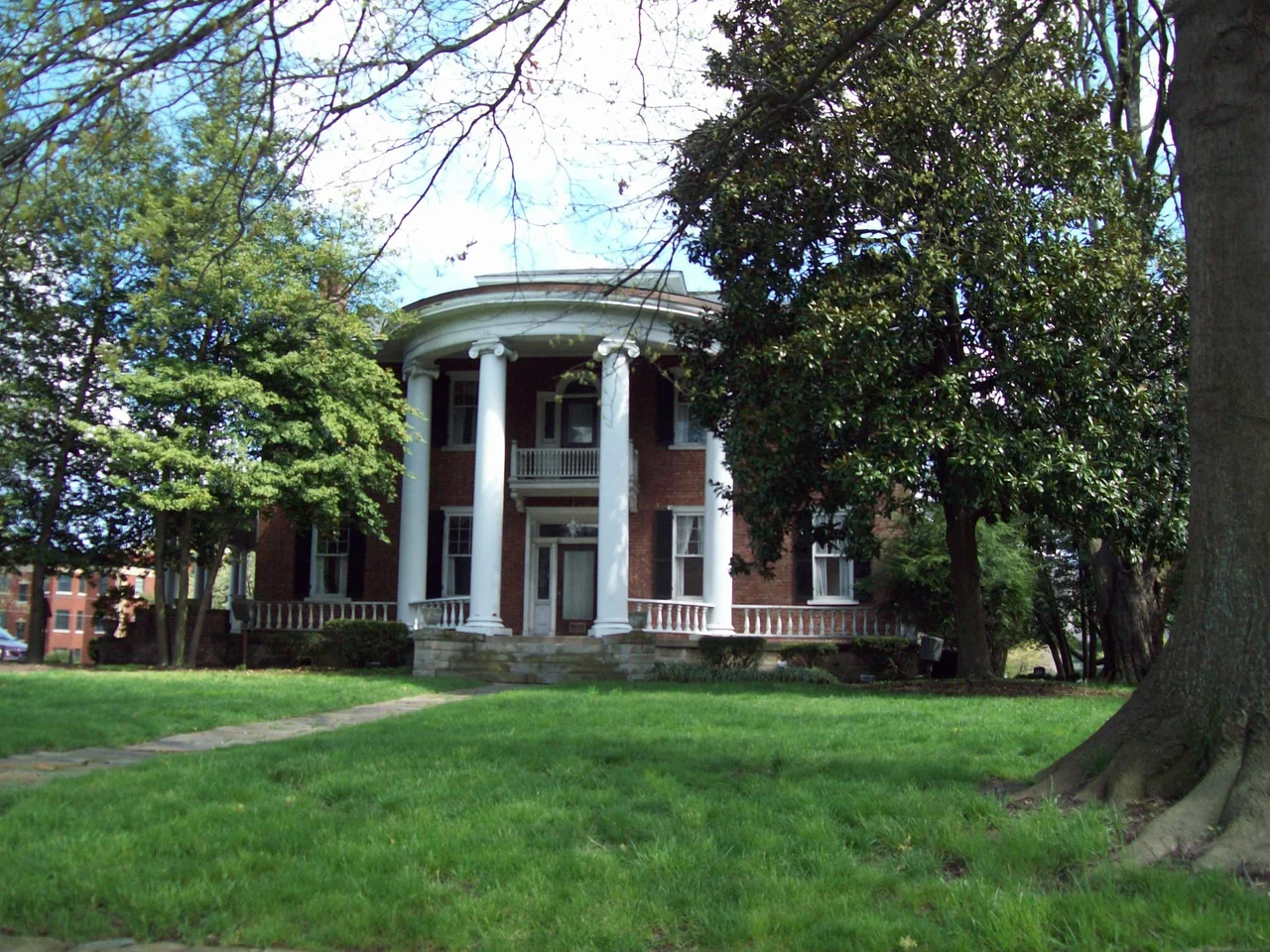

Holly Grove Mansion
Holly Grove Mansion is older than West Virginia itself. The big brick house was built in 1815 by Daniel Ruffner, whose family had spent the previous decade pulling salt brine out of wells along the Kanawha River and figuring out how to boil it into the white crystals that the early American economy ran on. Holly Grove sits on the grounds of what is now the West Virginia State Capitol complex - the gold-domed Cass Gilbert building was finished more than a century after the mansion was - and the two structures together form one of the more interesting architectural pairings on any state capitol grounds. One belongs to the early frontier of the trans-Allegheny salt industry. The other belongs to the high Beaux-Arts vocabulary of the 1930s. Both stand fifty yards from the Kanawha River.
The Ruffners and the Salt That Built the Valley
By the early 1800s, the Kanawha Valley was the most productive salt-making region in the United States. Brine wells driven deep into the riverbed yielded saltwater that was boiled down in long open kettles fired by local coal. The salt was shipped downriver to feed the meatpacking and food preservation industries of Cincinnati and points west. Several families ran the Kanawha salt works, but the Ruffners - David, Joseph, Daniel, and Lewis - were among the first and the most prominent. Daniel Ruffner built Holly Grove in 1815 as a brick Federal-style house on the bottom land that was then the village of Charleston, Virginia. The house was solid and large by the standards of an early-1800s river town: three stories in the front section, two in the rear, with the heavy walls and central-hall plan typical of upland Federal architecture. The Ruffners' wealth was built on enslaved Black labor that worked the salt furnaces and on the technology of brine extraction that the family helped to pioneer.
The 1902 Remodel
By the turn of the twentieth century, the Federal-period architecture of the early Republic was no longer in fashion. New owner John Nash took possession of the house and gave it a substantial remodel in about 1902 that transformed the front elevation. The most dramatic addition was the massive two-story semicircular portico that defines the building's current appearance - a Classical Revival flourish with paired Ionic columns, designed to project gravity and presence in the manner of much grander estates farther east. The remodel also reorganized interior spaces, updated the windows, and gave the brick exterior its more formal finished look. By the time the state of West Virginia acquired the surrounding land for the new capitol complex in the 1920s, Holly Grove looked less like an 1815 frontier merchant house and more like a colonnaded turn-of-the-century mansion - but the original 1815 brick walls were still load-bearing under the later facade.
The Capitol Comes to Holly Grove
When the old West Virginia State Capitol burned in January 1921 and the state had to build a new one, Charleston's East End was the natural location. The Kanawha River frontage, with its long view east, gave Cass Gilbert the site to design his Beaux-Arts statehouse. The new capitol complex was laid out around Holly Grove rather than over it. The state acquired the mansion, but the building was preserved - not demolished to clear the site or move to a less prominent corner of the grounds. The placement is now charmingly anachronistic. Visitors to the capitol can stand in front of Cass Gilbert's grand colonnade and look across a lawn to a smaller, older colonnade attached to the front of a brick house built when James Madison was president. The two structures bookend more than a century of West Virginia history.
An Office, A Reception Hall, A Monument
Holly Grove went through several functions in the twentieth century - private residence, briefly an inn, eventually a state-government building. In 1979, the mansion underwent an extensive rehabilitation when it became the headquarters of the West Virginia Commission on Aging. The work stabilized the structure, updated systems for modern office use, and preserved the historic character of the rooms. It was added to the National Register of Historic Places in 1974. In more recent years, Holly Grove has served as a state ceremonial reception space - used for receptions, small dinners, and occasional formal functions hosted by the governor or the state's cultural agencies. The brick walls of 1815 still stand. The 1902 portico still frames the front door. The salt industry that built the house is long gone, the enslaved labor that made the Ruffners rich is part of the larger reckoning of American history, and the capitol that surrounds it now is a permanent neighbor.
From the Air
Holly Grove Mansion sits on the West Virginia State Capitol grounds in Charleston at 38.34 degrees north, 81.62 degrees west, along the north bank of the Kanawha River at the east edge of downtown Charleston. Best viewed at 3,000 to 5,000 feet AGL: look for the gold dome of the capitol; Holly Grove is a much smaller brick building with a white portico immediately west of the capitol building, between it and the river. Yeager Airport (KCRW) is on the ridge just north of downtown. The Kanawha River and the capitol dome are dominant orientation landmarks.
Nearby Stories
- Mystery Hole 6.5 km away
- West Virginia Colored Children's Home 9.4 km away
- Clay, West Virginia 13 km away
- Staats Mill Covered Bridge 14 km away
- Hobet Coal Mine 23 km away
- Appalachia 23 km away
- Fred M. Vinson Museum and Welcome Center 30 km away
- Ponn Humpback Covered Bridge 43 km away