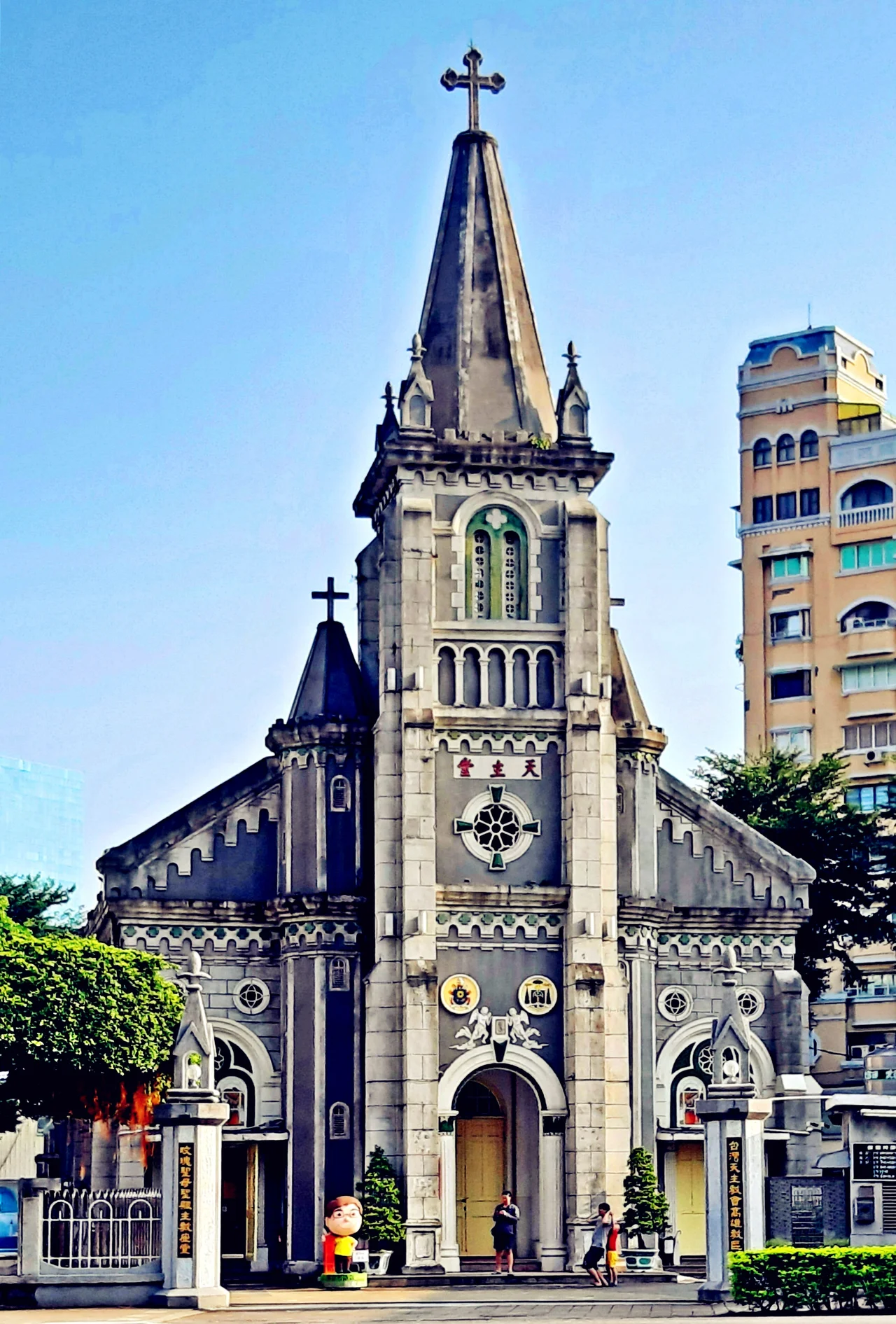

Holy Rosary Cathedral, Kaohsiung
Two Spanish Dominican priests arrived in Kaohsiung — then called Takao — between 1858 and 1860, during the final years of Qing Dynasty rule, when the city was little more than a fishing harbor. Father Fernando Sainz and Father Angel Bofurull came from the Philippines, which had been the base for Dominican mission work in Asia for centuries. What they built on a plot in what is now Lingya District became the Holy Rosary Cathedral: the oldest Catholic church in Taiwan, still standing, still active, still the seat of the Bishop of Kaohsiung more than 165 years later.
The Dominican Mission and Its Origins
The Dominican Order had been active in the Philippines since the sixteenth century, and it was from Manila that missionaries crossed to Taiwan with the ambition of establishing a permanent Catholic presence. Fathers Sainz and Angel Bofurull were working in a city that barely existed in the modern sense — Takao was a harbor with a small population, no major infrastructure, and no tradition of Christian practice. Establishing a church here required navigating not just the practical challenges of construction but the political complexity of working in a Qing-ruled territory under Spanish ecclesiastical administration based in another colonial capital entirely. The original structure they built between 1858 and 1860 was the seed. By 1863, an image of the Madonna and Child of the Holy Rosary had been installed at the high altar, where it remains today. That image is older than Taiwan's Japanese period, older than the Republic of China, older than most of the city around it.
Rebuilt in Stone and Brick
The original church gave way to the building that stands today, rebuilt to its present dimensions in 1928. The architectural style blends Gothic and Romanesque elements — pointed arches alongside rounded ones, stone masonry that suggests both vertical aspiration and solid permanence. The result is a building that does not belong to any single tradition but draws from the ecclesiastical architecture of multiple European sources. Visitors familiar with Manila Cathedral have noted similarities in the interior design, which is not surprising: the Manila Cathedral provided a model for Dominican church construction throughout the region, and the Kaohsiung cathedral reflects that heritage. The interior centers on the high altar where the 1863 Madonna and Child image is enshrined, a visual focal point that has presided over the space through two reconstructions and more than a century of history.
A Pontifical Decree from Rome
On May 22, 1995, Pope John Paul II elevated the Holy Rosary Cathedral to the status of Minor Basilica through a pontifical decree titled *Deipara in Cælis*. The decree was signed and notarized by Cardinal Angelo Sodano, then the Vatican Secretary of State — one of the most senior figures in the Catholic Church. The designation of Minor Basilica is an honor granted to churches of particular historical significance or devotional importance; it confers certain liturgical privileges and marks the building as a site of special status within the Catholic world. For a church that began as a modest mission structure in a nineteenth-century fishing harbor, the designation represents an extraordinary arc. What Fathers Sainz and Bofurull started in Takao now holds formal recognition from the papacy itself.
Cathedral, Landmark, and Meeting Place
The cathedral sits in Lingya District, a short walk west of Central Park Station on the Kaohsiung MRT. Its proximity to the Love River — the waterway that threads through central Kaohsiung — makes it a point where the religious and the recreational overlap: the cathedral is a destination for worshippers and, because of its setting, for families and visitors exploring the riverside. Catholic Mass is offered daily. The cathedral is particularly well known throughout Kaohsiung for its Christmas Eve celebrations, which extend through the whole evening before Christmas Day and draw large crowds to Lingya District. The building that two Dominican priests raised from scratch in a harbor village at the end of the Qing era has become, over more than a century and a half, woven into the ordinary rhythms of the city around it.
From the Air
The Holy Rosary Cathedral is located at approximately 22.620°N, 120.292°E in Lingya District, Kaohsiung, about 4 kilometers north of Kaohsiung International Airport (RCKH). From low altitude, the cathedral's twin towers and light-colored masonry are visible against the urban fabric of Lingya District. The Love River passes nearby to the north; Central Park's green space is visible to the east. Approaching from RCKH, fly north along the coastline and turn east over the harbor before identifying the cathedral's characteristic roofline among the surrounding buildings. Best viewed from 1,000 to 1,500 feet in morning light when the stone facade catches direct illumination.
Nearby Stories
- Taimali 7.2 km away
- Meinong East Gate Tower 15 km away
- Kunci Temple 20 km away
- Checheng Fu'an Temple 42 km away
- Dongji Island 49 km away
- Orchid Island 69 km away
- South Penghu Marine National Park 77 km away
- Hong Kong 12 549 km away